 Back
7B-LE3-A&P
 6:29

Terms in this set (20)
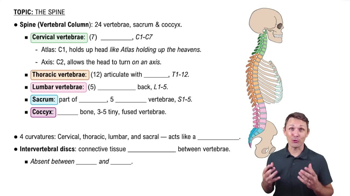
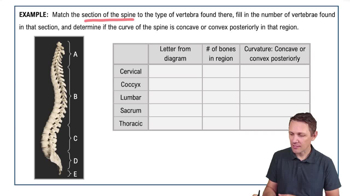
The vertebral column has five regions: cervical (7 vertebrae), thoracic (12 vertebrae), lumbar (5 vertebrae), sacrum (fused vertebrae), and coccyx (fused bones).
It transmits trunk weight to lower limbs, protects the spinal cord, and provides attachment points for ribs and muscles.
Cervical and lumbar curvatures are concave posteriorly; thoracic and sacral curvatures are convex posteriorly, increasing spine resilience and flexibility.
Each disc has a nucleus pulposus (inner gelatinous core) and an anulus fibrosus (outer fibrocartilage collar).
Scoliosis (lateral curvature), kyphosis (exaggerated thoracic curve), and lordosis (exaggerated lumbar curve).
Body (centrum), vertebral arch (pedicles and laminae), vertebral foramen, spinous process, transverse processes, and superior and inferior articular processes.
Small, oval bodies; bifid spinous processes (except C7); large triangular vertebral foramen; transverse foramina for arteries.
It has no body or spinous process, consists of anterior and posterior arches, and allows the head to nod 'yes' by articulating with occipital condyles.
The dens (odontoid process) projects superiorly and acts as a pivot for shaking the head 'no.'
Heart-shaped bodies with demifacets for rib articulation, circular vertebral foramina, long inferiorly pointing spinous processes, and costal facets on transverse processes.
They have massive, kidney-shaped bodies, short thick pedicles and laminae, flat hatchet-shaped spinous processes, and triangular vertebral foramina.
The sacrum is formed by fusion of five vertebrae (S1–S5); the coccyx is formed by fusion of 3–5 small vertebrae at the spine's terminus.
Manubrium (superior), body (middle), and xiphoid process (inferior).
It can project posteriorly and be damaged during CPR if hands are placed too low, risking injury to underlying organs.
12 pairs: true ribs (1–7) attach directly to sternum, false ribs (8–10) attach indirectly, and floating ribs (11–12) have no anterior attachment.
Shaft (with costal groove), head (articulates with vertebrae), neck, and tubercle (articulates with transverse process).
Flexion, extension, lateral flexion, and rotation; they have the greatest range of motion among vertebral regions.
Rotation is allowed; lateral flexion is possible but limited by ribs; flexion and extension are restricted.
Rotation is prevented; they allow flexion, extension, and lateral flexion, providing stability and weight-bearing support.
They run along the front and back of the vertebral column, preventing hyperextension and hyperflexion.