 Back
8.4
 04:06

Terms in this set (33)
Hyaline cartilage covering opposing bone surfaces to absorb compressive forces and prevent bone crushing.
Potential space unique to synovial joints filled with synovial fluid; capable of expanding during inflammation.
A two-layered envelope enclosing the joint cavity, with an external fibrous layer for strength and an inner synovial membrane that secretes synovial fluid.
Viscous fluid derived from blood filtration that lubricates articular surfaces, minimizes friction, nourishes cartilage cells, and contains phagocytic cells to remove debris.
Thickened parts of the fibrous capsule layer that reinforce the joint.
Ligaments positioned outside the articular capsule providing joint support.
Ligaments located deep to the capsule and covered by the synovial membrane.
Fluid-filled sacs lined with synovial membrane that reduce friction between adjacent moving structures.
Elongated bursae that wrap completely around tendons exposed to high friction, such as wrist tendons.
Include articular surface shapes, ligament arrangement, and muscle tone, with muscle tone being the most important.
Gliding motion without an axis, such as between intercarpal bones.
Movement around a single axis in one plane, e.g., hinge joints.
Movement around two axes in two planes, e.g., condylar and saddle joints.
Movement around three axes across all three body planes, e.g., ball-and-socket joints.
Movement that decreases the angle between articulating bones.
Movement that increases the angle between articulating bones; hyperextension goes beyond anatomical position.
Movement of a limb away from the body midline.
Movement of a limb toward the body midline.
Moving a limb in a cone shape combining flexion, abduction, extension, and adduction.
Turning of a bone around its own longitudinal axis, such as the thigh or atlantoaxial joint.
Forearm rotation placing the palm up (supination) or down (pronation).
Moving the foot upward toward the shin (dorsiflexion) or pointing the toes downward (plantar flexion).
Turning the sole of the foot medially (inversion) or laterally (eversion).
Anterior movement (protraction) or posterior movement (retraction) of a body part on a transverse plane.
Lifting a body part superiorly (elevation) or moving it inferiorly (depression).
Saddle joint movement allowing the tip of the thumb to touch the tips of other digits.
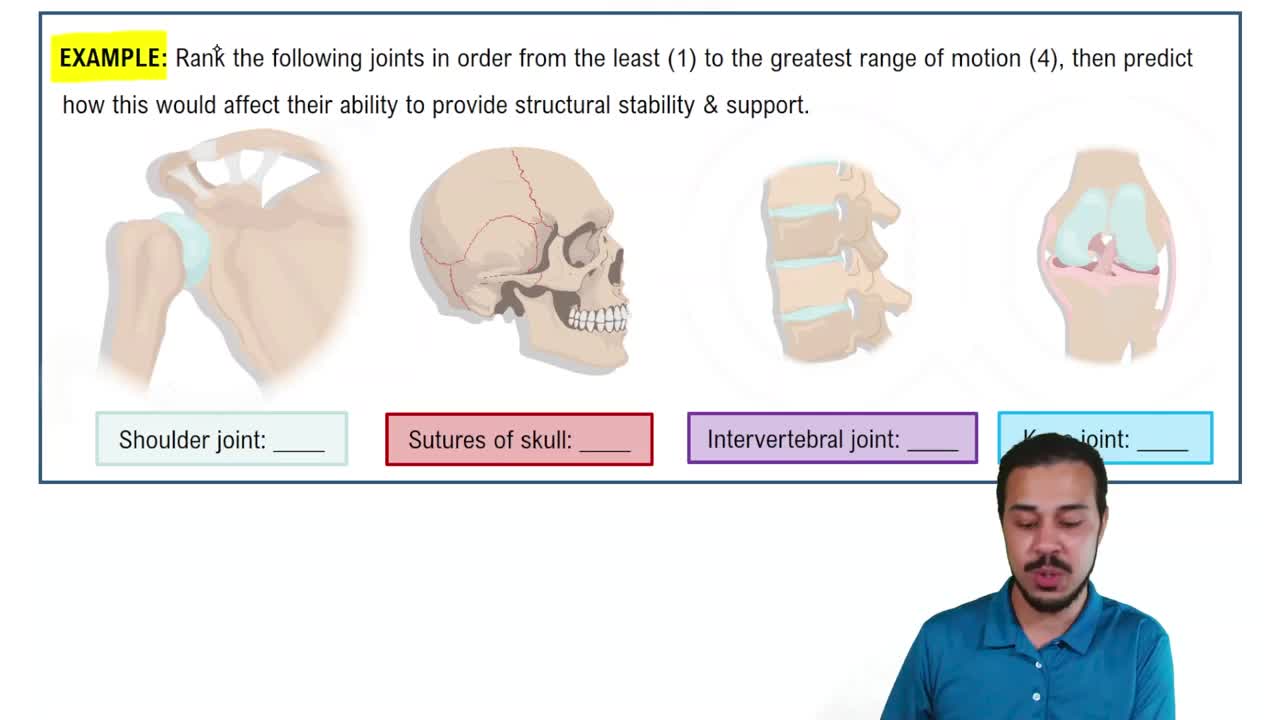
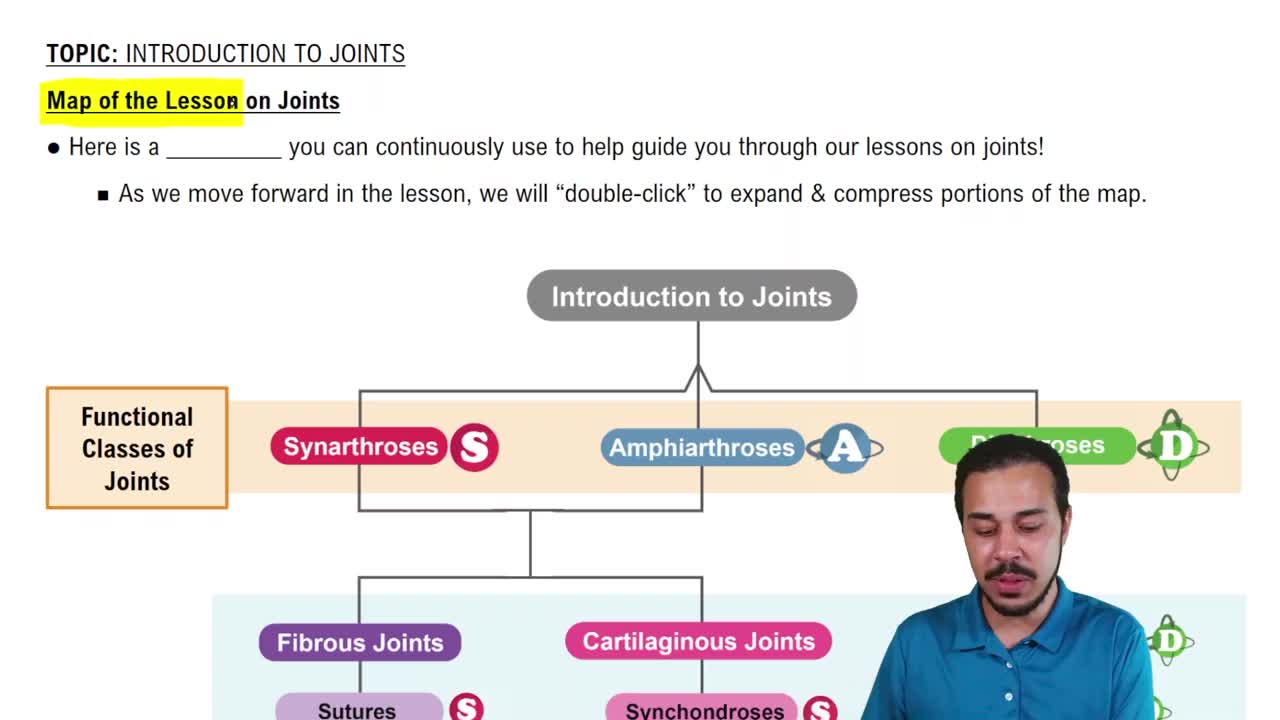
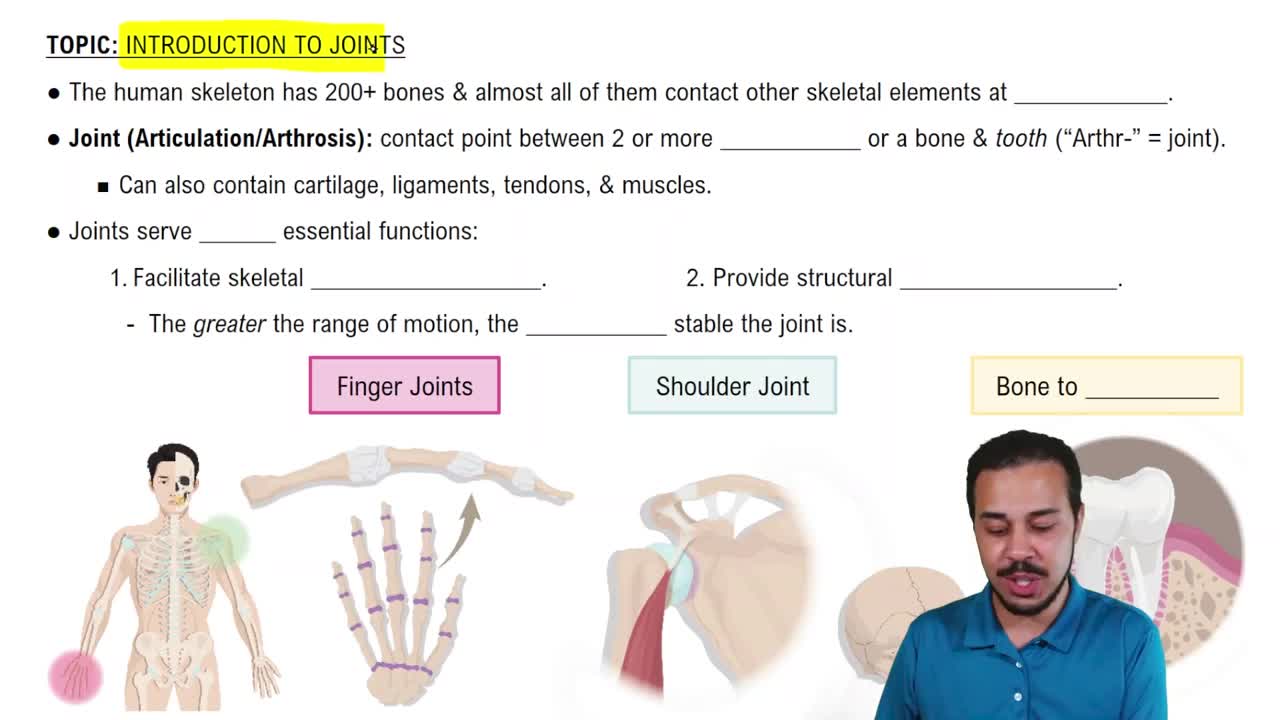
Fibrous joints are immovable, cartilaginous joints are slightly movable, and synovial joints are freely movable.
Flat surfaces permitting nonaxial gliding, e.g., intercarpal joints.
Cylindrical projection fitting into a trough, permitting uniaxial flexion and extension, e.g., elbow.
Rounded bone end fitting into a sleeve, permitting uniaxial rotation, e.g., proximal radioulnar joint.
Oval convex surface articulating with an oval depression, permitting biaxial movement, e.g., knuckle joint.
Articular surfaces with complementary concave and convex areas, permitting biaxial motion with greater freedom, e.g., thumb carpometacarpal joint.
Spherical head resting in a cup-like socket, permitting multiaxial movement, e.g., shoulder and hip joints.