 Back
A&P Lecture Exam 1 flashcards
 05:04

Terms in this set (28)
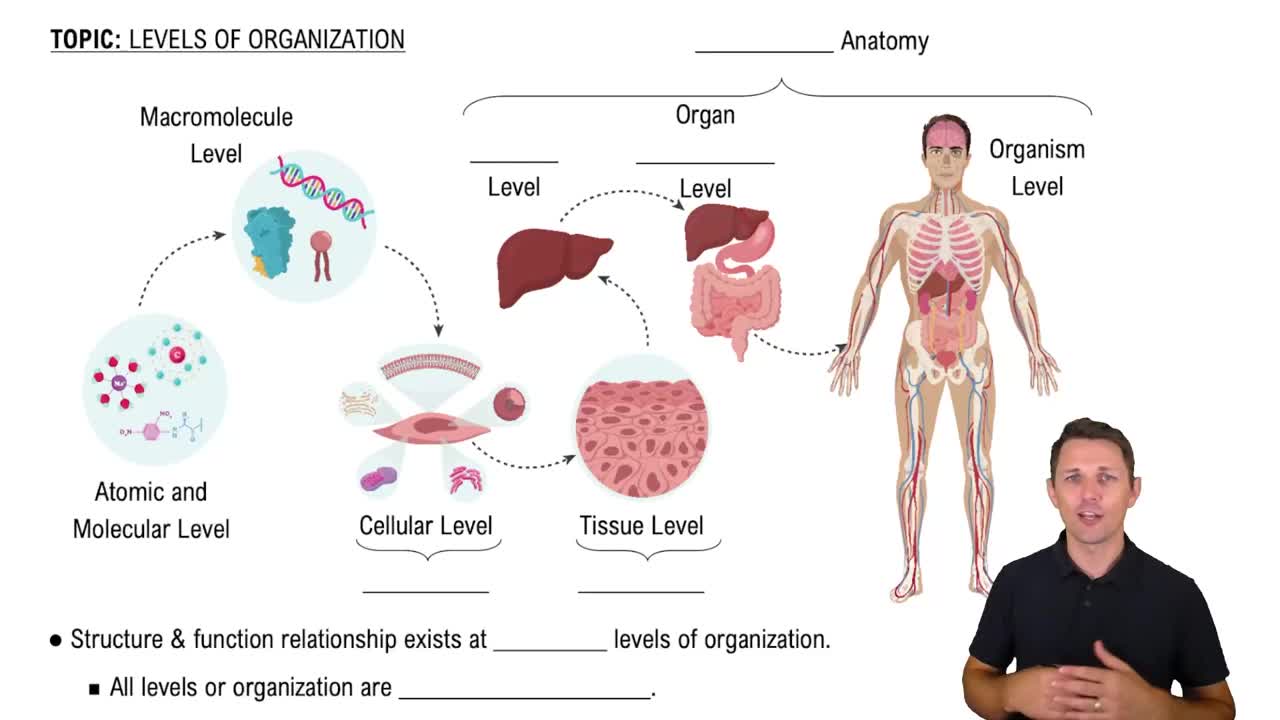
Chemical, Cellular, Tissue, Organ, Organ system, Organism; each level builds on the previous with increasing complexity and function.
All chemical reactions in an organism, including anabolism (building molecules) and catabolism (breaking down molecules), orchestrated by enzymes.
Positive feedback amplifies changes and is usually temporary (e.g., childbirth), while negative feedback reverses changes to maintain homeostasis (e.g., shivering to generate heat).
Stimulus, Receptor, Afferent pathway, Control center, Efferent pathway, Effector, and Response.
An atom that has gained or lost electrons, resulting in a charge; cations are positive, anions are negative.
Ionic bonds transfer electrons between atoms; covalent bonds share electrons between atoms.
Polarity, hydrogen bonding, high heat capacity, cohesion, adhesion, surface tension, and excellent solvent abilities.
Form a bilayer with hydrophilic heads facing outward and hydrophobic tails inward, creating a selectively permeable membrane.
Saturated fats have no double bonds and are solid at room temperature; unsaturated fats have one or more double bonds and are liquid at room temperature.
Active transport protein that moves 3 Na⁺ ions out and 2 K⁺ ions into the cell, maintaining resting membrane potential.
Passive movement of water across a membrane toward higher solute concentration, facilitated by aquaporins.
Isotonic: equal solute concentration; Hypertonic: higher solute outside, causing cell shrinkage; Hypotonic: lower solute outside, causing cell swelling.
DNA is transcribed into mRNA in the nucleus, then mRNA is translated into protein by ribosomes in the cytoplasm.
Transfers specific amino acids to the ribosome matching mRNA codons via its anticodon during translation.
Carbohydrates, Lipids, Proteins, Nucleic acids.
Primary energy source; built from monosaccharides like glucose.
Perform most cellular work; made of amino acids linked by peptide bonds.
Double helix storing genetic information; bases pair A-T and C-G.
Help maintain stable pH by binding or releasing hydrogen ions to prevent sudden changes.
Regulates blood pH by balancing CO₂, H₂CO₃, H⁺, and HCO₃⁻; lungs control CO₂, kidneys control bicarbonate.
Protection, temperature regulation, sensation, vitamin D synthesis, and immune support.
Stratum basale, stratum spinosum, stratum granulosum, stratum lucidum (only in thick skin), stratum corneum.
Produce melanin to protect skin from UV radiation; melanin is transferred to keratinocytes.
Main epidermal cells producing keratin, providing structural strength and waterproofing.
Tight junctions (seal cells), gap junctions (allow communication), desmosomes (anchor cells).
Passive transport requires no ATP and moves substances down their concentration gradient; active transport requires ATP to move substances against the gradient.
Rough ER folds and modifies proteins; Golgi apparatus packages and ships proteins to their destinations.
Dynamic equilibrium maintaining internal conditions within narrow limits despite external changes.