What are the two overlapping arms of adaptive immunity?
Humoral immunity (antibody-mediated) and cellular immunity (cell-mediated).
What is the main function of humoral immunity?
Antibodies produced by B lymphocytes circulate in body fluids, temporarily inactivate targets, and mark them for destruction by phagocytes or complement.
What distinguishes cellular immunity from humoral immunity?
Cellular immunity involves T lymphocytes acting directly by killing infected cells or indirectly by releasing chemicals to enhance inflammation or activate other immune cells.
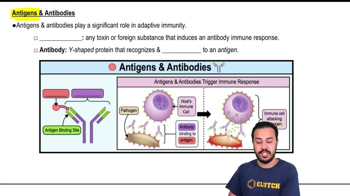
What are non-self antigens?
Substances that provoke an adaptive immune response, usually large, complex molecules not normally found in the body.
What are antigenic determinants?
Specific parts of an antigen that antibodies and lymphocyte receptors bind to; most antigens have multiple determinants.
What are self-antigens and why are MHC proteins important?
Self-antigens are protein molecules on cell surfaces not antigenic to self but antigenic to others; MHC proteins present antigens to T cells for recognition.
What are the three main cell types in the adaptive immune system?
B lymphocytes, T lymphocytes, and antigen-presenting cells (APCs).
Where do B and T lymphocytes originate and mature?
Both originate in red bone marrow; B cells mature in bone marrow, T cells mature in the thymus.
What is immunocompetence and self-tolerance in lymphocyte maturation?
Immunocompetence is the ability to recognize a specific antigen; self-tolerance is unresponsiveness to self-antigens.
What happens during positive and negative selection of T cells in the thymus?
Positive selection ensures T cells recognize self-MHC; negative selection eliminates T cells that bind self-antigens to prevent autoimmunity.
What is clonal selection in lymphocyte activation?
The process where a naive lymphocyte's first encounter with its specific antigen leads to its activation, proliferation, and differentiation.
What roles do antigen-presenting cells (APCs) play?
APCs engulf antigens and present fragments to T cells; major types include dendritic cells, macrophages, and B cells.
How are B cells activated and what do they differentiate into?
B cells are activated when antigens bind and cross-link their receptors; they proliferate and differentiate mainly into plasma cells that secrete antibodies.
What is the difference between primary and secondary humoral immune responses?
Primary response occurs on first antigen exposure with a lag phase; secondary response is faster, stronger, and longer-lasting due to memory cells.
What is active humoral immunity?
Immunity from B cells producing antibodies after encountering antigens naturally or via vaccination.
What is passive humoral immunity?
Immunity gained by receiving ready-made antibodies, without B cell activation or memory formation.
Describe the basic structure of an antibody.
Y-shaped protein with two identical heavy chains and two identical light chains, variable regions form antigen-binding sites, constant regions determine antibody class.
Name the five major classes of immunoglobulins (antibodies).
IgM, IgA, IgD, IgG, and IgE.
What are the four main mechanisms of antibody action?
Neutralization, agglutination, precipitation, and complement fixation.
How does neutralization work as an antibody defense mechanism?
Antibodies block specific sites on pathogens or toxins, preventing them from binding to host cells.
What is agglutination in antibody function?
Antibodies bind multiple antigens on cells, causing clumping that facilitates removal.
Explain precipitation as an antibody mechanism.
Antibodies cross-link soluble antigens, forming complexes that precipitate and are phagocytized.
What is complement fixation by antibodies?
Antibodies bound close together on a cell surface trigger complement activation, leading to cell lysis and enhanced inflammation.
 Back
 5:52