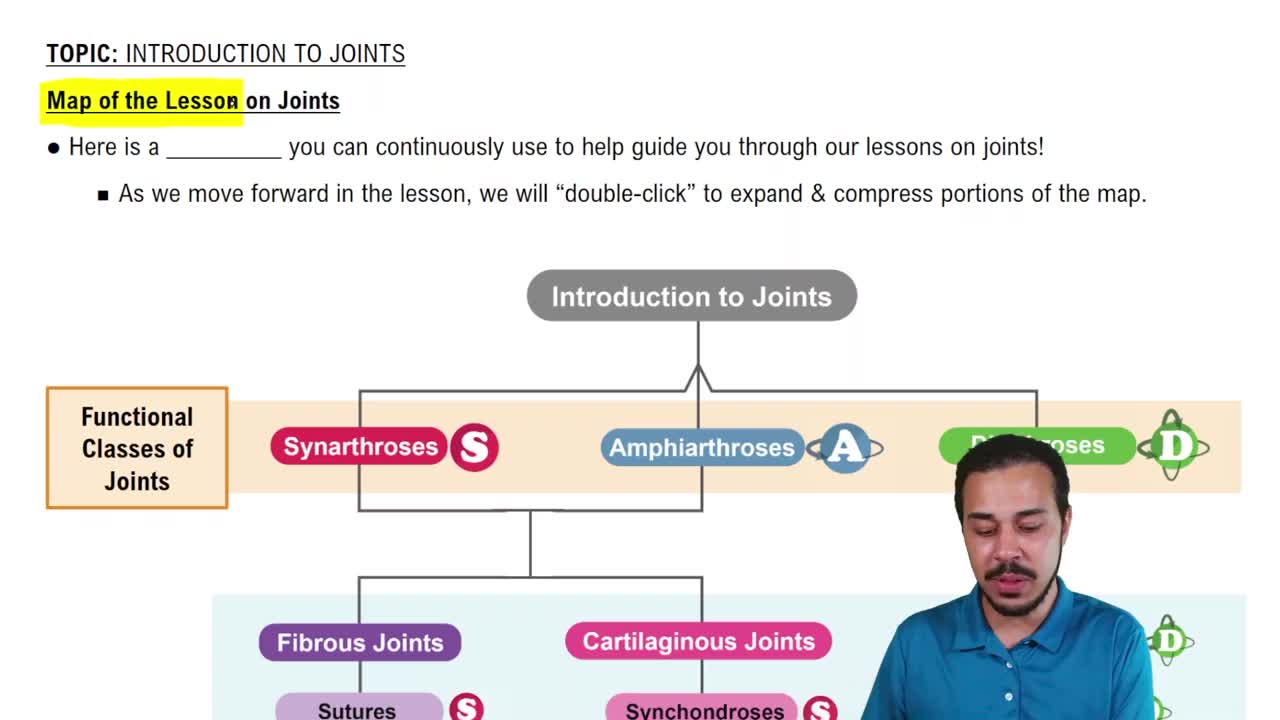
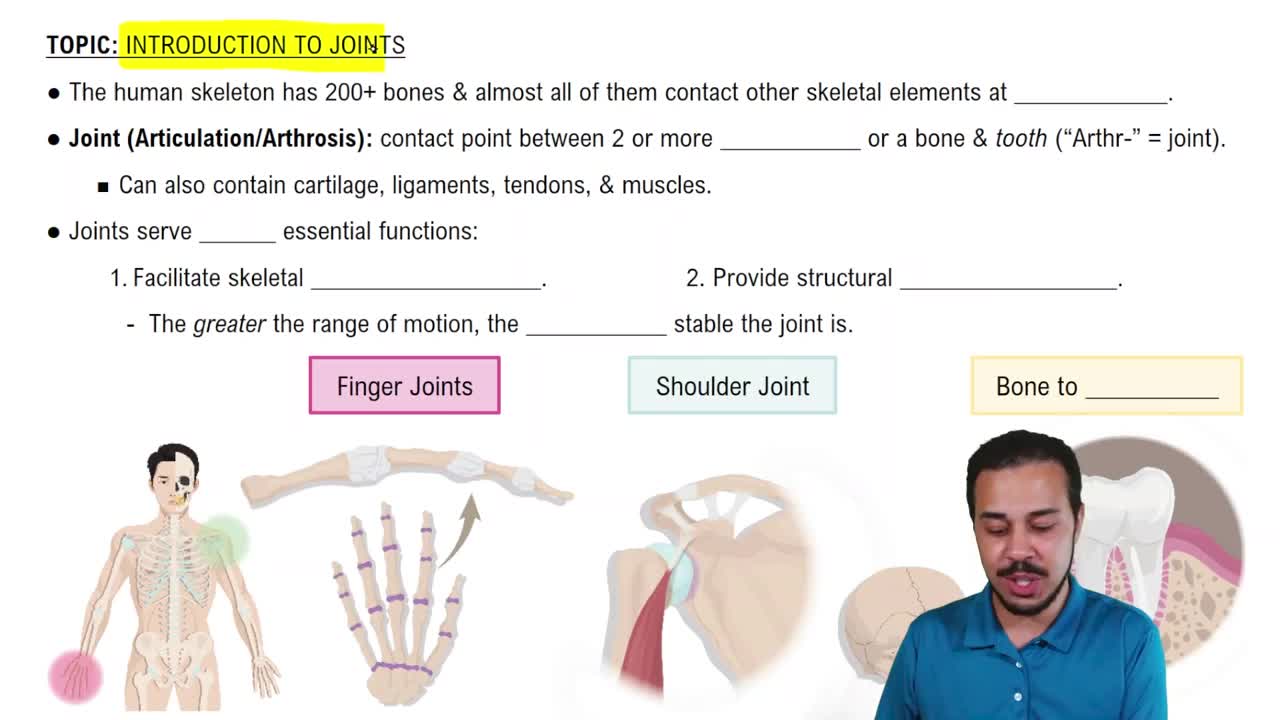
A suture is a synarthrotic joint where the edges of bones are interlocked and bound together by dense fibrous connective tissue, found only in the skull.
Define gomphosis.
A gomphosis is a synarthrotic fibrous joint where a tooth is bound to its socket by the periodontal ligament.
What characterizes a synchondrosis joint?
A synchondrosis is a rigid cartilaginous joint where bones are joined by hyaline cartilage, such as the epiphyseal plate or the first rib to the sternum.
Describe synostosis.
A synostosis is a totally rigid, immovable joint formed when two bones fuse and the boundary disappears, like the epiphyseal lines of long bones.
What is a syndesmosis joint?
A syndesmosis is a fibrous joint where bones are connected by ligaments, such as the distal articulation between the tibia and fibula.
Explain symphysis joints.
A symphysis is a cartilaginous joint where bones are separated by a wedge or pad of fibrocartilage, like the pubic symphysis.
What is the function of bursae in joints?
Bursae are fluid-filled sacs that cushion areas where tendons or ligaments rub over bones, reducing friction.
What is gliding movement in synovial joints?
Gliding is a linear motion where two flat surfaces slide past each other, such as between carpal or tarsal bones.
Define flexion and extension movements.
Flexion decreases the angle between bones, while extension increases the angle, returning a body part to anatomical position.
What is hyperextension?
Hyperextension is extension beyond the anatomical position, increasing the angle between bones past normal range.
Describe abduction and adduction.
Abduction moves a limb away from the body's midline, while adduction moves it toward the midline.
What is circumduction?
Circumduction is a circular movement of a limb without rotation, combining flexion, extension, abduction, and adduction.
Explain medial and lateral rotation.
Medial rotation turns a bone toward the body's midline; lateral rotation turns it away from the midline.
What are pronation and supination?
Pronation rotates the forearm so the palm faces down; supination rotates it back to the palm facing up.
Define inversion and eversion of the foot.
Inversion turns the sole of the foot medially (inward); eversion turns it laterally (outward).
What is dorsiflexion and plantar flexion?
Dorsiflexion lifts the toes upward; plantar flexion points the toes downward, like standing on tiptoe.
Describe opposition and reposition of the thumb.
Opposition moves the thumb toward the fingers for grasping; reposition moves the thumb back to anatomical position.
What is protraction and retraction?
Protraction moves a body part forward; retraction moves it backward, such as the mandible.
What is lateral flexion of the vertebral column?
Lateral flexion bends the vertebral column side to side.
Name the six types of synovial joints by shape.
The six types are gliding, hinge, pivot, condylar, saddle, and ball-and-socket joints.
Characteristics of hinge joints?
Hinge joints allow angular motion in one plane (monaxial), like the elbow and knee.
What is a pivot joint?
A pivot joint allows rotation around a single axis, such as the atlanto-axial joint.
Describe condylar joints.
Condylar joints have an oval articular face that fits into a depression, allowing biaxial motion, e.g., wrist joints.
What are saddle joints?
Saddle joints are biaxial joints permitting angular movement, like the thumb carpometacarpal joint.
Describe ball-and-socket joints.
Ball-and-socket joints have a round head fitting into a cup-shaped socket, allowing triaxial movement, e.g., shoulder and hip joints.
What factors limit joint range of motion to prevent injury?
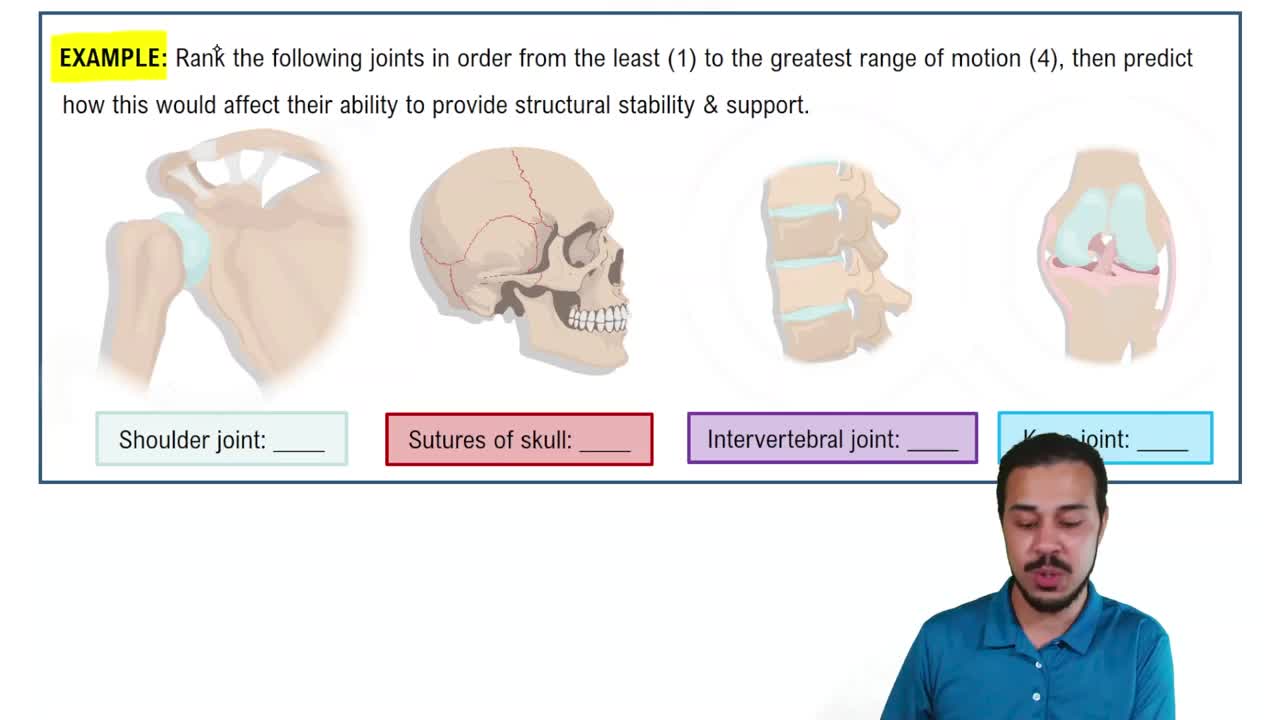
Joint capsules, ligaments, shapes of articulating surfaces, menisci, and surrounding bones, muscles, or fat pads limit range of motion.
What is bursitis?
Bursitis is inflammation of a bursa, causing pain and swelling near joints.
 Back
 04:06