Skip to main content
Anatomy & Physiology
My Course
Learn
Exam Prep
AI Tutor
Study Guides
Textbook Solutions
Flashcards
Explore
Try the app
My Course
Learn
Exam Prep
AI Tutor
Study Guides
Textbook Solutions
Flashcards
Explore
Try the app
Back
Anatomy & Physiology: Basic Chemistry and Biomolecules
You can tap to flip the card.
Which four elements make up more than 95% of the body's mass?
You can tap to flip the card.
👆
Which four elements make up more than 95% of the body's mass?
Oxygen, carbon, hydrogen, and nitrogen
make up more than 95% of the body's mass.
Track progress
Control buttons has been changed to "navigation" mode.
1/29
Recommended videos
Guided course
02:13
Atoms- Smallest Unit of Matter Example 1
30147
views
786
rank
Guided course
03:51
Atoms- Smallest Unit of Matter Example 3
19607
views
421
rank
Guided course
09:44
Electron Orbitals & Energy Shells
27288
views
582
rank
5
comments
Terms in this set (29)
Hide definitions
Which four elements make up more than 95% of the body's mass?
Oxygen, carbon, hydrogen, and nitrogen
make up more than 95% of the body's mass.
What is the smallest unit of an element that retains its distinctive behavior?
An
atom
is the smallest unit of an element that retains its distinctive properties.
What characteristic gives an element its distinctive properties?
The number of
protons
in an atom gives an element its distinctive properties.
If mercury has atomic number 80 and mass number 200.59, how many neutrons does its most abundant isotope likely have?
The most abundant isotopes of mercury likely have
about 120 neutrons
(mass number minus atomic number).
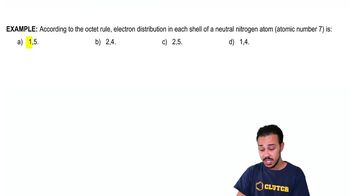
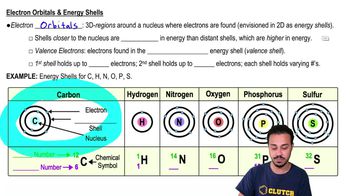
How many electron shells does nitrogen have if its atomic number is 7?
Nitrogen likely has
two electron shells
.
Which is a molecule but not a compound: H2O, 2H, H2, or H+?
H2
is a molecule but not a compound because it contains two atoms of the same element.
What type of bonds link nitrogen and hydrogen atoms in ammonia (NH3)?
Ammonia contains
polar covalent bonds
between nitrogen and hydrogen atoms.
What happens when an atom donates an electron to another atom?
It becomes an
ion
, specifically a
cation
if it loses electrons.
What is a substance formed of crystals of equal numbers of cations and anions held by ionic bonds called?
Such a substance is called a
salt
.
Which statement about chemical bonds is true?
Covalent bonds are stronger than ionic bonds in biological systems.
What type of energy is stored in a foot of snow on a steep roof?
The energy stored is
potential energy
.
The bonding of calcium, phosphorus, and other elements to form mineral crystals in bone is an example of what type of reaction?
It is a
synthesis reaction
.
What type of reaction is represented by AB → A + B?
This represents a
decomposition reaction
.
Which reactions release energy?
Catabolic, exergonic, and decomposition reactions
release energy.
Which combination of atoms is most likely to result in a chemical reaction?
Hydrogen and hydrogen
atoms are most likely to react.
Why does chewing bread facilitate its chemical breakdown?
Because
saliva contains enzymes
that aid chemical breakdown.
Is methane (CH4) organic or inorganic?
Methane (CH4) is an
organic
compound.
What is most likely to be evenly distributed in water in a homogeneous solution?
Sodium ions and chloride ions
are evenly distributed in a homogeneous solution.
What type of mixture is pancake batter with chocolate chips sinking to the bottom?
It is a
suspension
.
A substance that dissociates into K+ and Cl– in solution is classified as what?
It is a
salt
.
What does a blood pH of 7.48 indicate?
The blood is
slightly alkaline
.
C6H12O6 is the chemical formula for what type of sugar?
It is a
hexose monosaccharide
.
What organic compound do brain cells primarily rely on for fuel?
Glucose
is the primary fuel for brain cells.
Which functional group is part of the building blocks of proteins?
The
amino
group is part of protein building blocks.
A pentose sugar is part of the monomer used to build which macromolecule?
Pentose sugar is part of
nucleic acids
.
What is a phospholipid characterized by?
A phospholipid has both
polar and nonpolar regions
.
What shape does nucleotide bonding form in DNA?
Nucleotide bonding forms a
double helix
.
Which statements about uracil are true?
Uracil contains nitrogen, is a pyrimidine, and is found in RNA.
What is the term for an enzyme's ability to bind only substrates of compatible shape and charge?
This is called
specificity
.
 BackBack
 02:13
02:13