 Back
Anatomy & Physiology: Basic Concepts and Terminology
 05:04

Terms in this set (23)
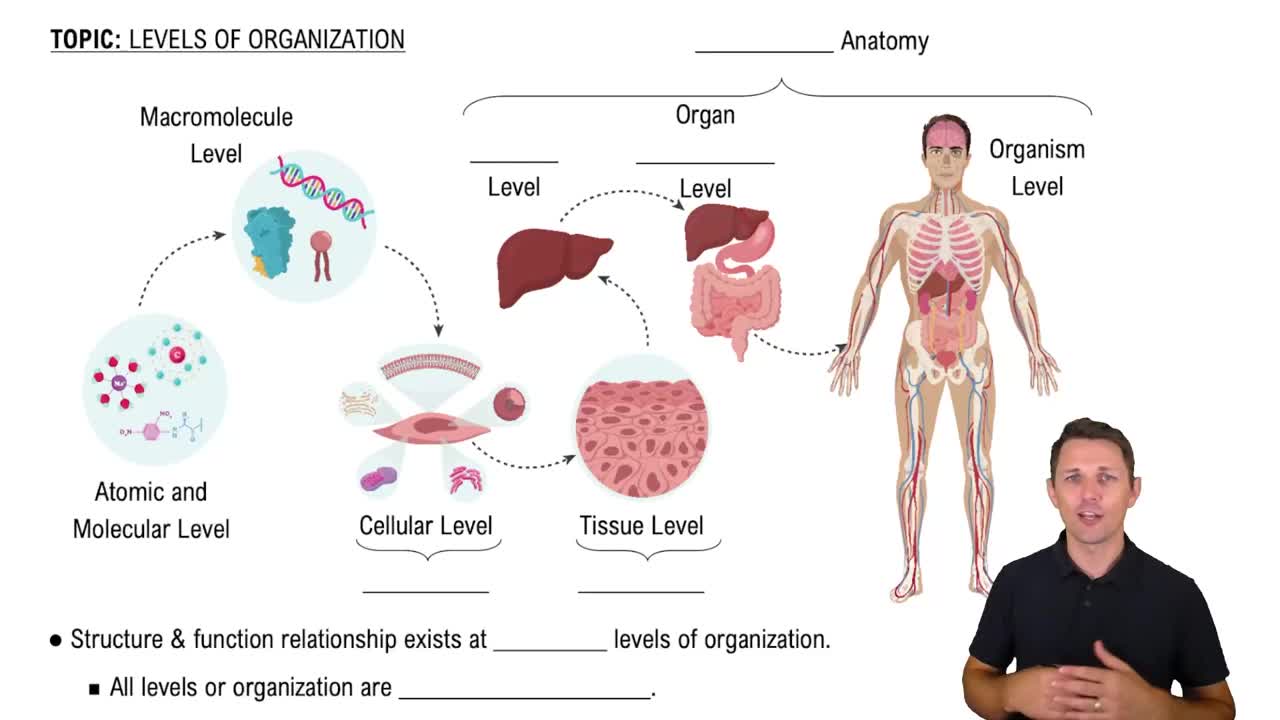
The hierarchy includes atom, molecule, macromolecule, organelle, cell, tissue, organ, organ system, and organism.
Protects the body, regulates temperature, prevents water loss, and synthesizes vitamin D.
Provides support, protection for organs, stores minerals, and produces blood cells.
Produces movement, maintains posture, and generates heat.
Regulates body activities through nerve impulses and detects changes in the environment.
Regulates body activities through hormones transported by the blood.
Transports nutrients, wastes, gases, and hormones throughout the body.
Returns tissue fluids to the blood, carries certain absorbed food molecules, and defends the body against infection.
Exchanges gases between the blood and air and regulates blood pH.
Performs mechanical and chemical processes of digestion, absorption of nutrients, and elimination of wastes.
Removes wastes from the blood and regulates blood pH, ion balance, and water balance.
Produces gametes, supports embryonic development (female), and produces sex hormones.
Includes frontal (forehead), orbital (eye), nasal (nose), oral (mouth), cervical (neck), thoracic (chest), abdominal, pelvic, and pubic regions.
Includes occipital (back of head), vertebral (spinal column), scapular (shoulder blade), lumbar (lower back), gluteal (buttock), and popliteal (back of knee).
The abdomen is divided into four quadrants: right upper, left upper, right lower, and left lower.
Divided into nine regions: right and left hypochondriac, epigastric, right and left lumbar, umbilical, right and left inguinal, and hypogastric.
Superior means toward the head or upper part; inferior means away from the head or lower part.
Anterior means toward the front of the body; posterior means toward the back.
Medial means toward the midline of the body; lateral means away from the midline.
Divides the body into anterior (front) and posterior (back) parts.
Divides the body into right and left parts; the midsagittal plane divides it equally.
Divides the body into superior (upper) and inferior (lower) parts.
Abduction is movement away from the midline; adduction is movement toward the midline.