Back

Anatomy & Physiology: Blood and Hematology

Control buttons has been changed to "navigation" mode.
1/28
  • What are the three main functions of blood?

    Transport of oxygen, nutrients, wastes, and hormones; Regulation of body temperature, pH, and fluid volume; Protection against blood loss and infection.
  • What are the major components of whole blood?

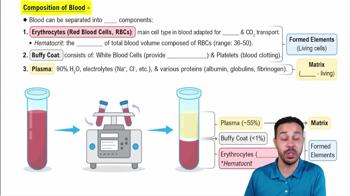
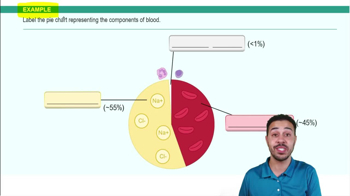
    Plasma (~55%), Buffy coat (<1%, leukocytes and platelets), and Erythrocytes (~45%, red blood cells).
  • What is hematocrit?

    The percentage of whole blood volume composed of red blood cells, normally about 45%.
  • Describe the physical characteristics of blood.

    Viscous, opaque fluid with metallic taste; color varies with oxygen content; pH 7.35–7.45; volume ~5-6 L in males, 4-5 L in females.
  • What is blood plasma composed of?

    Straw-colored fluid, ~90% water, containing nutrients, gases, hormones, wastes, proteins (mainly albumin), and inorganic ions.
  • What are formed elements in blood?

    Cellular components including erythrocytes (RBCs), leukocytes (WBCs), and platelets.
  • What structural features make erythrocytes ideal for gas transport?

    Biconcave shape for large surface area, 97% hemoglobin content, and lack of mitochondria to avoid using transported oxygen.
  • What is hemoglobin composed of?

    Four polypeptide chains (two alpha, two beta) each with a heme group containing an iron ion that binds oxygen.
  • How many oxygen molecules can one hemoglobin molecule carry?

    Four oxygen molecules, one bound to each iron ion in the heme groups.
  • What is erythropoiesis and where does it occur?

    The production of red blood cells, occurring in red bone marrow.
  • What hormone regulates erythropoiesis?

    Erythropoietin (EPO), primarily produced by the kidneys in response to hypoxia.
  • What dietary components are essential for erythropoiesis?

    Amino acids, lipids, carbohydrates, vitamin B12, folic acid, and iron.
  • What happens to old erythrocytes?

    They are phagocytized by macrophages in the spleen; hemoglobin is broken down and iron is recycled.
  • What is anemia?

    A condition where blood's oxygen-carrying capacity is too low to support normal metabolism.
  • What causes iron-deficiency anemia?

    Blood loss, low iron intake, or impaired iron absorption leading to small, pale RBCs called microcytes.
  • What is sickle-cell anemia?

    A genetic disorder caused by a mutation in hemoglobin beta chain, causing RBCs to become crescent-shaped and prone to rupture.
  • What are leukocytes and their main function?

    White blood cells that protect the body against bacteria, viruses, parasites, toxins, and tumor cells.
  • Name the two major categories of leukocytes.

    Granulocytes (neutrophils, eosinophils, basophils) and Agranulocytes (lymphocytes, monocytes).
  • What is the mnemonic to remember leukocyte abundance?

    "Never Let Monkeys Eat Bananas" for Neutrophils, Lymphocytes, Monocytes, Eosinophils, Basophils.
  • What is hemostasis?

    The rapid process that stops bleeding, involving vascular spasm, platelet plug formation, and coagulation.
  • What triggers the intrinsic and extrinsic pathways of coagulation?

    Intrinsic: activated platelets or collagen; Extrinsic: tissue factor (TF) from damaged tissues.
  • What is the role of platelets in hemostasis?

    Form temporary plugs at injury sites and release chemicals that promote vasoconstriction and clotting.
  • What is fibrinolysis?

    The process of clot removal after repair, where plasmin digests fibrin mesh.
  • What are the ABO blood groups based on?

    Presence or absence of A and B antigens on RBC surfaces and corresponding antibodies in plasma.
  • What is the Rh blood group system?

    Based on presence (Rh+) or absence (Rh−) of the D antigen; important in transfusion and pregnancy.
  • What is leukocytosis?

    An elevated white blood cell count, typically a normal response to infection.
  • What is thrombocytopenia?

    A deficiency of circulating platelets, leading to spontaneous bleeding and petechiae.
  • What is polycythemia?

    An abnormal excess of red blood cells, increasing blood viscosity and risk of clotting.