Transport of gases, nutrients, hormones; regulation of pH, temperature, fluid volume; protection against blood loss and infection.
What are the main components of blood?
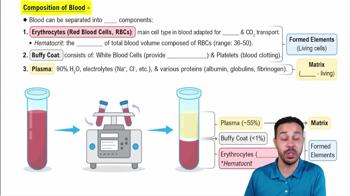
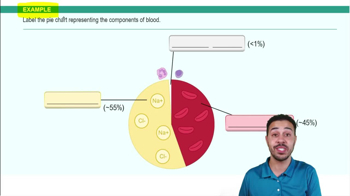
Blood consists of erythrocytes (RBCs), buffy coat (white blood cells and platelets), and plasma (90% water, electrolytes, proteins).
What is hematocrit?
The percentage of total blood volume composed of erythrocytes, typically ranging from 36-50%.
Describe the structure of erythrocytes.
Small, biconcave-shaped cells without a nucleus or organelles, coated with flexible proteins like spectrin to maintain shape and increase surface area.
What is the primary function of hemoglobin in erythrocytes?
Hemoglobin is a protein that transports oxygen and carbon dioxide by reversibly binding these gases.
How many oxygen molecules can one hemoglobin molecule carry?
Each hemoglobin molecule can carry up to \(4\) oxygen molecules, one per heme group.
What is the role of spectrin in erythrocytes?
Spectrin maintains the shape and flexibility of erythrocytes, allowing them to deform as they pass through capillaries.
What are leukocytes and their main function?
Leukocytes (white blood cells) defend the body against infection and foreign substances.
Differentiate granulocytes and agranulocytes.
Granulocytes contain visible cytoplasmic granules; agranulocytes lack visible granules under a microscope.
Name the three types of granulocytes and a key feature of each.
Neutrophils (multi-lobed nucleus, first responders), Eosinophils (bilobed nucleus, combat parasites), Basophils (two-lobed nucleus, involved in inflammation).
What is phagocytosis and which leukocyte primarily performs it?
Phagocytosis is the process of engulfing and digesting microbes, primarily performed by neutrophils and macrophages.
What role do eosinophils play in immunity?
Eosinophils protect against parasitic helminths and contribute to allergic responses.
What is the function of basophils and mast cells?
They release histamine and other chemicals to increase capillary permeability and promote inflammation.
What are the two main types of agranulocytes?
Monocytes (which differentiate into macrophages and dendritic cells) and lymphocytes (B cells, T cells, and natural killer cells).
Describe the process of hemostasis.
Hemostasis is a controlled process to stop bleeding involving vascular spasm, platelet plug formation, and coagulation.
What triggers vascular spasm in hemostasis?
Vascular spasm is triggered by chemicals like endothelins released from damaged endothelial cells causing vasoconstriction.
Outline the three steps of platelet plug formation.
1) Adhesion: platelets bind exposed collagen via von Willebrand factor; 2) Activation: platelets release chemicals; 3) Aggregation: platelets recruit more platelets to form a plug.
What is the role of von Willebrand factor in hemostasis?
It acts as a bridge between platelets and exposed collagen to initiate platelet adhesion.
Describe the coagulation cascade phases.
Phase 1: formation of prothrombin activator via intrinsic or extrinsic pathways; Phase 2: conversion of prothrombin to thrombin; Phase 3: thrombin converts fibrinogen to fibrin to stabilize the clot.
What is fibrinolysis?
The process of breaking down fibrin clots after healing, involving conversion of plasminogen to plasmin, a fibrin-digesting enzyme.
 Back
 2:36