 Back
Anatomy & Physiology: Blood, Heart, and Blood Vessels
 2:36

Terms in this set (31)
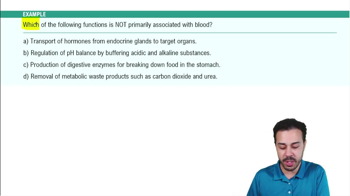
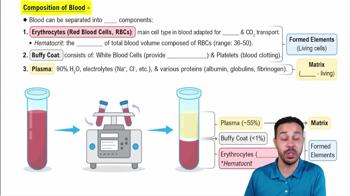
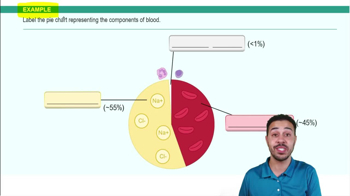
Proteins, cells (red blood cells, white blood cells, platelets), plasma, and pH balance.
The percentage of red blood cells in the total blood volume.
Produced in bone marrow. Hormones like erythropoietin (from kidneys) stimulate red blood cell production.
Spleen, liver, kidney, and bone marrow.
The pressure exerted by plasma proteins that pulls water into the capillaries from the interstitial fluid.
Platelets aggregate to form a plug and release chemicals to promote blood clotting.
Vascular spasm, platelet plug formation, and coagulation cascade.
Intrinsic, extrinsic, and common pathways.
Antibodies binding to antigens on red blood cells causing clumping.
The heart's ability to generate its own rhythmic electrical impulses without external stimuli.
To ensure unidirectional blood flow through the heart chambers.
Systemic circuit carries blood between the heart and body; pulmonary circuit carries blood between the heart and lungs.
Na+ influx causes depolarization, Ca2+ influx causes plateau, and K+ efflux causes repolarization.
Depolarization, plateau, and repolarization.
SA node is the primary pacemaker; AV node delays impulse to allow ventricular filling.
Electrical activity of the heart: P wave (atrial depolarization), QRS complex (ventricular depolarization), T wave (ventricular repolarization).
Tachycardia: heart rate >100 bpm; Bradycardia: heart rate <60 bpm.
Volume of blood pumped per minute; calculated as \(\text{CO} = \text{HR} \times \text{SV}\) (heart rate × stroke volume).
The stroke volume increases in response to an increase in the volume of blood filling the heart (preload).
Factors that change heart rate by affecting the SA node, e.g., sympathetic stimulation increases rate.
Hormone that reduces blood volume and pressure by promoting sodium and water excretion.
Arteries, veins, and capillaries.
An anastomosis is a connection between blood vessels; the Circle of Willis is a cerebral arterial anastomosis at the brain base.
Circulatory pathways where blood passes through two capillary beds before returning to the heart.
The average pressure in arteries during one cardiac cycle; important for organ perfusion.
Using a sphygmomanometer to detect systolic and diastolic pressures.
Sympathetic increases heart rate and vasoconstriction; parasympathetic decreases heart rate.
Chemoreceptors in carotid and aortic bodies detect blood chemistry; baroreceptors in carotid sinus and aortic arch detect pressure changes.
Chronic high blood pressure, often >140/90 mmHg, increasing risk of cardiovascular disease.
The balance of hydrostatic and osmotic pressures that determines fluid movement across capillary walls.
Excess fluid accumulation in tissues due to increased hydrostatic pressure, decreased osmotic pressure, or lymphatic obstruction.