Back

Anatomy & Physiology: Blood, Heart, Circulation, and Respiratory System

Control buttons has been changed to "navigation" mode.
1/23
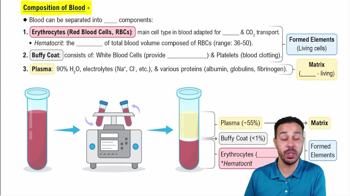
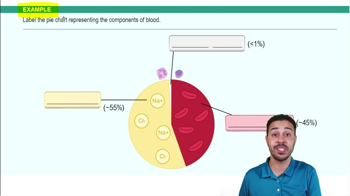
  • What are the main components and formed elements of blood?

    • Plasma - fluid component
    • Plasma proteins
    • Platelets - cell fragments from megakaryocytes
    • Red blood cells (erythrocytes)
    • White blood cells (leukocytes) - granular (neutrophil, basophil, eosinophil) and agranular (lymphocyte, monocyte)
  • What is the primary function of red blood cells and hemoglobin?

    Red blood cells bind and transport oxygen using hemoglobin.
  • What determines ABO blood types and Rh factor?

    ABO blood types are based on presence of A or B antigens on RBCs; Rh factor is based on presence or absence of Rh antigen. Blood typing is crucial for compatibility in transfusions.
  • What are the three phases of hemostasis?

    1. Vascular phase
    2. Platelet phase
    3. Coagulation phase
    Hemostasis stops bleeding via a cascade of events.
  • Differentiate pulmonary circulation from systemic circulation.

    Pulmonary circulation moves blood between heart and lungs; systemic circulation moves blood between heart and body tissues.
  • What is the functional anatomy of arteries, veins, and capillaries?

    • Arteries carry blood away from heart, branching from large to small
    • Capillaries are smallest vessels for exchange with thin walls
    • Veins carry blood back to heart, starting small and draining into larger veins
  • Describe the flow of blood through the heart.

    Blood flows: body → superior/inferior vena cava → right atrium → tricuspid valve → right ventricle → pulmonary valve → pulmonary arteries → lungs → pulmonary veins → left atrium → mitral valve → left ventricle → aortic valve → aorta → body.
  • What is the cardiac cycle and its main phases?

    The cardiac cycle includes atrial systole, ventricular systole, and diastole phases where atria and ventricles contract and relax to pump blood.
  • What is the role of the sinoatrial (SA) node?

    The SA node is the heart's pacemaker, generating spontaneous action potentials to initiate heart muscle contraction.
  • How does the cardiac conduction system propagate the heartbeat?

    Signal travels from SA node → internodal pathways → atrioventricular (AV) node → AV bundle → bundle branches → Purkinje fibers → ventricular myocardium.
  • How do sympathetic and parasympathetic innervation affect heart rate?

    Parasympathetic (vagus nerve) slows SA node; sympathetic nerves and hormones (epinephrine, norepinephrine) increase heart rate.
  • What do the P wave, QRS complex, and T wave represent on an ECG?

    • P wave: atrial depolarization
    • QRS complex: ventricular depolarization
    • T wave: ventricular repolarization
  • Define cardiac output and its formula.

    Cardiac output (CO) is the blood volume ejected per minute. \(CO = HR \times SV\) where HR is heart rate and SV is stroke volume.
  • What are the main lymphocyte types and their functions?

    • Cytotoxic T cells: lyse infected cells
    • Helper T cells: activate other immune cells
    • Suppressor T cells: regulate immune response
    • B cells: produce antibodies
    • Natural Killer (NK) cells: destroy abnormal cells
  • Compare innate and adaptive immunity.

    • Innate immunity: nonspecific, general defenses like barriers, phagocytes, inflammation
    • Adaptive immunity: specific, uses lymphocytes to target particular pathogens with memory
  • What is ventilation in the respiratory system?

    Ventilation is the process of moving air into and out of the lungs.
  • What are the functions of the upper and lower respiratory tracts?

    Upper tract warms, filters, humidifies air; lower tract conducts air and performs gas exchange.
  • What epithelium lines the respiratory tract and its function?

    Pseudostratified columnar epithelium with cilia moves mucus and trapped particles toward the oral cavity.
  • What is the role of the alveoli in respiration?

    Alveoli are the site of external respiration where oxygen and carbon dioxide exchange occurs across a thin respiratory membrane.
  • How does pulmonary ventilation occur mechanically?

    Diaphragm and external intercostal muscles contract to increase thoracic volume, lowering pressure and drawing air in; relaxation reverses the process.
  • How is oxygen transported in the blood?

    Oxygen binds to hemoglobin in red blood cells forming oxyhemoglobin (HbO2) for transport.
  • In what forms is carbon dioxide transported in the blood?

    CO2 is transported dissolved in plasma, bound to hemoglobin, and mostly as bicarbonate ions (HCO3-).
  • What brain centers control respiration rate?

    Respiratory centers in the pons and medulla oblongata regulate breathing rate based on CO2 levels.