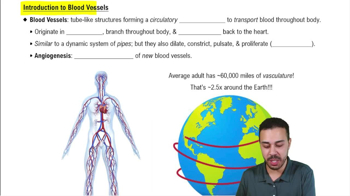
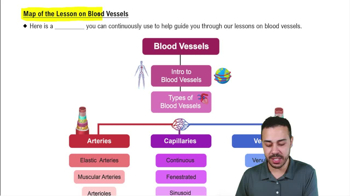
Arteries carry blood away from the heart; Arterioles are small arteries leading to capillaries; Capillaries are sites of exchange; Venules collect blood from capillaries; Veins return blood to the heart.
Layers of blood vessel walls
From inside out: Tunica intima (inner layer), Tunica media (smooth muscle layer), Tunica externa (outer connective tissue layer).
Differences between arteries and veins
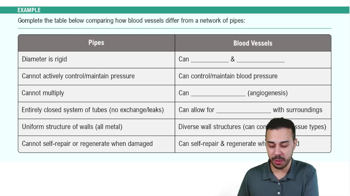
Arteries have thicker walls, higher pressure, smaller round lumen, folded endothelium, and are more elastic. Veins have larger irregular lumen and valves to prevent backflow.
Arterial diameter control mechanisms
Vasoconstriction: contraction of arterial smooth muscle; Vasodilation: relaxation enlarging lumen; both controlled by sympathetic nervous system.
Types of arteries from heart to capillaries
Elastic arteries (large, many elastic fibers), Muscular arteries (medium-sized, many muscle cells), Arterioles (smallest, thin or incomplete tunica media).
Characteristics of veins
Veins have larger diameter, thinner walls, lower pressure, valves to prevent backflow, and rely on skeletal muscle and respiratory pumps to assist blood return.
Function of venous valves
Folds of tunica intima that prevent blood from flowing backward, aiding venous return especially in limbs.
Capillary structure and function
Capillaries are smallest vessels with thin endothelial walls, no tunica media or externa, and are sites of exchange between blood and interstitial fluid.
Capillary beds and blood flow regulation
Capillary beds connect arterioles and venules; precapillary sphincters open/close to regulate blood flow in pulses.
Mechanisms of capillary exchange
Materials move by diffusion, filtration (fluid out at arterial end), and reabsorption (fluid in at venous end).
Factors influencing blood pressure
Total peripheral resistance depends on vascular resistance, blood viscosity, and turbulence.
Definition of systolic and diastolic pressure
Systolic pressure: peak arterial pressure during ventricular contraction; Diastolic pressure: minimum arterial pressure during relaxation.
Mean arterial pressure (MAP) formula
MAP = Diastolic pressure + one-third of pulse pressure, where pulse pressure = systolic - diastolic.
Role of cardiovascular center in blood pressure regulation
Located in medulla oblongata; includes cardioacceleratory and cardioinhibitory centers and vasomotor center controlling vessel diameter.
Hormones affecting cardiovascular regulation
Epinephrine and norepinephrine increase cardiac output and vasoconstriction; ADH, aldosterone, erythropoietin, ANP, and BNP also modulate blood volume and pressure.
Blood flow priority to the brain
Brain has high oxygen demand; cerebral vessels dilate when peripheral vessels constrict to maintain constant blood flow.
Pulmonary circuit blood flow path
Deoxygenated blood from right atrium → right ventricle → pulmonary trunk → pulmonary arteries → lungs → pulmonary veins → left atrium.
Systemic circuit blood flow path
Oxygenated blood from left ventricle → ascending aorta → systemic arteries → capillaries → systemic veins → vena cava → right atrium.
Major branches of the aortic arch
Brachiocephalic trunk (right subclavian and right common carotid), left common carotid artery, and left subclavian artery.
Differences between fetal and adult circulation
Fetal lungs nonfunctional; blood bypasses lungs via foramen ovale and ductus arteriosus; placenta provides oxygen; at birth, these shunts close.
 Back
 3:38