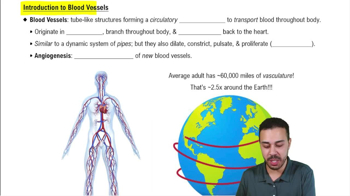
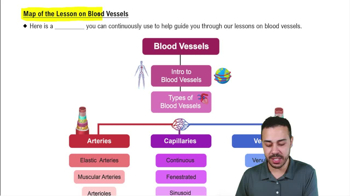
Arteries carry blood away from the heart, arterioles are smaller arteries, capillaries are exchange vessels, venules are small veins, and veins carry blood back to the heart.
Structure of Artery and Vein Walls
Both have 3 layers: Tunica Intima (deepest), Tunica Media (middle), and Tunica Externa (outer). The lumen is the inside space of the vessel.
Endothelium Differences in Arteries and Veins
Endothelium is part of the tunica intima. It is rippled in arteries to allow dilation and constriction, and smooth in veins.
Artery vs Vein Characteristics
Arteries have more smooth muscle and elastic fibers allowing vasodilation and vasoconstriction. Veins have valves to prevent backflow and carry blood under low pressure.
Three main types: Elastic arteries (e.g., aorta), Muscular arteries (distribute blood to muscles/organs), and Arterioles (small arteries leading to capillaries).
Arteriosclerosis
Thickening and loss of elasticity of artery walls. Includes atherosclerosis (plaque buildup) and focal calcification (calcified plaque). Can cause coronary artery disease and strokes.
Aneurysm
A bulge in a weakened artery wall that can rupture causing internal bleeding. In the brain, it can cause hemorrhagic stroke.
Capillary Beds and Precapillary Sphincters
Capillaries form interconnected beds supplied by arterioles. Precapillary sphincters regulate blood flow to tissues based on need.
Collaterals and Anastomoses
Collaterals are multiple arteries supplying a capillary bed. Anastomosis is the joining of vessels, providing alternate blood flow routes if one artery is blocked.
Angiogenesis
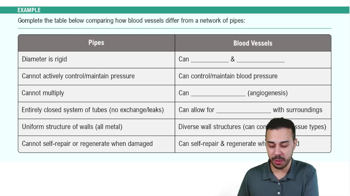
Formation of new blood vessels from existing ones, triggered by oxygen-starved cells. Can be beneficial (e.g., cardiac muscle) or harmful (e.g., tumor growth).
Vein Characteristics
Veins have thinner walls than arteries, carry blood under low pressure, and often contain valves to prevent backflow, especially in limbs.
Venous Valves
Folds of tunica intima that open to allow blood flow toward the heart and close to prevent backflow, essential for blood return against gravity.
Varicose Veins
Distended veins caused by malfunctioning valves, common in people who stand long periods, with familial links.
Deep Vein Thrombosis (DVT)
Blood clots forming in deep leg veins due to slow blood flow, which can dislodge and cause pulmonary embolism.
Factors Affecting Blood Flow Resistance
Resistance depends on vessel length, vessel diameter (smaller diameter increases resistance), blood viscosity, and turbulence.
Arterial Blood Pressure
Pressure from heartbeat that maintains blood flow. Systolic pressure is peak during ventricular contraction; diastolic pressure is minimum during relaxation.
Hypertension Effects
Chronic high blood pressure increases heart workload, causes left ventricular enlargement, and raises risk of atherosclerosis, aneurysms, heart attacks, and strokes.
Hormones Increasing Blood Volume and Pressure
ADH, Angiotensin II, and Erythropoietin increase blood volume and pressure via vasoconstriction, water retention, and red blood cell production.
Hormones Decreasing Blood Volume and Pressure
Natriuretic peptides reduce blood volume and pressure by promoting sodium and water excretion, reducing thirst, and causing vasodilation.
Blood Flow to Brain
Brain has high oxygen demand; blood flow is constant overall but varies regionally with neural activity. The cerebral arterial circle provides collateral circulation.
Stroke (Cerebrovascular Accident)
Blockage of artery supplying brain causes loss of blood flow, leading to permanent neural damage after about 4 minutes without oxygen.
Cardiovascular Response to Exercise
Light exercise causes vasodilation and increased venous return; heavy exercise maximizes cardiac output and restricts blood flow to nonessential organs.
Major Systemic Arteries from Aortic Arch
Brachiocephalic trunk, left common carotid artery, and left subclavian artery supply blood to head, neck, shoulders, and upper limbs.
Hepatic Portal System
Carries nutrient-rich blood from digestive organs to liver for processing before blood returns to systemic circulation via hepatic veins.
Effects of Aging on Cardiovascular System
Increased risk of blood clots, atherosclerosis, aneurysms, myocardial infarction, and reduced efficiency of blood vessels and heart.
 Back
 3:38