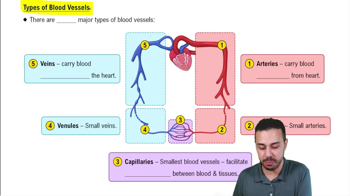
Arteries carry blood away from the heart, usually oxygenated in systemic circuit; Capillaries are tiny vessels for exchange of gases, nutrients, and wastes; Veins carry blood back to the heart, usually deoxygenated.
What are the three tunics of blood vessels?
Tunica intima (innermost layer), tunica media (middle layer), and tunica externa (outermost layer).
What is the composition and function of the tunica intima?
Composed of endothelium (simple squamous epithelium) and a basement membrane; provides a smooth inner lining for blood flow and includes the internal elastic lamina for vessel stretch.
What is the composition and function of the tunica media?
Made of circular layers of smooth muscle and elastic fibers; controls vessel diameter through vasoconstriction and vasodilation, regulating blood flow and resistance.
What is the composition and function of the tunica externa?
Composed of dense irregular connective tissue; supports and anchors the vessel and prevents overstretching; also called the tunica adventitia.
What is the role of the vasa vasorum?
Tiny blood vessels that supply oxygen and nutrients to the outer layers of large blood vessels, especially the tunica media and tunica externa.
How do the tunic layers differ between arteries and veins?
Arteries have thicker tunica media with more smooth muscle and elastic fibers; veins have thinner tunica media, larger lumens, and valves to prevent backflow.
They stretch during ventricular contraction and recoil afterward to maintain continuous blood flow; examples include the aorta and its branches.
What is the function of muscular arteries?
Distribute blood to organs and tissues; have a well-developed tunica media with smooth muscle.
What is the function of arterioles?
Control blood flow into capillary beds by vasoconstriction and vasodilation, regulating resistance.
What are metarterioles?
Small vessels that feed capillary beds; contain precapillary sphincters that open or close to regulate blood flow into true capillaries.
What is atherosclerosis?
Plaque buildup in the tunica intima of arteries, narrowing vessels and potentially causing clots that block blood flow, leading to heart attack or stroke.
What causes varicose veins?
Enlarged, bulging veins caused by blood pooling due to reduced venous return, often from prolonged standing or increased abdominal pressure.
What is hypertension?
Abnormally high blood pressure that increases risk of heart disease, stroke, and kidney disease; can be primary or secondary.
How do baroreceptors regulate blood pressure?
Located in aorta and carotid arteries; detect arterial wall stretch and send signals to the autonomic nervous system to adjust heart rate and vessel diameter.
What is the difference between veins and venules?
Venules are the smallest veins collecting blood from capillaries; veins are larger vessels with valves that return blood to the heart and act as blood reservoirs.
What are the three main factors influencing blood pressure?
The delivery of blood to tissues to supply oxygen and nutrients and remove wastes.
What are the two types of autoregulation in blood flow?
Myogenic mechanism responds to pressure changes by vasoconstriction or dilation; metabolic controls respond to chemical changes from active cells to adjust vessel diameter.
How does water move across capillaries?
Through filtration driven by hydrostatic pressure pushing water out, and osmosis driven by colloid osmotic pressure pulling water in.
What causes edema related to capillary water movement?
Increased capillary hydrostatic pressure or decreased colloid osmotic pressure causes excess fluid accumulation in interstitial spaces.
 Back
 1:09