 Back
Anatomy & Physiology: Blood Vessels, Lymphatic System, and Respiratory System
 3:38

Terms in this set (40)
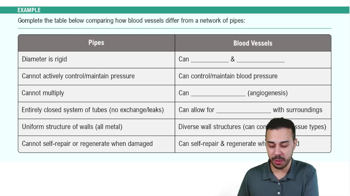
Tunica intima (inner), tunica media (middle, smooth muscle), and tunica externa (outer connective tissue). Arteries have thicker tunica media; veins have valves and thinner walls.
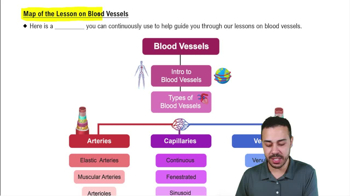
Elastic arteries have more elastic fibers for stretch and recoil; muscular arteries have more smooth muscle for vasoconstriction and vasodilation.
Arterioles regulate blood flow into capillaries via vasoconstriction/dilation; venules collect blood from capillaries and begin return to heart.
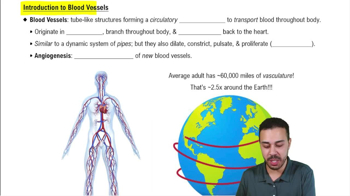
Arteries carry oxygen-rich blood away from the heart; veins carry oxygen-poor blood back. Flow in arteries is pulsatile and under higher pressure; veins have valves to prevent backflow.
Single layer of endothelial cells with a basement membrane; allows exchange of gases, nutrients, and wastes between blood and tissues.
Continuous capillaries: most tissues; fenestrated capillaries: kidneys, intestines; sinusoids: liver, bone marrow, spleen.
Metarterioles act as thoroughfare channels; true capillaries branch from metarterioles and regulate blood flow into capillary beds.
An aneurysm is a weakened, bulging artery wall that can rupture, causing life-threatening bleeding.
Arteriosclerosis is general hardening of arteries; atherosclerosis is plaque buildup narrowing arteries, increasing blood pressure and risk of clots.
Plaque rupture exposes collagen, triggering clot formation (thrombus); if dislodged, it becomes an embolism that can block vessels.
Blood flow = cardiac output; pressure gradient drives flow; peripheral resistance opposes flow. Changes in cardiac output affect pressure gradient.
Blood flow is proportional to pressure gradient and inversely proportional to resistance: \(F=\frac{P}{R}\)
Blood viscosity, vessel length, and vessel radius. Vessel radius can change quickly via vasoconstriction/dilation.
Capillaries have the greatest total cross-sectional area, slowing flow to allow exchange of substances.
Systolic BP is pressure during heart contraction; diastolic BP is pressure during relaxation.
MAP = diastolic pressure + 1/3 (systolic - diastolic). It represents average arterial pressure during a cardiac cycle.
Baroreceptors detect blood pressure changes and send signals to the brain to adjust heart rate and vessel diameter.
ANS controls vasoconstriction and vasodilation via sympathetic and parasympathetic signals affecting smooth muscle in vessel walls.
Kidneys regulate blood volume by controlling water and salt excretion, affecting blood pressure long-term.
Renin initiates the renin-angiotensin-aldosterone system, increasing blood pressure by vasoconstriction and sodium retention.
Return interstitial fluid to blood and provide immune defense by filtering lymph and housing lymphocytes.
Blind-ended vessels with thin walls that absorb interstitial fluid and transport it as lymph.
Lacteals in intestinal villi absorb fats as chyle, transporting them to the bloodstream.
Primary: bone marrow and thymus (lymphocyte production/maturation); secondary: lymph nodes, spleen (immune response sites).
Physical barriers, phagocytes, immunological surveillance, interferons, complement system, inflammation, fever.
Innate immunity is non-specific and immediate; acquired immunity is specific and develops after exposure.
Cell-mediated involves T cells attacking infected cells; antibody-mediated involves B cells producing antibodies against antigens.
MHC molecules present antigens to T cells; Class I on all nucleated cells, Class II on antigen-presenting cells.
Primary response is slower and weaker; secondary response is faster and stronger due to memory cells.
Hypersensitivity is an exaggerated immune response causing tissue damage; anaphylaxis is a severe, life-threatening form.
Autoimmune disease targets self-antigens; hypersensitivity is an excessive response to non-self antigens.
Aerobic respiration produces ATP efficiently using oxygen, essential for cell survival and function.
Pulmonary ventilation, external respiration, gas transport, internal respiration; each occurs at different sites for gas exchange.
Double-layered membrane surrounding lungs; reduces friction and creates pressure gradient for lung expansion.
Pressure and volume are inversely related; lung volume changes cause pressure gradients driving air flow.
Diaphragm and external intercostals increase thoracic volume to draw air in.
Mostly bound to hemoglobin in red blood cells; a small amount dissolved in plasma.
As bicarbonate ions, bound to hemoglobin, and dissolved in plasma; enzyme carbonic anhydrase facilitates conversion.
Respiratory rhythmicity center (medulla), apneustic and pneumotaxic centers (pons) regulate breathing patterns.
Increased pCO2 or decreased pH stimulate chemoreceptors to increase respiratory rate to expel CO2.