 Back
BackAnatomy & Physiology: Body Cavities, Directional Terms, and Body Regions
 03:00
03:00
Terms in this set (24)
The dorsal body cavity is located along the back of the body and contains the cranial cavity (housing the brain) and the vertebral cavity (housing the spinal cord).
The ventral body cavity is located at the front of the body and includes the thoracic cavity and the abdominopelvic cavity.
The thoracic cavity is the upper part of the ventral cavity, containing the lungs and heart, protected by the rib cage.
The abdominopelvic cavity is the lower part of the ventral cavity, subdivided into the abdominal cavity (digestive organs) and pelvic cavity (reproductive and urinary organs).
Anterior means toward the front of the body.
Posterior means toward the back of the body.
Superior means above or higher in position.
Inferior means below or lower in position.
Medial means toward the midline of the body.
Lateral means away from the midline of the body.
Proximal means closer to the point of attachment or origin.
Distal means farther from the point of attachment or origin.
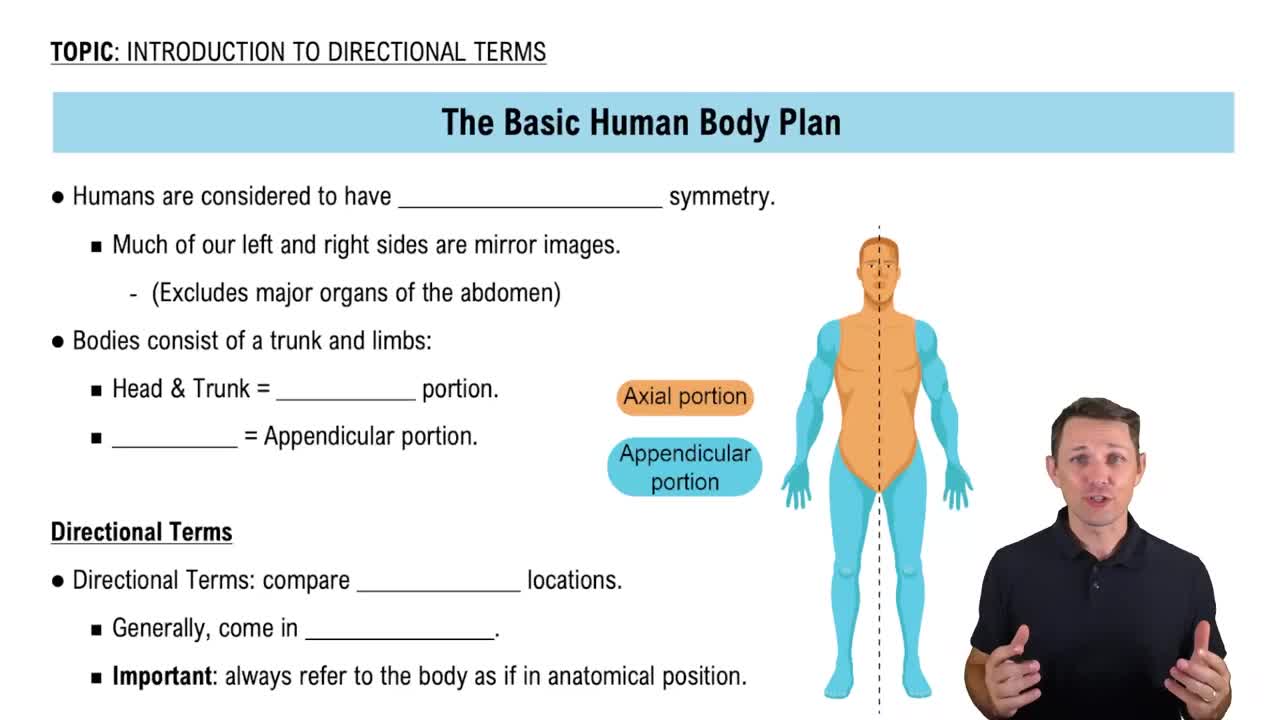
The anatomical position is standing upright, facing forward, arms at sides with palms facing forward.
The brachial region refers to the upper arm between the shoulder and elbow.
The antebrachial region is the forearm, between the elbow and wrist.
Cephalic refers to the head region.
The abdominal region is the area between the chest and pelvis.
The lumbar region is the lower back area between the ribs and pelvis.
Inguinal refers to the groin area where the thigh meets the pelvis.
Plantar refers to the sole or bottom of the foot.
The popliteal region is the area behind the knee.
Palmar refers to the palm of the hand.
Orbital refers to the eye socket region.
Superficial means toward or on the surface; deep means away from the surface, more internal.