Skip to main content
Anatomy & Physiology
My Course
Learn
Exam Prep
AI Tutor
Study Guides
Textbook Solutions
Flashcards
Explore
Try the app
My Course
Learn
Exam Prep
AI Tutor
Study Guides
Textbook Solutions
Flashcards
Explore
Try the app
Back
Anatomy & Physiology: Body Regions, Directions, Tissues, and Membranes
You can tap to flip the card.
What is the anatomical position?
You can tap to flip the card.
👆
What is the anatomical position?
Body is upright, facing forward, palms outward, legs spread apart, toes facing forward.
Track progress
Control buttons has been changed to "navigation" mode.
1/21
Recommended videos
03:21
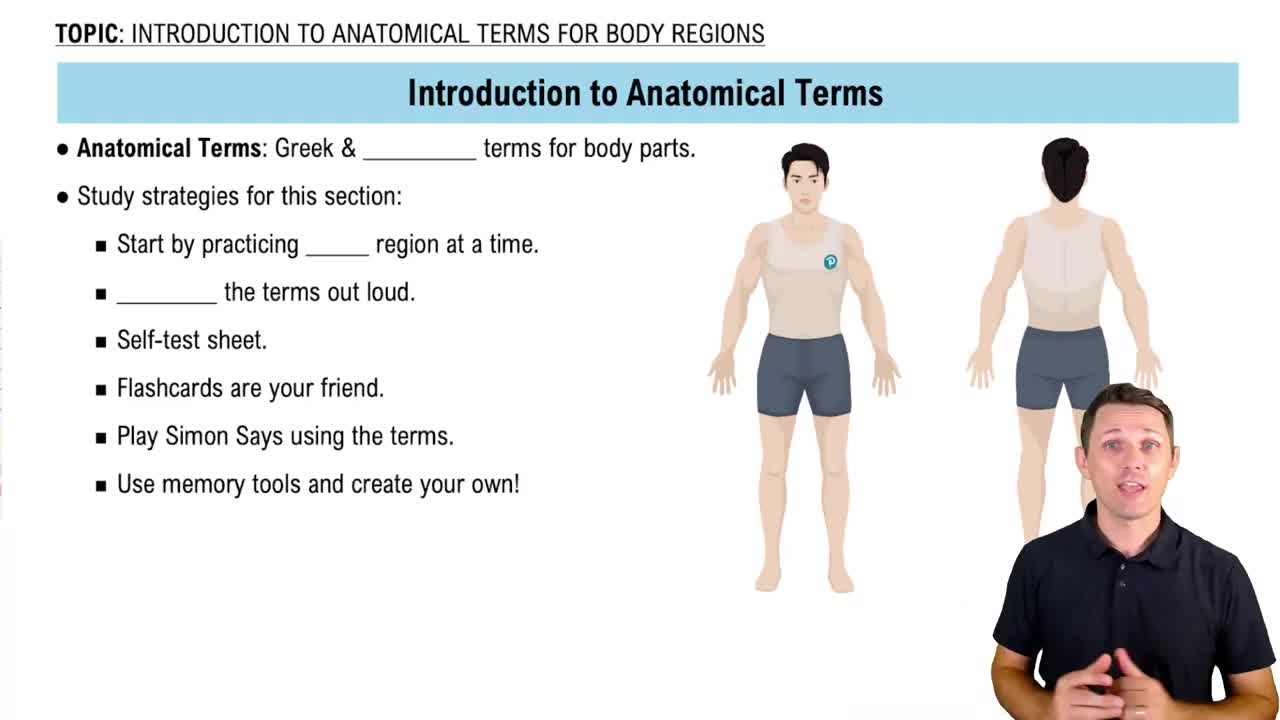
Introduction to Anatomical Terms
14832
views
544
rank
1
comments
Terms in this set (21)
Hide definitions
What is the anatomical position?
Body is upright, facing forward, palms outward, legs spread apart, toes facing forward.
Define the term 'Superior' in body orientation.
Closer to the head or above another structure.
What does 'Inferior' mean in anatomical terms?
Closer to the feet or below another structure.
What is the difference between 'Medial' and 'Lateral'?
Medial
means closer to the midline;
Lateral
means farther from the midline.
What are the four main body planes?
Sagittal (left/right), Midsagittal (equal left/right halves), Frontal/Coronal (front/back), Transverse (top/bottom).
Name the major body cavities.
Dorsal cavity (cranial and vertebral), Ventral cavity (thoracic and abdominopelvic).
What organs are found in the right upper quadrant of the abdomen?
Liver, gall bladder, parts of large and small intestine, pancreas, stomach, right kidney.
What is the function of simple squamous epithelium?
Diffusion and filtration; secretes lubricating substances in serosae.
Where is simple cuboidal epithelium found and what is its function?
Located in kidney tubules and small gland ducts; functions in secretion and absorption.
Describe the function and location of stratified squamous epithelium.
Protects underlying tissues in areas subject to abrasion; found in skin epidermis and moist linings like mouth and esophagus.
What is the role of transitional epithelium?
Allows stretching and recoil; lines urinary organs like bladder and ureters.
Name the three types of connective tissue proper: loose.
Areolar (wraps and cushions organs), Adipose (insulation), Reticular (supports organ framework).
What is the function of dense regular connective tissue?
Attaches muscles to bones and bones to bones; withstands tensile stress in one direction.
Where is hyaline cartilage found and what is its function?
Ends of bones, ribs, nose, trachea; supports and cushions, resists compressive stress.
Identify the main function of skeletal muscle tissue.
Voluntary movement of the body; characterized by striations and multinucleated cells.
What distinguishes cardiac muscle tissue?
Involuntary contraction of the heart; striated with single nucleus and intercalated discs.
Describe the function of smooth muscle tissue.
Involuntary movement such as peristalsis and blood pressure control; spindle-shaped cells without striations.
What are mucous membranes and where are they found?
Membranes coated with mucus secretions; line digestive, respiratory, urinary, and reproductive tracts.
What is the function of serous membranes?
Line ventral body cavities and secrete lubricating fluid to reduce friction between organs.
What is the cutaneous membrane?
The skin; composed of keratinized stratified squamous epithelium and underlying connective tissue.
What is the role of synovial membranes?
Line joint cavities and produce synovial fluid for lubrication.
 BackBack
 03:21
