Skip to main content
Anatomy & Physiology
My Course
Learn
Exam Prep
AI Tutor
Study Guides
Textbook Solutions
Flashcards
Explore
Try the app
My Course
Learn
Exam Prep
AI Tutor
Study Guides
Textbook Solutions
Flashcards
Explore
Try the app
Back
Anatomy & Physiology: Bones and Bone Structure
You can tap to flip the card.
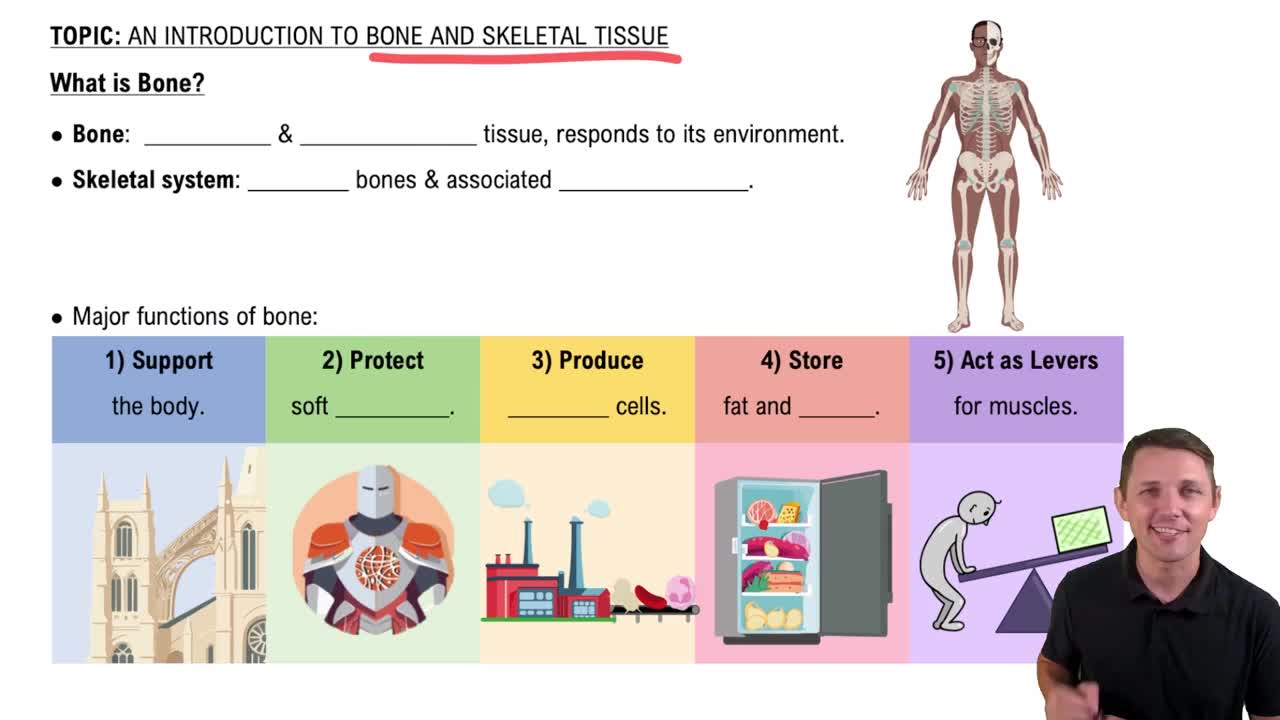
Major functions of the skeletal system
You can tap to flip the card.
👆
Major functions of the skeletal system
Structural support
,
storage of minerals and lipids
,
blood cell production
,
protection of soft tissues and organs
, and
leverage for movement
.
Track progress
Control buttons has been changed to "navigation" mode.
1/23
Recommended videos
Guided course
3:56
What is Bone?
29699
views
936
rank
3
comments
Guided course
3:00
An Introduction to Bone and Skeletal Tissue Example 2
16627
views
357
rank
1
comments
Guided course
4:14
Types of Bones
19748
views
503
rank
1
comments
Terms in this set (23)
Hide definitions
Major functions of the skeletal system
Structural support
,
storage of minerals and lipids
,
blood cell production
,
protection of soft tissues and organs
, and
leverage for movement
.
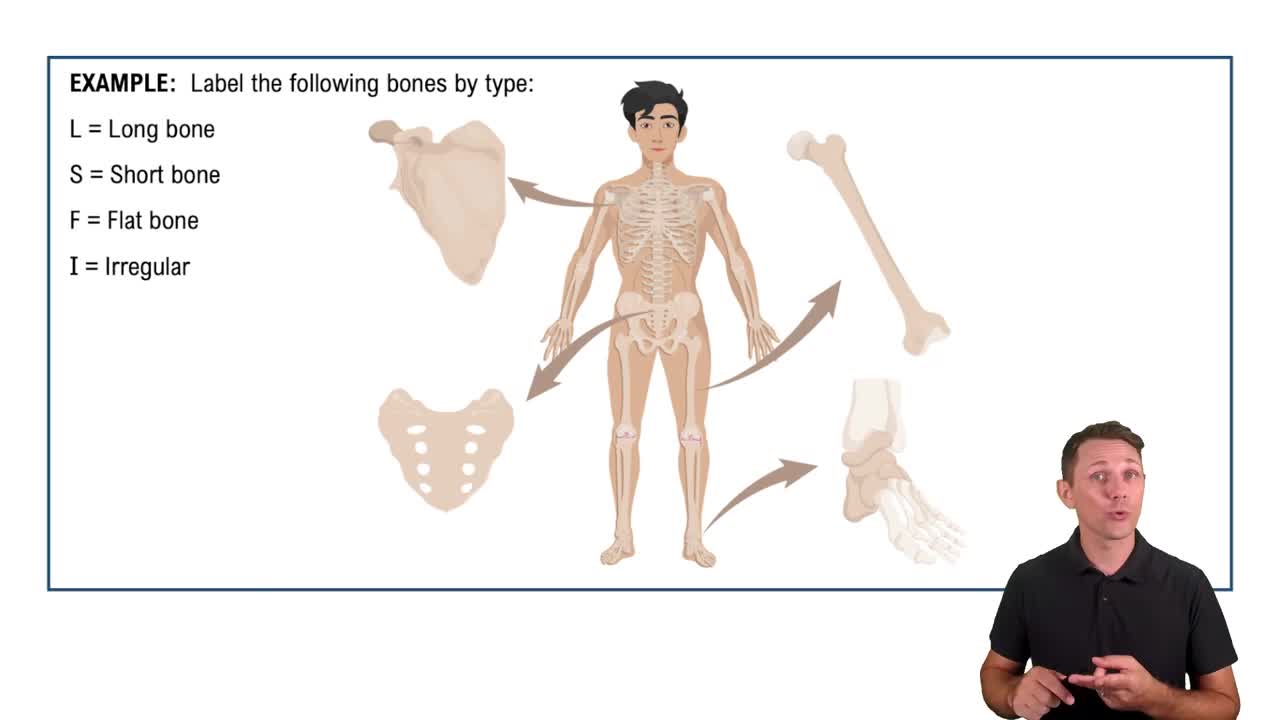
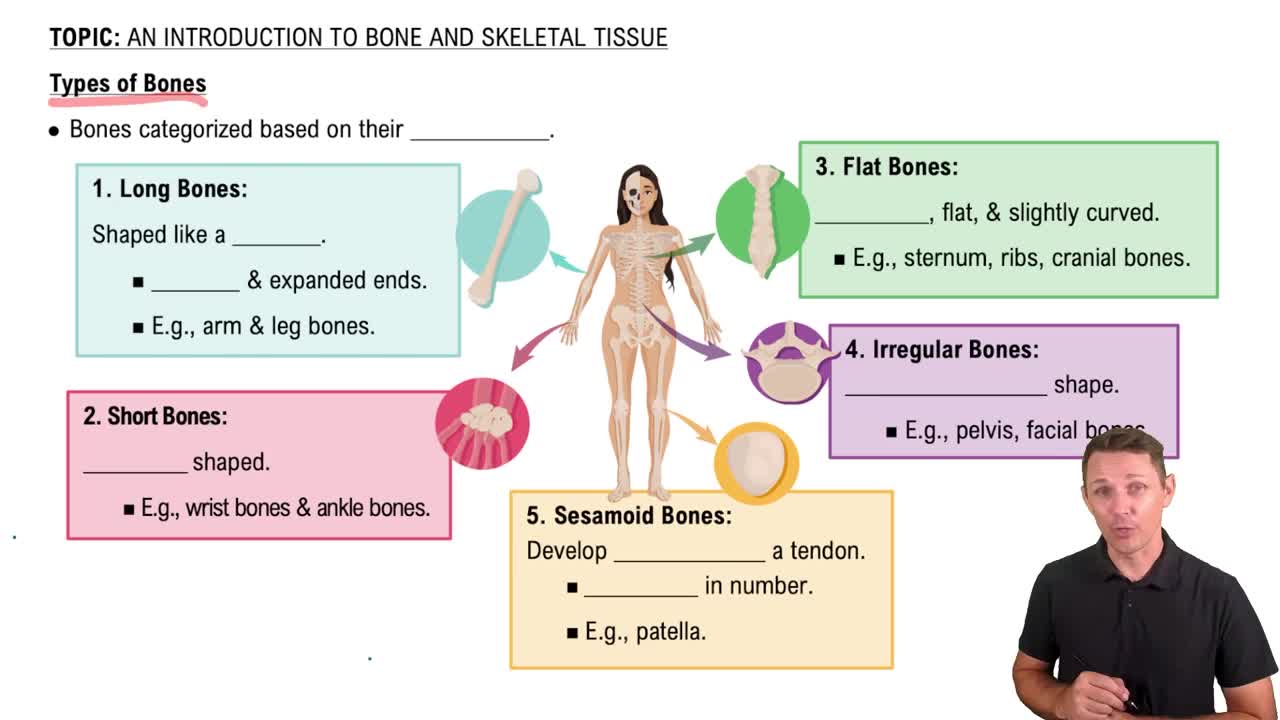
Classification of bones by shape
Sutural, irregular, short, flat, long, and sesamoid bones, each with distinct shapes and locations.
Structure of a long bone
Consists of a
diaphysis
(shaft of compact bone),
epiphyses
(ends of spongy bone), and
metaphysis
(zone connecting diaphysis and epiphysis).
Structure of a flat bone
A core of spongy bone (diploë) between two layers of compact bone (cortex).
Bone tissue characteristics
Dense matrix of protein fibers and calcium salts, with osteocytes in lacunae connected by canaliculi.
Bone matrix composition
Two-thirds calcium phosphate (hydroxyapatite crystals) and one-third collagen fibers providing strength and flexibility.
Osteogenic cells
Stem cells in periosteum and endosteum that divide and differentiate into osteoblasts, important for fracture repair.
Osteoblasts
Immature bone cells that produce osteoid (organic matrix) and promote calcium salt deposition.
Osteocytes
Mature bone cells in lacunae that maintain bone matrix and help repair damaged bone.
Osteoclasts
Large multinucleate cells that resorb bone matrix by secreting acids and enzymes (osteolysis).
Osteon
Basic functional unit of compact bone, consisting of a central canal surrounded by concentric lamellae and osteocytes in lacunae.
Types of lamellae in compact bone
Concentric (form osteons), interstitial (fill spaces between osteons), and circumferential (outer and inner bone surfaces).
Spongy bone structure
No osteons; matrix arranged as trabeculae with spaces filled by red or yellow bone marrow.
Periosteum
Membrane covering bone surface with outer fibrous and inner cellular layers; isolates bone and aids growth and repair.
Endosteum
Incomplete cellular layer lining inner bone surfaces, containing osteogenic cells, osteoblasts, and osteoclasts.
Endochondral ossification
Process where bone replaces cartilage, forming most bones of the body.
Intramembranous ossification
Bone formation within dermis producing flat bones like skull, mandible, and clavicles.
Bone growth types
Interstitial growth
increases length at epiphyseal plates;
appositional growth
increases width by adding circumferential lamellae.
Bone remodeling
Continuous recycling of bone matrix involving osteocytes, osteoblasts, and osteoclasts to maintain bone strength and mineral balance.
Hormones regulating calcium homeostasis
Parathyroid hormone increases blood calcium by stimulating osteoclasts; calcitonin decreases blood calcium by inhibiting osteoclasts.
Effects of exercise on bone
Physical activity stimulates bone remodeling, making bones thicker and stronger; inactivity leads to bone mass loss.
Osteopenia and osteoporosis
Osteopenia is reduced bone mass starting around age 30; osteoporosis is severe bone loss causing fragile bones.
Types of fractures
Open (compound), closed (simple), transverse, displaced, compression, spiral, epiphyseal, comminuted, greenstick, Colles, and Pott's fractures.
 BackBack
 3:56