 Back
Anatomy & Physiology: Bones and Bone Structures
 3:56

Terms in this set (20)
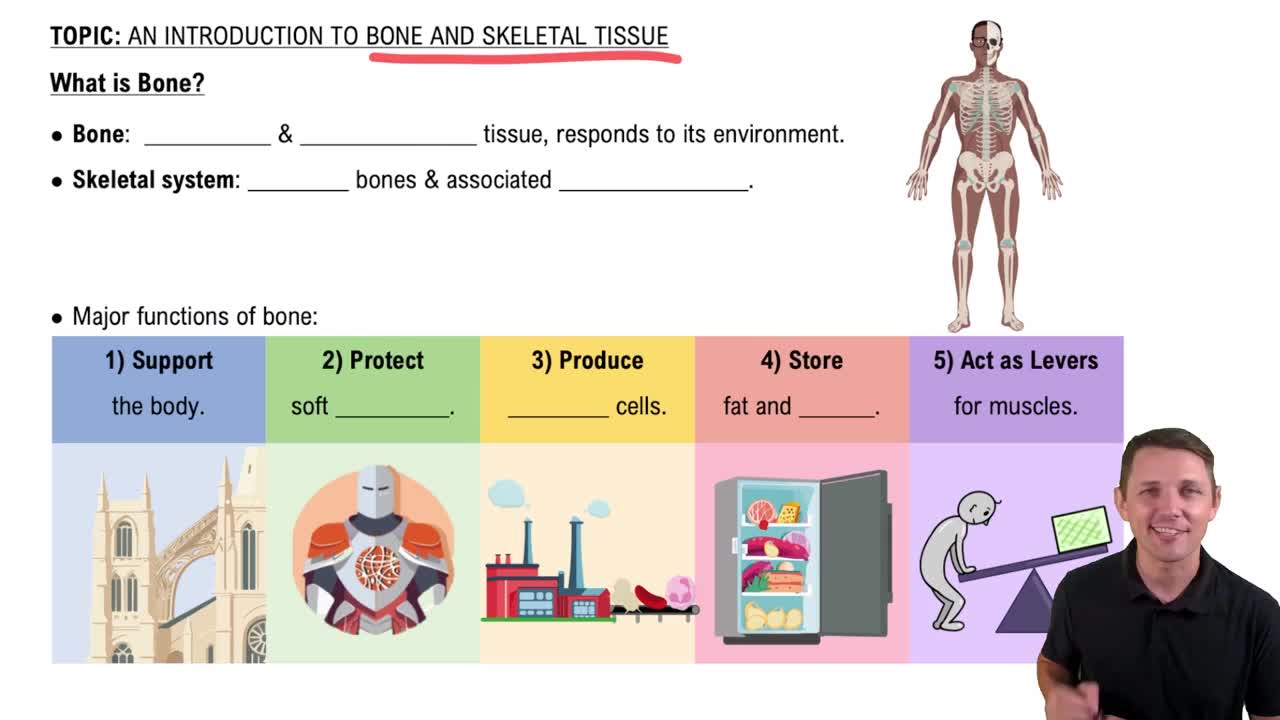
Bones provide structural support, protect organs, enable movement, store minerals, and produce blood cells.
Compact bone (dense and strong) and spongy bone (light and porous).
The shaft or central part of a long bone, composed mainly of compact bone.
The end part of a long bone, usually wider than the diaphysis and composed mostly of spongy bone.
The region between the diaphysis and epiphysis where growth occurs in children.
A dense layer of vascular connective tissue covering the outer surface of bones except at joints.
The central cavity within the diaphysis that contains bone marrow.
Red marrow produces blood cells; yellow marrow stores fat.
The basic structural unit of compact bone, consisting of concentric lamellae around a central canal.
The skull, vertebral column, and rib cage.
The limbs and girdles (pectoral and pelvic girdles).
Includes the frontal, parietal, temporal, occipital, sphenoid, and ethmoid bones.
Supports the body, protects the spinal cord, and provides attachment points for ribs and muscles.
33 vertebrae: 7 cervical, 12 thoracic, 5 lumbar, 5 sacral (fused), and 4 coccygeal (fused).
True ribs attach directly to the sternum; false ribs attach indirectly or not at all.
Humerus, radius, ulna, carpals, metacarpals, and phalanges.
Femur, patella, tibia, fibula, tarsals, metatarsals, and phalanges.
Supports the weight of the upper body and protects pelvic organs.
Compact bone is dense with osteons; spongy bone has a porous, trabecular network.
Osteocytes maintain bone tissue and communicate with other bone cells.