Back

Anatomy & Physiology: Bones and Bone Tissue

Control buttons has been changed to "navigation" mode.
1/27
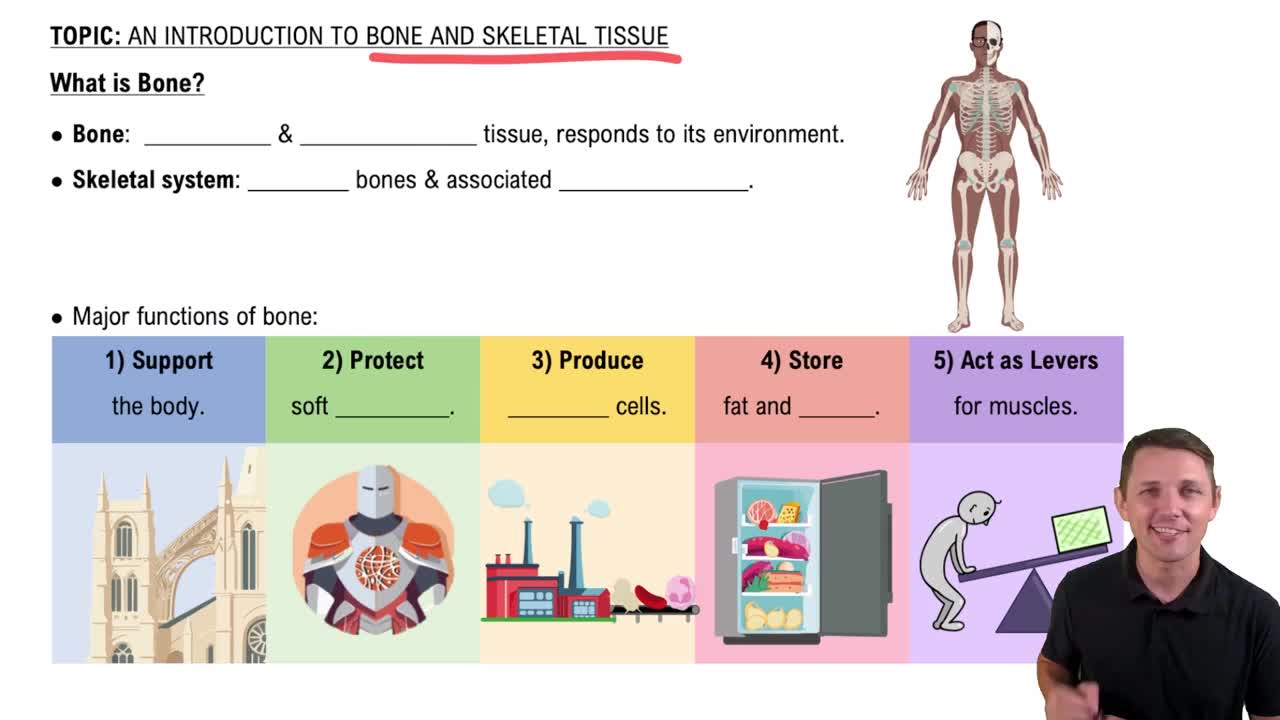
  • Main organs of the skeletal system

    The main organs are bones, which include osseous tissue, dense regular and irregular collagenous connective tissue, and bone marrow.
  • Functions of the skeletal system

    • Protection of organs
    • Mineral storage and acid-base homeostasis
    • Blood cell formation (hematopoiesis)
    • Fat storage
    • Movement
    • Support
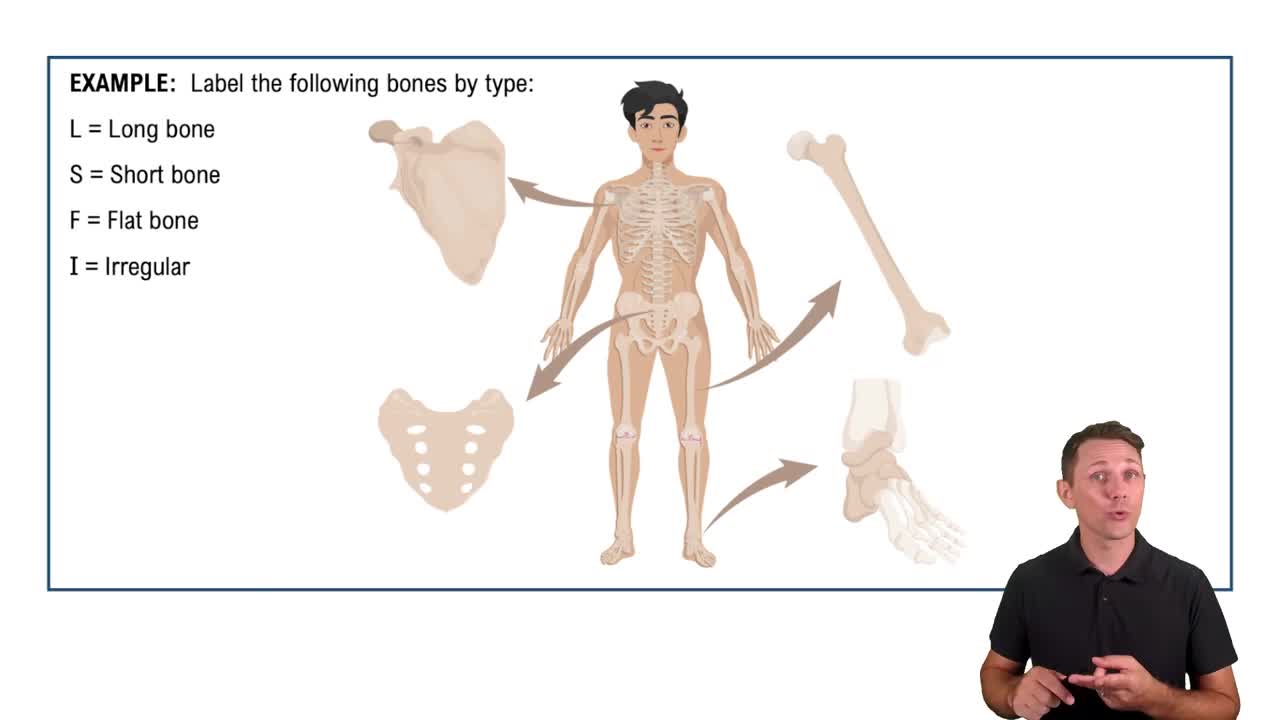
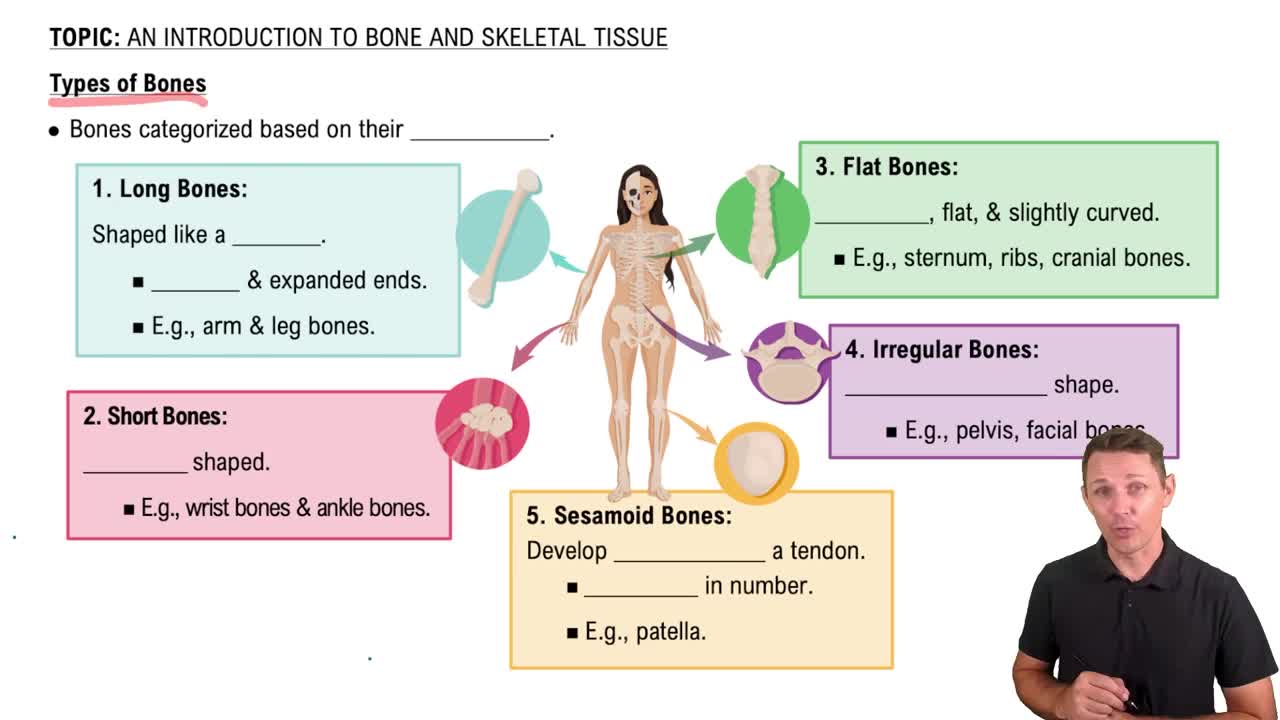
  • Classification of bones by shape

    • Long bones: longer than wide (e.g., femur)
    • Short bones: cube-shaped (e.g., carpals)
    • Flat bones: thin and broad (e.g., ribs)
    • Irregular bones: complex shapes (e.g., vertebrae)
    • Sesamoid bones: within tendons (e.g., patella)
  • Structure of a long bone

    Includes periosteum, perforating fibers, diaphysis (shaft), epiphyses (ends), articular cartilage, marrow cavity, compact bone, spongy bone, endosteum, and epiphyseal lines.
  • Difference between compact and spongy bone

    Compact bone is dense and resists compression and twisting; spongy bone is porous with trabeculae that resist forces from multiple directions and house bone marrow.
  • Components of bone extracellular matrix

    Bone matrix is 65% inorganic minerals (mainly hydroxyapatite) and 35% organic matrix (osteoid) including collagen fibers and proteins.
  • Role of hydroxyapatite crystals in bone

    Hydroxyapatite crystals \(\mathrm{Ca}_{10}(\mathrm{PO}_4)_6(\mathrm{OH})_2\) provide hardness and resistance to compression.
  • Function of collagen fibers in bone

    Collagen fibers form cross-links that help bone resist torsion and tensile forces and align with hydroxyapatite to enhance hardness.
  • Functions of osteoblasts

    Osteoblasts build bone by secreting organic matrix and assisting in inorganic matrix formation during bone deposition.
  • Functions of osteocytes

    Osteocytes maintain bone matrix and reside in lacunae; they are metabolically less active but regulate local bone maintenance.
  • Functions of osteoclasts

    Osteoclasts break down bone by resorbing bone matrix, secreting acids and enzymes to dissolve inorganic and organic components.
  • Structure of an osteon

    An osteon consists of concentric lamellae, a central canal with blood vessels and nerves, lacunae with osteocytes, and canaliculi connecting lacunae.
  • Role of canaliculi in bone

    Canaliculi are small channels that allow osteocytes to communicate and share nutrients through cytoplasmic extensions.
  • Difference between compact and spongy bone histology

    Compact bone is organized into osteons; spongy bone has trabeculae with lamellae and lacunae but no osteons, receiving blood from marrow vessels.
  • Intramembranous ossification

    Bone forms directly from mesenchymal membrane, producing flat bones like skull and clavicles via primary ossification centers.
  • Endochondral ossification

    Bone forms from a hyaline cartilage model, replacing cartilage with bone; forms most bones below the head except clavicles.
  • Zones of the epiphyseal plate involved in longitudinal growth

    • Zone of proliferation: chondrocytes divide
    • Zone of hypertrophy: chondrocytes enlarge
    • Zone of calcification: cartilage matrix calcifies
    • Zone of ossification: bone replaces calcified cartilage
  • Process of appositional growth

    Osteoblasts in the periosteum add new bone layers on the surface, increasing bone width by forming new circumferential lamellae.
  • Effects of growth hormone on bone growth

    Growth hormone increases chondrocyte division in epiphyseal plate, stimulates osteogenic cells, and promotes appositional growth by osteoblasts.
  • Effects of testosterone on bone growth

    Testosterone increases appositional growth, accelerates mitosis in epiphyseal plate causing growth spurts, and speeds epiphyseal plate closure.
  • Effects of estrogen on bone growth

    Estrogen increases longitudinal growth, inhibits osteoclasts, causes growth spurts, and accelerates epiphyseal plate closure faster than testosterone.
  • Bone remodeling process

    Continuous cycle of bone deposition by osteoblasts and resorption by osteoclasts to maintain calcium homeostasis and adapt to stress.
  • Response of bone to mechanical stress

    Bone deposition increases with compression and tension; bone resorption occurs with continuous pressure.
  • Role of parathyroid hormone (PTH) in calcium homeostasis

    PTH increases blood calcium by stimulating osteoclasts to resorb bone, enhancing gut absorption, and reducing urinary calcium loss.
  • Role of calcitonin in calcium homeostasis

    Calcitonin lowers blood calcium by promoting bone deposition, pulling calcium into bone matrix; active mainly during growth.
  • Stages of fracture healing

    • Hematoma formation
    • Soft callus formation by fibroblasts and chondroblasts
    • Bone callus formation by osteoblasts
    • Bone remodeling replacing primary bone with secondary bone
  • Difference between simple and compound fractures

    Simple fractures do not break the skin; compound fractures involve skin and tissue damage around the fracture.