Back

Anatomy & Physiology: Bones and Skeletal Tissues

Control buttons has been changed to "navigation" mode.
1/29
  • What are the three types of skeletal cartilage?

    Hyaline cartilage (most abundant, provides support and flexibility), Elastic cartilage (contains elastic fibers, found in external ear and epiglottis), and Fibrocartilage (thick collagen fibers, great tensile strength, found in menisci and vertebral discs).
  • What is the perichondrium and its function?

    A layer of dense connective tissue surrounding cartilage that helps resist outward expansion and contains blood vessels for nutrient delivery.
  • How does cartilage grow?

    By appositional growth (new matrix laid on surface by cells in perichondrium) and interstitial growth (chondrocytes divide and secrete matrix from within).
  • List the seven important functions of bones.

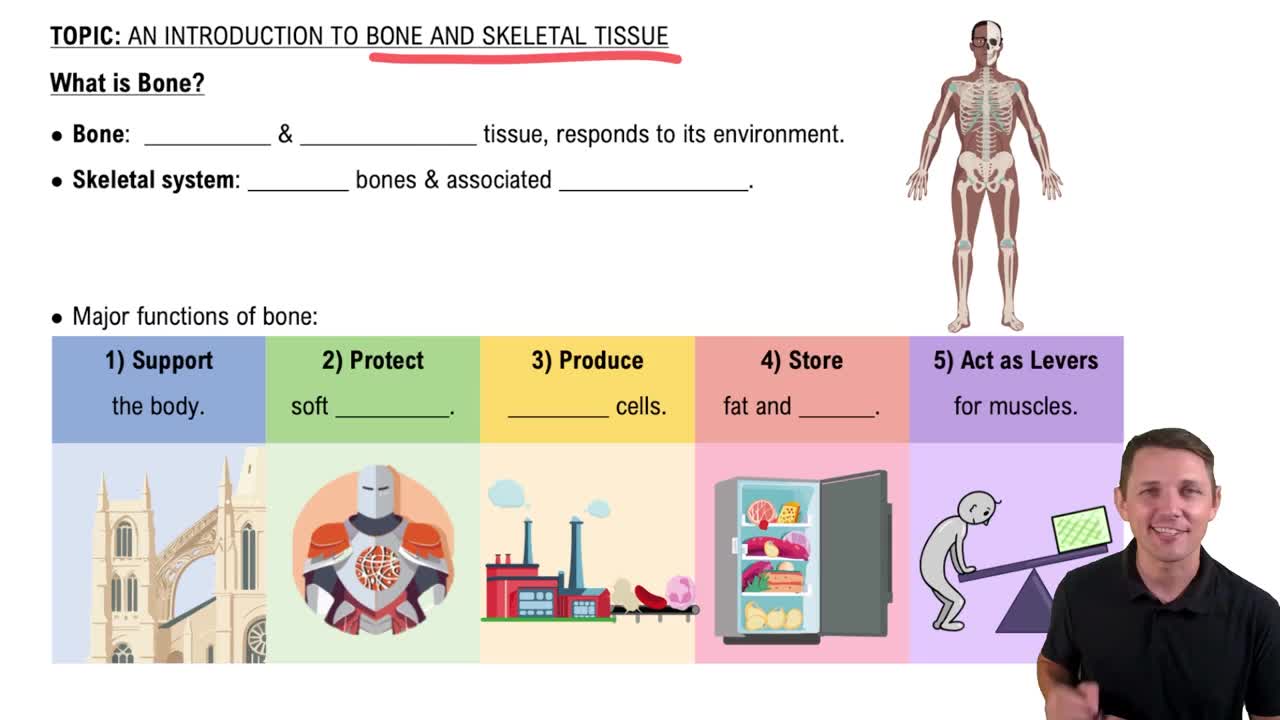
    Support, protection, movement, mineral and growth factor storage, blood cell formation (hematopoiesis), triglyceride (fat) storage, and hormone production (osteocalcin).
  • What are the two main divisions of the human skeleton?

    Axial skeleton (skull, vertebral column, rib cage) and appendicular skeleton (limbs and girdles attaching limbs to axial skeleton).
  • How are bones classified by shape?

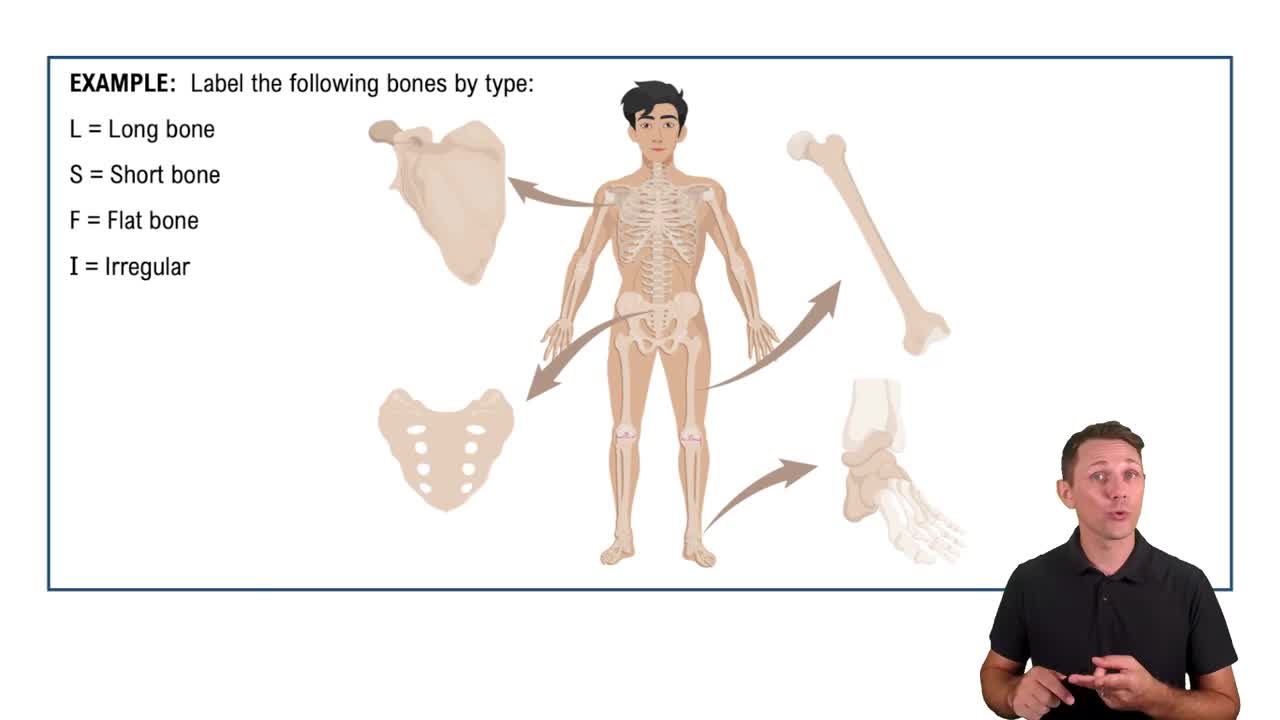
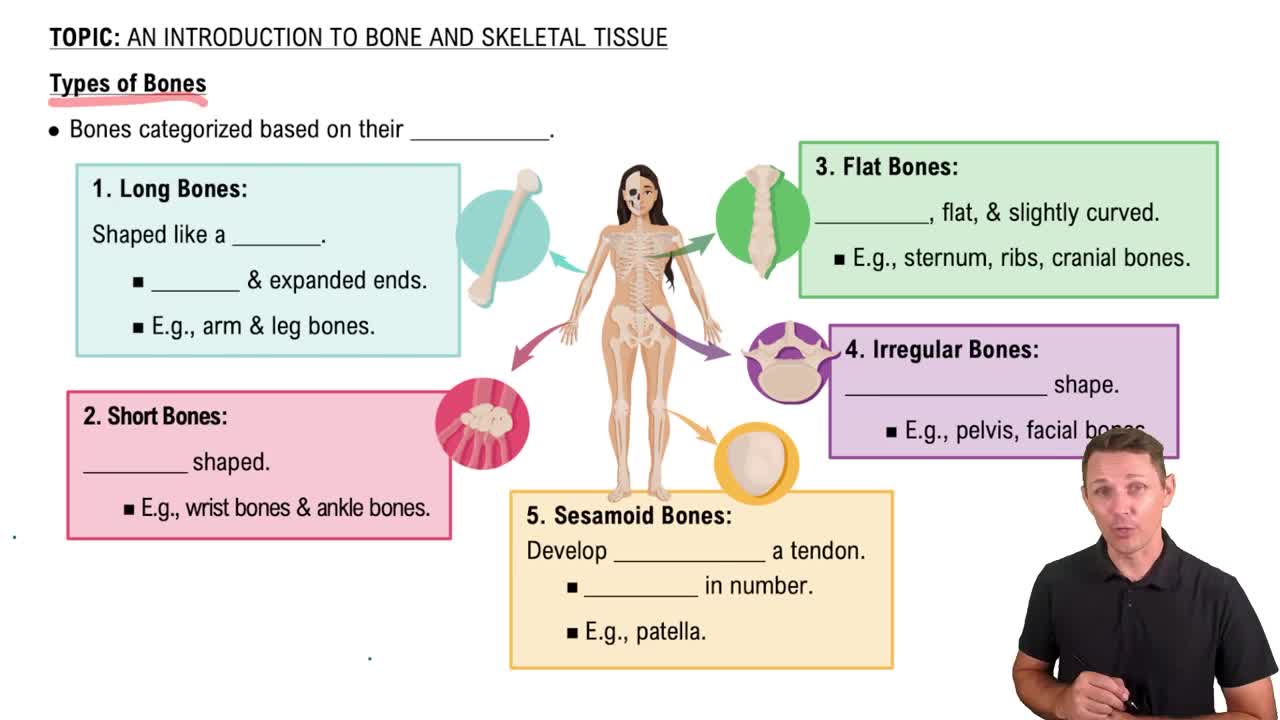
    Long bones (longer than wide), short bones (cube-shaped, including sesamoid bones), flat bones (thin, flat, slightly curved), and irregular bones (complicated shapes).
  • What are the two types of bone tissue and their characteristics?

    Compact bone: dense, smooth outer layer; Spongy bone: honeycomb of trabeculae with spaces filled by marrow.
  • Describe the structure of a typical long bone.

    Has a diaphysis (shaft of compact bone with medullary cavity), epiphyses (ends with compact bone outside and spongy bone inside), articular cartilage on joint surfaces, and an epiphyseal line.
  • What are the periosteum and endosteum?

    Periosteum: double-layered membrane covering external bone surfaces except joints, containing osteogenic cells. Endosteum: delicate membrane covering internal bone surfaces and trabeculae, also containing osteogenic cells.
  • Where is red marrow found and what is its function?

    In trabecular cavities of spongy bone and diploƫ of flat bones; site of hematopoiesis (blood cell formation).
  • Name the five major types of bone cells.

    Osteogenic cells, osteoblasts, osteocytes, bone-lining cells, and osteoclasts.
  • What is the role of osteoblasts?

    Bone-forming cells that secrete unmineralized bone matrix called osteoid; actively mitotic.
  • What do osteocytes do?

    Mature bone cells that maintain bone matrix and act as stress sensors, communicating with osteoblasts and osteoclasts.
  • Describe osteoclasts and their function.

    Large multinucleate cells derived from hematopoietic stem cells that resorb bone by secreting enzymes and acids.
  • What is an osteon (Haversian system)?

    The structural unit of compact bone, consisting of concentric lamellae around a central canal containing blood vessels and nerves.
  • What are canaliculi and their function?

    Hairlike canals connecting lacunae and central canal, allowing osteocytes to communicate and exchange nutrients and wastes.
  • What is the chemical composition of bone?

    Organic components (cells and osteoid with collagen for strength and flexibility) and inorganic components (hydroxyapatites, calcium phosphate crystals for hardness).
  • What are the two types of ossification in bone development?

    Endochondral ossification: bone replaces hyaline cartilage; Intramembranous ossification: bone develops from fibrous membrane.
  • Where does endochondral ossification occur?

    Forms most bones inferior to the base of the skull except clavicles, starting with a cartilage model.
  • What are the five main steps of endochondral ossification?

    Bone collar formation, cartilage calcification and cavity formation, periosteal bud invasion, diaphysis elongation and medullary cavity formation, secondary ossification in epiphyses.
  • How do long bones grow in length?

    By interstitial growth at the epiphyseal plate, involving zones of resting, proliferation, hypertrophy, calcification, and ossification.
  • How do bones grow in width?

    By appositional growth where osteoblasts add bone matrix on the external surface and osteoclasts remove bone on the internal surface.
  • What hormones regulate bone growth?

    Growth hormone (stimulates epiphyseal plate), thyroid hormone (modulates growth hormone), and sex hormones (testosterone and estrogens promote growth spurts and plate closure).
  • What is bone remodeling?

    Continuous process of bone deposit by osteoblasts and bone resorption by osteoclasts to maintain bone strength and mineral homeostasis.
  • How does parathyroid hormone (PTH) regulate blood calcium?

    PTH stimulates osteoclasts to resorb bone, releasing calcium into blood when levels are low; secretion stops when calcium is normal.
  • What is Wolff's law?

    Bones grow or remodel in response to mechanical stress, becoming thicker and stronger where stressed.
  • What are the stages of bone fracture repair?

    Hematoma formation, fibrocartilaginous callus formation, bony callus formation, and bone remodeling.
  • What is osteoporosis?

    A disease where bone resorption exceeds deposit, leading to decreased bone mass and increased fracture risk.
  • What causes rickets and osteomalacia?

    Vitamin D deficiency or insufficient calcium leading to poorly mineralized, soft bones; rickets occurs in children, osteomalacia in adults.