 Back
Anatomy & Physiology: Bones, Joints, and Muscles
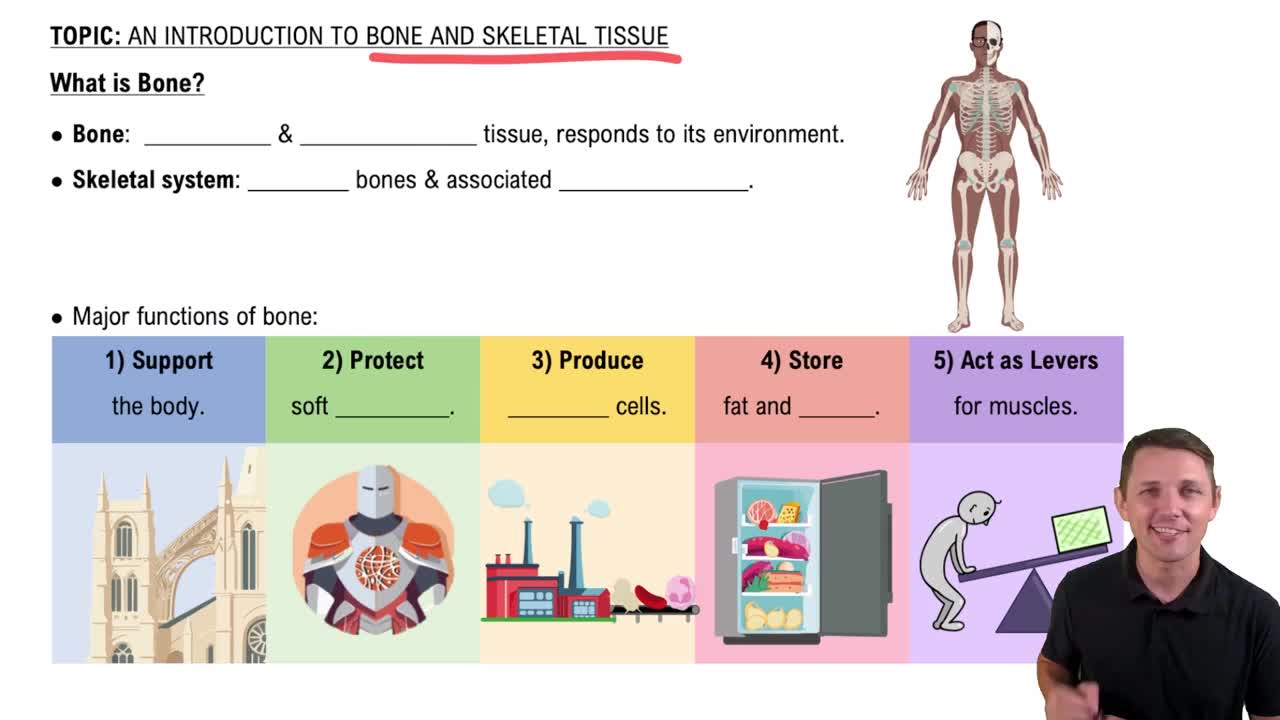
 3:56

Terms in this set (63)
Collarbone; part of the pectoral girdle.
Shoulder blade; part of the pectoral girdle.
Bone of the upper arm.
Forearm bone on the thumb side.
Forearm bone on the pinky side.
Thigh bone.
Thin bone on the outer side of the lower leg.
Ankle bone that articulates with the tibia and fibula.
Heel bone.
Anatomical name for the thumb.
Anatomical name for the big toe.
Depression or hollow in a bone.
Hole or opening in a bone.
Rounded joint surface of a bone.
Large bony projection found on the femur.
Cell that builds new bone.
Cell that breaks down bone.
Mature bone cell that maintains bone tissue.
Where blood cells are produced.
Membrane covering the outer surface of bone, except at joint surfaces.
Dense bone organized into osteons.
Lighter, porous bone made of trabeculae.
Cylindrical structural unit of compact bone.
Thin struts or plates making up spongy bone.
Skull, vertebral column, and thoracic cage.
Upper and lower limbs plus shoulder and pelvic girdles.
Bone that forms the forehead.
Bone at the side of the skull; contains the mastoid process.
Cheekbone.
Lower jaw; contains the mental foramen and mental protuberance.
Depression in the sphenoid bone that houses the pituitary gland.
7 neck vertebrae; have transverse foramina.
12 vertebrae that articulate with ribs.
5 lower-back vertebrae with large bodies.
Ribs 1–7; attach directly to sternum by their own cartilage.
Ribs 8–12; do not attach directly to sternum.
Ribs 11–12; have no anterior attachment to sternum.
Excessive outward rounding of thoracic spine.
Excessive inward curve of lumbar spine.
Sideways curvature of the spine.
Generally, more mobility means less stability.
Fibrous joint holding a tooth in its socket.
Moving a body part forward.
Pointing the foot downward.
Straightening a joint; increasing the joint angle.
Turning the forearm so the palm faces forward/up.
Moving the thumb to touch the fingertips.
Ongoing breakdown and rebuilding of bone.
Bone density below normal, but not low enough to be osteoporosis.
Osteoblasts form bone; osteoclasts resorb it. The balance affects bone mass.
Voluntary, striated muscle attached to the skeleton.
Striated involuntary heart muscle with intercalated discs.
Nonstriated involuntary muscle in organ walls.
Specialized connections between cardiac muscle cells.
Thin muscle filament.
Thick muscle filament.
Contractile unit of a muscle fiber, between Z discs.
Boundary of a sarcomere.
Region with thin filaments only.
Region with thick filaments only.
Thin filaments slide past thick ones; sarcomeres shorten.
Loss or shrinking of muscle, such as from disuse.
Pale half-moon near the base of a fingernail.