Skip to main content
Anatomy & Physiology
My Course
Learn
Exam Prep
AI Tutor
Study Guides
Textbook Solutions
Flashcards
Explore
Try the app
My Course
Learn
Exam Prep
AI Tutor
Study Guides
Textbook Solutions
Flashcards
Explore
Try the app
Back
Anatomy & Physiology: Cell Junctions, Membrane Transport, and Membrane Potential
You can tap to flip the card.
What are the three main types of cell junctions?
You can tap to flip the card.
👆
What are the three main types of cell junctions?
Tight junctions
,
desmosomes
, and
gap junctions
.
Track progress
Control buttons has been changed to "navigation" mode.
1/29
Recommended videos
Guided course
05:33
Cell Junctions
24065
views
304
rank
Terms in this set (29)
Hide definitions
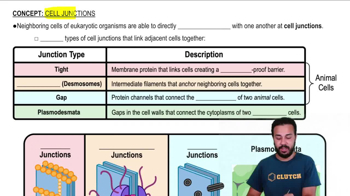
What are the three main types of cell junctions?
Tight junctions
,
desmosomes
, and
gap junctions
.
What is the primary function of tight junctions?
Tight junctions create
leakproof seals
between cells, preventing fluids and molecules from passing between them.
Where are tight junctions especially useful in the body?
In organs that must be leakproof, such as the
urinary bladder
.
How do desmosomes function in cell adhesion?
Desmosomes act like
Velcro
, attaching cells tightly but allowing flexibility under stress.
What proteins form the linker in desmosomes?
Linker proteins called
cadherins
interlock like zipper teeth between neighboring cells.
What is the role of keratin filaments in desmosomes?
Keratin filaments connect plaques inside cells, providing
anchoring strength
.
What is the main function of gap junctions?
Gap junctions allow
direct communication
between cells by passing ions, hormones, and nutrients.
What proteins form the tunnels in gap junctions?
Transmembrane proteins called
connexons
form the channels.
What is the structure of the plasma membrane?
A
phospholipid bilayer
with polar heads facing outward and hydrophobic tails inward, embedded with proteins and cholesterol.
What does it mean that membranes are 'fluid mosaics'?
Proteins (the mosaic) move within the fluid phospholipid bilayer (the grout), allowing membrane flexibility.
Name the three major categories of membrane proteins.
Transport proteins
,
receptor proteins
, and
recognition proteins
.
What is passive transport?
Movement of molecules across membranes
without energy
, driven by diffusion down a concentration gradient.
What are the types of passive transport?
Simple diffusion, facilitated diffusion, and osmosis.
What is osmosis?
The diffusion of
water
across a selectively permeable membrane.
Define isotonic, hypertonic, and hypotonic solutions in relation to red blood cells.
Isotonic:
equal water movement;
Hypertonic:
water moves out, cells shrink;
Hypotonic:
water moves in, cells swell.
What factors influence the speed of diffusion?
Concentration gradient, molecular size, and temperature.
What is active transport?
Movement of molecules across membranes
requiring energy (ATP)
, often against concentration gradients.
What are the two types of active transport?
Primary active transport
uses ATP directly;
secondary active transport
uses energy from ionic gradients.
Describe the sodium-potassium pump.
An antiporter that pumps
Na+
out and
K+
into the cell against their gradients, maintaining electrochemical balance.
What is vesicular transport?
Transport of large particles or fluids across membranes in vesicles, requiring ATP.
Name the types of vesicular transport.
Endocytosis, exocytosis, transcytosis, and vesicular trafficking.
What is phagocytosis?
A type of endocytosis where cells engulf large particles or microorganisms ('cell eating').
What is pinocytosis?
A type of endocytosis where cells ingest extracellular fluid and dissolved substances ('cell drinking').
What is receptor-mediated endocytosis?
Selective uptake of molecules via receptors that cluster in coated pits forming vesicles.
What is resting membrane potential (RMP)?
The electrical potential across the plasma membrane due to separation of charged particles.
Which ion primarily sets the resting membrane potential?
Potassium (K+)
because of its diffusion out of the cell and electrical gradient.
How does K+ contribute to RMP?
K+ diffuses out through leakage channels but is pulled back by negative interior charge, balancing at RMP.
How does sodium (Na+) affect RMP?
Na+ is attracted inside but membrane permeability to Na+ is low, so it has less influence than K+.
What role does the glycocalyx play in cell-environment interactions?
It mediates cell adhesion and communication via cell adhesion molecules (CAMs) and membrane receptors.
 BackBack
 05:33
