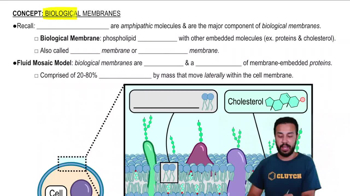
What are the main structural components of a phospholipid molecule in the cell membrane?
A phospholipid has a hydrophilic phosphate head and two hydrophobic fatty acid tails (one saturated and one unsaturated).
What is the structure of the cell membrane?
The cell membrane is a phospholipid bilayer with hydrophilic heads facing outward and hydrophobic tails facing inward.
What are the main components of the cell membrane besides phospholipids?
The membrane contains 5% glycolipids and 20% cholesterol, which stabilize the membrane, plus various proteins.
List the primary functions of membrane proteins.
Membrane proteins function in transport, cell recognition, receptors and ligands, anchoring cellular structures, enzymatic activity, and cell junction formation.
What is vesicular transport and what are its two main types?
Vesicular transport moves large particles via ATP-dependent processes: endocytosis (into the cell) and exocytosis (out of the cell).
Describe endocytosis and its types.
Endocytosis is the cell engulfing material by membrane invagination forming vesicles; types include phagocytosis (cell eating) and receptor-mediated endocytosis.
What happens during exocytosis?
Exocytosis exports materials by vesicles fusing with the cell membrane, releasing contents outside and adding vesicle membrane to the cell membrane.
What creates the membrane potential (MP) in cells?
MP arises from ion separation across the membrane, with positive charge outside and negative inside, mainly due to K+ ion movement through leakage channels.
How is the resting membrane potential established?
It is established when the number of K+ ions leaking out equals those leaking in, balancing the charge difference across the membrane.
What is chromatin and how is it related to chromosomes?
Chromatin is DNA and proteins in the nucleus; chromosomes are condensed chromatin structures containing genes.
What is DNA replication and why is it important?
DNA replication copies DNA before cell division, ensuring each daughter cell receives a full set of genetic information.
What are the three stages of DNA replication?
Initiation (strand separation by helicase), elongation (DNA polymerase builds new strands), and termination (completion of two identical DNA molecules).
What does 'semiconservative replication' mean?
Each new DNA molecule contains one original strand and one newly synthesized strand, conserving half of the original DNA.
What is protein synthesis?
Protein synthesis is the process of converting genetic information in DNA into proteins via transcription and translation.
What are the two main processes of protein synthesis?
Transcription (DNA to mRNA in the nucleus) and translation (mRNA to protein at ribosomes in the cytoplasm).
What is the role of mRNA in protein synthesis?
mRNA carries a copy of the genetic code from DNA out of the nucleus to ribosomes for protein assembly.
How does transcription occur?
RNA polymerase synthesizes mRNA by adding nucleotides complementary to the DNA template strand.
How is the amino acid sequence determined during translation?
mRNA codons (triplets) specify amino acids, which ribosomes link together to form the protein.
What are the three types of cell junctions in epithelial cells?
Tight junctions, desmosomes, and gap junctions.
What is the function of tight junctions?
Tight junctions seal adjacent epithelial cells, blocking extracellular space and controlling substance movement.
What role do desmosomes play in epithelial tissue?
Desmosomes provide strong, flexible connections between cells and influence tissue shape and folding.
What is the function of gap junctions?
Gap junctions form channels allowing fluid, ions, and small molecules to pass directly between adjacent cells for communication.
 Back
 02:21