Skip to main content
Anatomy & Physiology
My Course
Learn
Exam Prep
AI Tutor
Study Guides
Textbook Solutions
Flashcards
Explore
Try the app
My Course
Learn
Exam Prep
AI Tutor
Study Guides
Textbook Solutions
Flashcards
Explore
Try the app
Back
Anatomy & Physiology: Cell Structure and Membrane Transport
You can tap to flip the card.
What are the three basic parts of a human cell?
You can tap to flip the card.
👆
What are the three basic parts of a human cell?
Plasma membrane
: flexible outer boundary,
Cytoplasm
: intracellular fluid with organelles,
Nucleus
: DNA-containing control center.
Track progress
Control buttons has been changed to "navigation" mode.
1/20
Recommended videos
Guided course
03:45
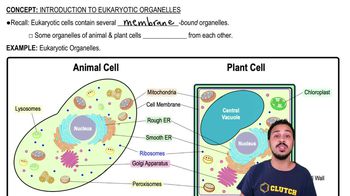
Introduction to Eukaryotic Organelles
30167
views
550
rank
Guided course
05:32
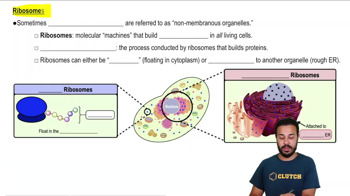
Ribosomes
25289
views
411
rank
Guided course
02:04
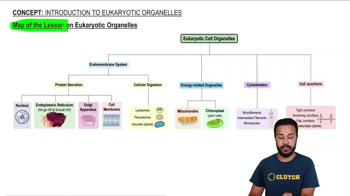
Map of the Lesson on Eukaryotic Organelles
22067
views
292
rank
Terms in this set (20)
Hide definitions
What are the three basic parts of a human cell?
Plasma membrane
: flexible outer boundary,
Cytoplasm
: intracellular fluid with organelles,
Nucleus
: DNA-containing control center.
Describe the structure of the plasma membrane.
A
fluid mosaic model
with a bilayer of phospholipids and embedded proteins, including cholesterol for stiffness.
What are the characteristics of phospholipids in the membrane?
Phosphate heads are
polar and hydrophilic
, fatty acid tails are
nonpolar and hydrophobic
.
What roles do membrane proteins play?
They function as
transport proteins
,
enzymes
,
receptors
, and
cell-to-cell connectors
.
What is selective permeability of the plasma membrane?
Allows nutrients in, wastes out, and prevents unwanted substances from entering due to its
hydrophobic core
.
What is simple diffusion?
Movement of nonpolar, lipid-soluble substances directly through the lipid bilayer down their concentration gradient.
What is facilitated diffusion?
Passive transport of hydrophobic molecules via carrier or channel proteins down their concentration gradient.
How do carrier proteins work in facilitated diffusion?
They bind specific molecules, change shape, and transport them across the membrane.
What are channel proteins and their types?
Transmembrane proteins with aqueous cores; types include
leakage channels
(always open) and
gated channels
(controlled opening).
What is osmosis?
Diffusion of water through a selectively permeable membrane via lipid bilayer or aquaporins.
Define tonicity and its effects on red blood cells.
Isotonic
: normal shape,
Hypertonic
: cell shrinks (crenation),
Hypotonic
: cell swells and may burst (lysis).
What distinguishes active membrane transport from passive transport?
Active transport requires
ATP energy
to move solutes against their concentration gradient.
What is the function of the sodium-potassium pump?
Pumps 3 Na+ out and 2 K+ in, maintaining electrochemical gradients essential for excitable cells.
What is secondary active transport?
Uses energy stored in ion gradients created by primary active transport to move other solutes.
What is vesicular transport?
Movement of large substances across membranes inside vesicles, requiring ATP.
Name the three types of vesicular transport.
Transcytosis
,
Endocytosis
(phagocytosis, pinocytosis, receptor-mediated), and
Exocytosis
.
Describe phagocytosis.
Cell engulfs solid particles using pseudopods to form a phagosome, used by macrophages.
Describe pinocytosis.
Nonspecific uptake of extracellular fluid and solutes by plasma membrane infolding.
What is receptor-mediated endocytosis?
Selective uptake of molecules binding to specific membrane receptors.
How does exocytosis work?
Secretory vesicles fuse with the plasma membrane to eject substances like hormones and neurotransmitters.
 BackBack
 03:45