Back

Anatomy & Physiology: Cells and Membranes

Control buttons has been changed to "navigation" mode.
1/24
  • How does cell structure relate to function?

    Cell structure is specialized to perform specific functions, such as the shape of red blood cells aiding oxygen transport or microvilli increasing surface area for absorption.
  • What is the plasma membrane composed of?

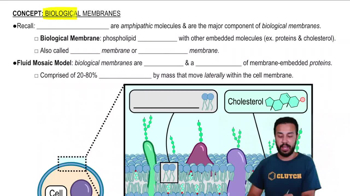
    The plasma membrane is composed of a lipid bilayer with embedded proteins and carbohydrates.
  • What are the major roles of lipids in the plasma membrane?

    Lipids provide a flexible matrix and act as a barrier to ions and water-soluble substances.
  • What functions do proteins serve in the plasma membrane?

    Proteins act as receptors, channels, carriers, enzymes, and structural anchors.
  • What is the role of carbohydrates in the plasma membrane?

    Carbohydrates are involved in cell recognition, adhesion, and protection.
  • Name the three types of cell junctions and their functions.

    • Tight junctions: prevent passage of substances between cells.
    • Desmosomes: provide mechanical strength by anchoring cells.
    • Gap junctions: allow communication via ion and molecule passage.
  • What is passive transport?

    Passive transport is the movement of substances across the membrane without energy, down their concentration gradient.
  • Define concentration gradient.

    A concentration gradient is the difference in the concentration of a substance between two areas.
  • What is active transport?

    Active transport moves substances against their concentration gradient using energy, usually from ATP.
  • How do solute pumps differ from vesicular transport?

    Solute pumps move molecules through membrane proteins; vesicular transport moves large particles or fluids via vesicles.
  • Define electrochemical gradient.

    An electrochemical gradient combines concentration and electrical charge differences influencing ion movement across membranes.
  • What is membrane potential?

    Membrane potential is the voltage difference across a cell's plasma membrane due to ion distribution.
  • What is cytoplasm and its function?

    Cytoplasm is the cell's internal fluid containing organelles, supporting cellular processes and structure.
  • What is the function of mitochondria?

    Mitochondria produce ATP through cellular respiration, supplying energy to the cell.
  • What role do ribosomes play in the cell?

    Ribosomes synthesize proteins by translating mRNA.
  • Differentiate between rough and smooth endoplasmic reticulum.

    Rough ER has ribosomes for protein synthesis; smooth ER synthesizes lipids and detoxifies substances.
  • What is the function of the Golgi apparatus?

    The Golgi apparatus modifies, sorts, and packages proteins and lipids for transport.
  • What are peroxisomes and their function?

    Peroxisomes break down fatty acids and detoxify harmful substances using enzymes.
  • Describe the function of lysosomes.

    Lysosomes digest cellular waste, pathogens, and damaged organelles using enzymes.
  • What are centrioles and their role?

    Centrioles organize microtubules during cell division to form the mitotic spindle.
  • Describe the structure and function of the nucleus.

    The nucleus contains DNA, controls cell activities, and is enclosed by the nuclear envelope.
  • What is the nuclear envelope?

    The nuclear envelope is a double membrane with pores that regulates material exchange between nucleus and cytoplasm.
  • What is chromatin composed of?

    Chromatin is DNA wrapped around histone proteins, organizing genetic material.
  • Define multinucleate and anucleate cells.

    • Multinucleate: cells with multiple nuclei.
    • Anucleate: cells lacking a nucleus.