 Back
BackAnatomy & Physiology: Ch. 1-2
 05:04
05:04
Terms in this set (24)
Human Anatomy
Study of the structure or form of the human body
Human Physiology
Study of the body’s functions
The body’s structure and function are closely related
Cellular Composition
Cells are the smallest units that carry out the functions of life
Metabolism
Living organisms carry out chemical processes collectively called _____
Anabolism
Metabolic processes that "build" are called
Catabolism
Metabolic processes that "break down" are called
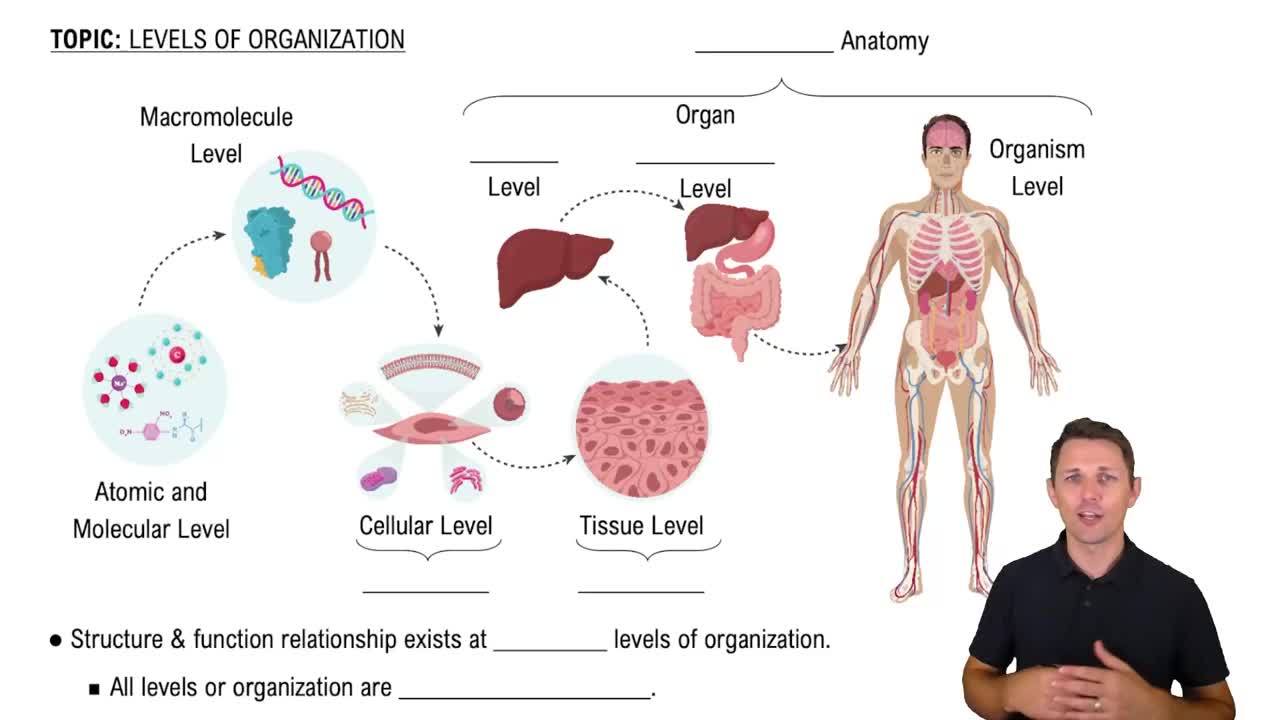
The 6 Structural Levels of Organization
Chemical, Cellular, Tissue, Organ, Organ System, and Organism
Chemical Level
Smallest level; ranges from tiny atoms to complex molecules
Cellular Level
Groups of many different types of molecules combine to form cellular structures
Tissue Level
Two or more cell types and material outside them, extracellular matrix, combine to perform a common function
Organ Level
2+ tissues combine to form an organ with a recognizable shape that performs a specialized task
Organ System Level
2+ Organs that together carry out a broad function
Organism Level
The organ systems function together to make up the working human body - an organism
Systemic Anatomy
Examines individual organ systems
Regional Anatomy
Examines the body in regions, such as head and neck
Surface Anatomy
Examines surface markings
Gross Anatomy
Examines structures that can be seen with the unaided eye
Microscopic Anatomy
Examines cells (Cytology) and tissues (Histology) with a microscope
Physiology
Includes numerous subfields classified by organ or organ systems
4 Core Principles of Anatomy & Physiology
Feedback Loops, Relationship of Structure and Function, Gradients, Cell-Cell Communication
Homeostasis
The condition in which the body develops and maintains a stable internal environment
Homeostatic Imbalances
Disturbances in homeostasis can lead to disease or death if uncorrected
Regulated Variables
Variables in the internal environment, like temperature, blood sugar, and others are controlled to stay close to a particular normal value (no exact value for homeostasis)
Controlled Variables
Variables that are manipulated to maintain the regulated variables, such as the process that increases blood sugar stored from carbohydrates