 Back
Anatomy & Physiology Chapter 1 Key Terms
 03:00

Terms in this set (29)
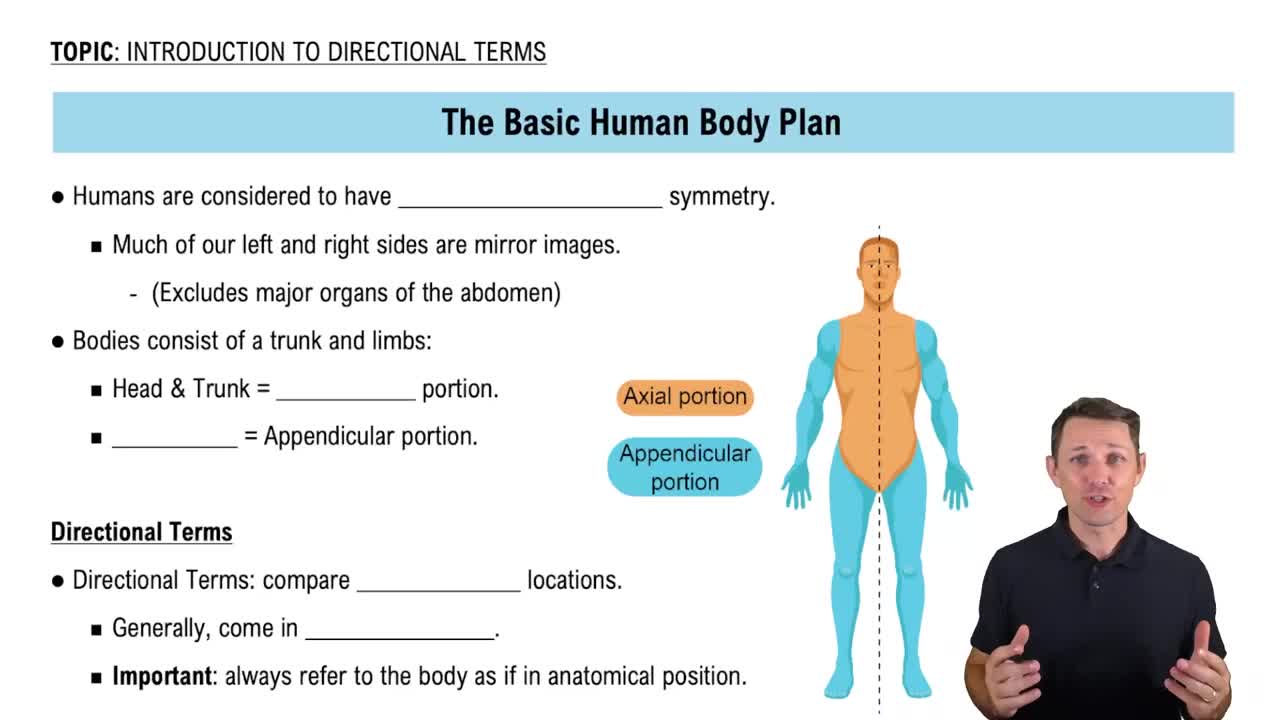
The standard body position used as a reference in anatomy: standing upright, facing forward, arms at sides, palms facing forward.
Directional term meaning toward the head or upper part of a structure.
Directional term meaning away from the head or toward the lower part of a structure.
Directional term meaning toward the front of the body.
Directional term meaning toward the back of the body.
Directional term meaning toward the midline of the body.
Directional term meaning away from the midline of the body.
Directional term meaning closer to the origin of a body part or point of attachment.
Directional term meaning farther from the origin of a body part or point of attachment.
Directional term meaning toward or on the surface of the body.
Directional term meaning away from the body surface; more internal.
Spaces within the body that house organs, such as the cranial, thoracic, and abdominopelvic cavities.
Includes nutrients, oxygen, water, normal body temperature, and appropriate atmospheric pressure.
Substances obtained from food that are used for energy and cell building.
Essential for cellular respiration and energy production in the body.
Most abundant chemical in the body; provides a medium for chemical reactions and regulates temperature.
Approximately 37°C (98.6°F); necessary for proper metabolic reactions.
Pressure exerted by the air is necessary for proper breathing and gas exchange.
Groups of organs that work together to perform complex functions, e.g., cardiovascular, respiratory, digestive systems.
Protects the body, regulates temperature, and prevents water loss; includes skin, hair, and nails.
Provides support, protection, and movement; stores minerals and produces blood cells.
Allows movement, maintains posture, and produces heat.
Controls body activities with electrical signals; responds to internal and external changes.
Transports nutrients, gases, hormones, and wastes through the blood.
Supplies oxygen to the blood and removes carbon dioxide.
Breaks down food for absorption and eliminates solid waste.
The body's ability to maintain a stable internal environment despite external changes.
Mechanism that reverses a change to maintain homeostasis, e.g., body temperature regulation.
Mechanism that amplifies a change, e.g., blood clotting or childbirth contractions.