 Back
Anatomy & Physiology: Chapter 3 - Intercellular Junctions and Transport
 05:33

Terms in this set (21)
Intercellular junctions are specialized connections between adjacent cells that facilitate communication and adhesion.
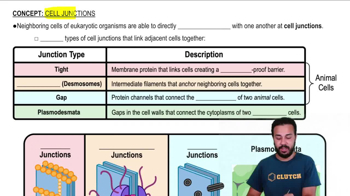
Tight junctions, desmosomes, and gap junctions.
Tight junctions create a seal that prevents substances from passing between cells.
Desmosomes are anchoring junctions that hold cells together, providing mechanical strength.
Gap junctions allow direct communication between cells through channels that permit ion and molecule passage.
Passive transport moves substances across membranes without energy, down their concentration gradient.
Diffusion, facilitated diffusion, and osmosis.
Diffusion is the movement of molecules from high to low concentration until equilibrium is reached.
Facilitated diffusion uses carrier proteins to move substances down their concentration gradient.
Osmosis is the diffusion of water across a selectively permeable membrane.
Active transport moves substances against their concentration gradient using energy (ATP).
The sodium-potassium pump, which moves Na+ out and K+ into the cell.
Endocytosis is the process of engulfing substances into the cell by forming vesicles.
Exocytosis is the process of vesicles fusing with the membrane to release contents outside the cell.
Carrier proteins facilitate the movement of specific molecules across the membrane.
Channel proteins form pores for molecules to pass through, while carrier proteins change shape to transport molecules.
The concentration gradient; substances move from high to low concentration.
It allows the cell to control which substances enter or leave, maintaining homeostasis.
An isotonic solution has equal solute concentration inside and outside the cell, causing no net water movement.
Water enters the cell, causing it to swell and possibly burst.
Water leaves the cell, causing it to shrink.