 Back
Anatomy & Physiology Chapter 3 Key Concepts
 05:33

Terms in this set (20)
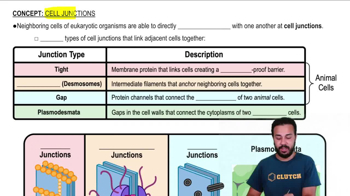
Intercellular junctions are specialized connections between adjacent cells that allow communication and adhesion.
Tight junctions, desmosomes, and gap junctions.
Tight junctions create a seal that prevents substances from passing between cells.
Desmosomes provide strong adhesion between cells, resisting mechanical stress.
Gap junctions allow direct communication by permitting ions and small molecules to pass between cells.
Diffusion is the passive movement of molecules from an area of higher concentration to lower concentration.
Concentration gradient, temperature, molecule size, and membrane permeability.
An active transport protein that moves 3 sodium ions out and 2 potassium ions into the cell using ATP.
It maintains cell membrane potential and regulates cell volume.
Lysosomes are organelles containing digestive enzymes that break down waste and cellular debris.
Peroxisomes detoxify harmful substances and break down fatty acids using oxidative enzymes.
Lysosomes digest cellular waste; peroxisomes detoxify chemicals and metabolize lipids.
Interphase (G1, S, G2) and mitotic phase (mitosis and cytokinesis).
DNA replication occurs, doubling the genetic material.
Cell growth and preparation for DNA synthesis.
Final preparation for mitosis, including protein synthesis and organelle replication.
Division of the nucleus into two genetically identical daughter nuclei.
The division of the cytoplasm, resulting in two separate daughter cells.
Active transport requires energy to move substances against their concentration gradient; diffusion is passive.
Oxygen and carbon dioxide freely diffuse across cell membranes.