Skip to main content
Anatomy & Physiology
My Course
Learn
Exam Prep
AI Tutor
Study Guides
Textbook Solutions
Flashcards
Explore
Try the app
My Course
Learn
Exam Prep
AI Tutor
Study Guides
Textbook Solutions
Flashcards
Explore
Try the app
Back
Anatomy & Physiology: Chapter 4 Tissues
You can tap to flip the card.
What is a tissue in anatomy?
You can tap to flip the card.
👆
What is a tissue in anatomy?
Tissue
is a group of cells similar in structure that perform a common or related function.
Track progress
Control buttons has been changed to "navigation" mode.
1/19
Recommended videos
Guided course
05:04
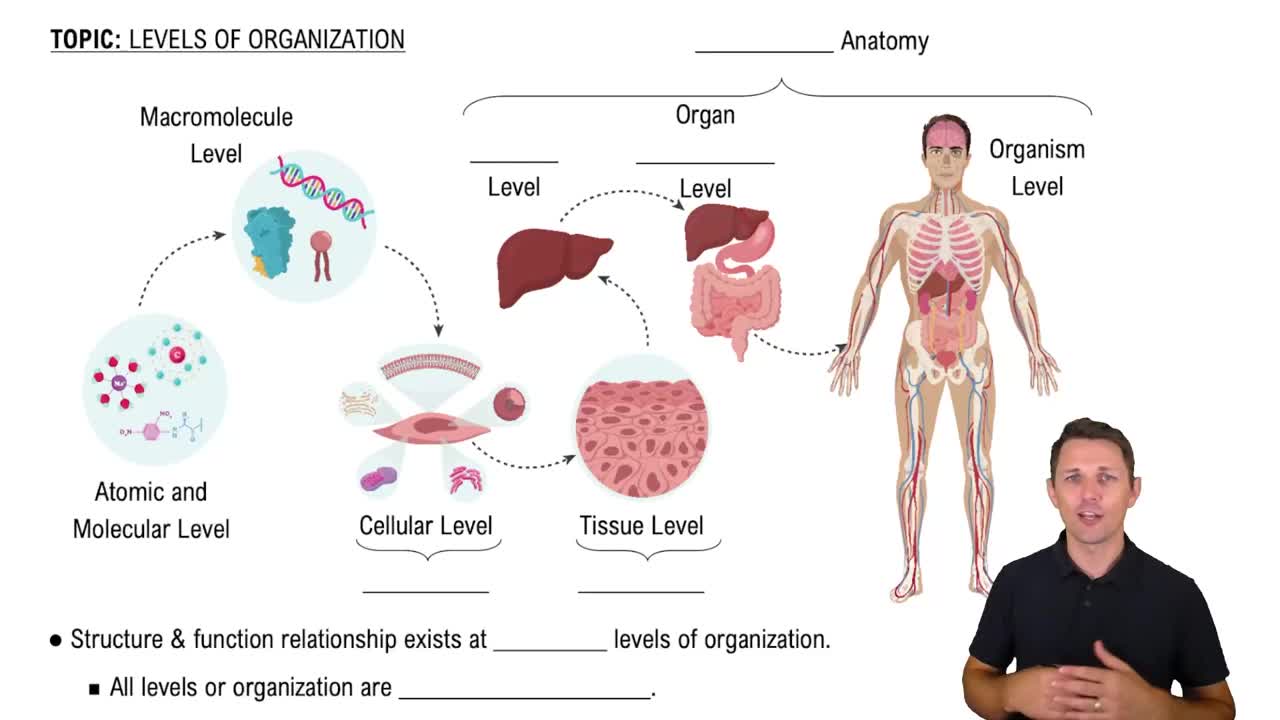
The Levels of Organization
49274
views
1463
rank
5
comments
Guided course
02:22
Levels of Organization Example 1
27737
views
594
rank
2
comments
Terms in this set (19)
Hide definitions
What is a tissue in anatomy?
Tissue
is a group of cells similar in structure that perform a common or related function.
What are the four basic tissue types?
Epithelial, connective, muscle,
and
nervous tissue
.
What are the two main forms of epithelial tissue?
Covering and lining epithelia
(external and internal surfaces) and
glandular epithelia
(secretory tissue in glands).
What are the main functions of epithelial tissue?
Protection, absorption, filtration, excretion, secretion, and sensory reception.
How are glands classified?
By
site of product release
(endocrine or exocrine) and
number of cells
forming the gland (unicellular or multicellular).
What is the difference between endocrine and exocrine glands?
Endocrine glands
secrete hormones internally into the blood;
exocrine glands
secrete products onto body surfaces or cavities via ducts.
What are the two modes of secretion in multicellular exocrine glands?
Merocrine
(secretion by exocytosis) and
holocrine
(secretion by cell rupture).
What are the major functions of connective tissue?
Binding and support, protecting, insulating, storing reserve fuel, and transporting substances.
Name the four main classes of connective tissue.
Connective tissue proper, cartilage, bone, and blood.
What are 'blast' cells in connective tissue?
Immature cells that actively secrete ground substance and extracellular matrix fibers.
What are 'cyte' cells in connective tissue?
Mature, less active cells that maintain the health of the matrix.
What proteins do muscle cells use to contract?
Myofilaments made of
actin
and
myosin
proteins.
What are the three types of muscle tissue?
Skeletal muscle, cardiac muscle, and smooth muscle.
What are the two specialized cells in nervous tissue?
Neurons
(generate and conduct impulses) and
supporting cells
(support, insulate, and protect neurons).
What triggers the tissue repair process?
Compromise of the body's barriers activates inflammatory and immune responses.
What are the two major ways tissue repair occurs?
Regeneration
(same tissue replaces destroyed tissue) and
fibrosis
(connective tissue replaces destroyed tissue).
What happens during the inflammation stage of tissue repair?
Release of inflammatory chemicals causes blood vessel dilation, increased permeability, and blood clotting.
What occurs during the organization stage of tissue repair?
Blood clot is replaced with granulation tissue; epithelium regenerates; fibroblasts produce collagen to bridge the gap.
What is the final stage of tissue repair?
Regeneration and fibrosis effect permanent repair; scab detaches; fibrous tissue matures; epithelium thickens.
 BackBack
 05:04