Back

Anatomy & Physiology: Chapters 1 & 2 Key Concepts

Control buttons has been changed to "navigation" mode.
1/38
  • Which body system functions to produce blood cells?

    The skeletal system functions to produce blood cells.
  • What is the smallest unit of living things?

    The cell is the smallest unit of living things.
  • What does the lymphatic system consist of?

    The lymphatic system consists of the spleen, lymph nodes, thymus, bone marrow, and lymphatic vessels.
  • Which organs belong to both the endocrine and female reproductive systems?

    The ovaries belong to both the endocrine and female reproductive systems.
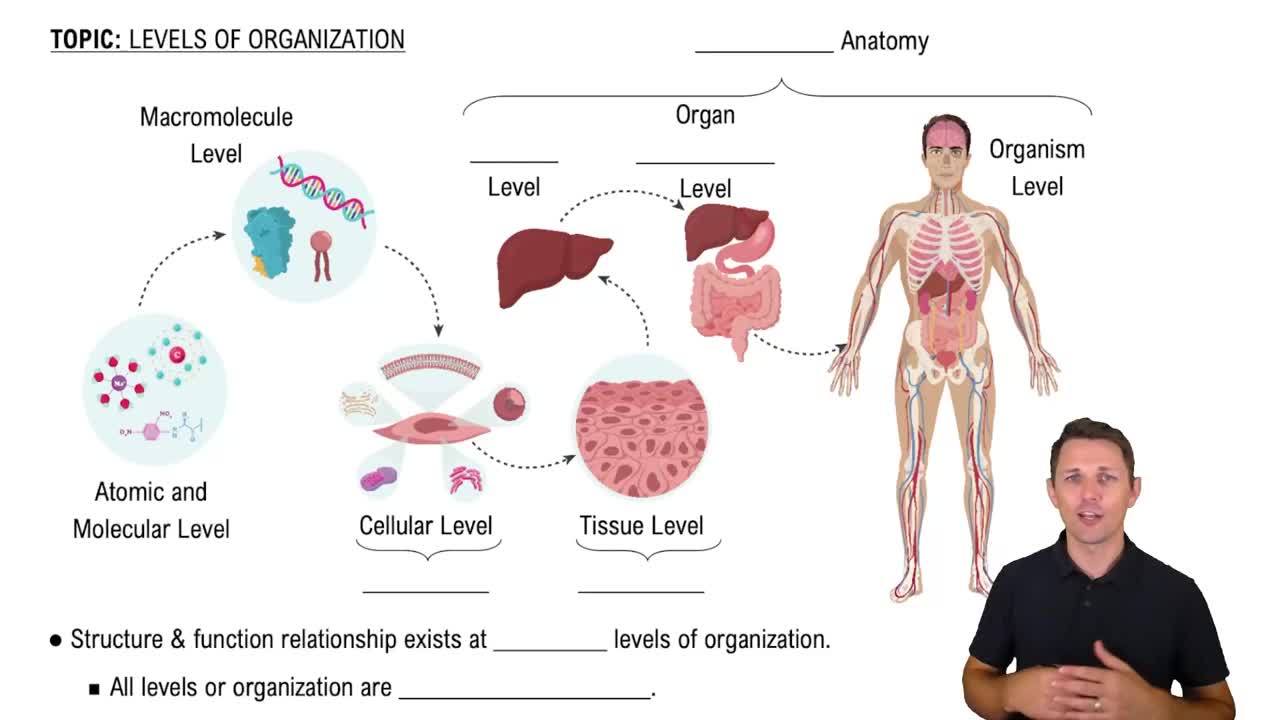
  • What is the correct order of increasing structural complexity?

    Cellular, tissue, organ, organ system.
  • What is embryology a subdivision of?

    Embryology is a subdivision of developmental anatomy.
  • What is the main function of the reproductive system?

    The reproductive system produces sperm and eggs.
  • Which system acts as a fast-acting control system for the body?

    The nervous system acts as a fast-acting control system.
  • What is the respiratory system composed of?

    The respiratory system consists of the lungs, trachea, bronchus, larynx, pharynx, and nasal cavity.
  • What concept is illustrated by incisors biting and molars grinding food?

    This illustrates the complementarity of structure and function.
  • What is the organ system that contains bones, cartilage, and ligaments?

    The skeletal system contains bones, cartilage, and ligaments.
  • What is the function of the integumentary system?

    The integumentary system separates the body's internal environment from the external environment.
  • What is the main function of the cardiovascular system?

    The cardiovascular system pumps and transports blood.
  • What is surface anatomy used for clinically?

    Surface anatomy is used to locate blood vessels to take a pulse or draw blood.
  • What is gross (macroscopic) anatomy?

    The study of large body structures visible to the naked eye, such as the heart, lungs, and kidneys.
  • What is physiology?

    The study of how body parts work and carry out life-sustaining activities.
  • What are the three components of a homeostatic control system?

    Receptor, control center, and effector.
  • What is negative feedback?

    A mechanism where the response reduces or shuts off the original stimulus to maintain homeostasis.
  • What is an example of positive feedback?

    Release of oxytocin to increase the strength of labor contractions.
  • What are the necessary life functions?

    • Metabolism
    • Responsiveness
    • Excretion
    • Movement
    • Maintaining boundaries
    • Digestion
    • Reproduction
    • Growth
  • What is the law of mass balance?

    The amount of a substance taken in by the body must equal the amount lost.
  • What is the function of the muscular system?

    The muscular system provides locomotion.
  • What is the function of the endocrine system?

    The endocrine system secretes hormones.
  • What is the anatomical position?

    Body standing upright, feet slightly apart, palms facing forward, and thumbs pointing away from the body.
  • What does the term 'proximal' mean?

    Closer to the origin of the body part or point of attachment.
  • What body cavity contains the lungs and heart?

    The thoracic cavity contains the lungs and heart.
  • What is the function of serous membranes?

    They line cavity walls and cover organs to reduce friction.
  • What are the four major elements that make up 96% of body weight?

    Carbon, oxygen, hydrogen, and nitrogen.
  • What is an isotope?

    Atoms of the same element with the same number of protons but different numbers of neutrons.
  • What type of bond forms when one atom donates an electron to another?

    An ionic bond.
  • What is a hydrogen bond?

    A weak bond formed when a hydrogen atom is attracted to an electronegative atom.
  • What is a solution?

    A homogeneous mixture of two or more components.
  • What is the valence shell?

    The outermost energy level of an atom.
  • What is the main function of carbohydrates?

    Provide an immediate source of cellular fuel.
  • What are the building blocks of proteins?

    Amino acids.
  • What is ATP structurally similar to?

    A nucleotide.
  • What is the primary structure of a protein?

    The sequence of amino acids.
  • What is the function of DNA?

    To direct protein synthesis.