 Back
BackAnatomy & Physiology: Chemistry Basics
 02:13
02:13
Terms in this set (25)
Matter is anything that has mass and occupies space, existing in solid, liquid, or gas states.
Energy is the capacity to do work or move matter. Types include kinetic (energy in action) and potential (stored energy).
Elements are pure substances made of atoms that cannot be broken down by ordinary chemical methods and have unique properties.
Oxygen (O), Carbon (C), Hydrogen (H), and Nitrogen (N).
Protons (positive charge), neutrons (no charge), and electrons (negative charge).
In the nucleus, which contains almost all the atom's mass.
The number of protons in an atom's nucleus, unique to each element.
Atoms of the same element with the same number of protons but different numbers of neutrons.
Heavy isotopes that spontaneously decay, emitting radiation and transforming into more stable forms.
Two or more atoms chemically bonded together, e.g., H2 or C6H12O6.
A molecule is two or more atoms bonded; a compound is a molecule with atoms of different elements.
Ionic bonds, covalent bonds, and hydrogen bonds.
Formed by the transfer of electrons from one atom to another, creating oppositely charged ions that attract.
Formed by sharing one or more pairs of valence electrons between atoms.
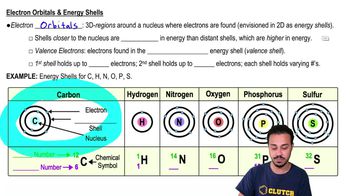
Atoms tend to form bonds to have eight electrons in their valence shell for stability (except the first shell, which is full with two electrons).
Weak attractions between slightly positive hydrogen atoms and slightly negative atoms in polar molecules.
A homogeneous mixture where solutes are dissolved in a solvent, usually water in the body.
Colloids have larger solute particles that do not settle out; suspensions have large particles that settle out over time.
Two or more atoms or molecules combine to form a larger, more complex molecule (anabolism).
A molecule is broken down into smaller molecules or atoms (catabolism).
Both synthesis and decomposition occur; bonds are made and broken, exchanging parts between molecules.
Reactions where electrons are transferred; the electron donor is oxidized, and the acceptor is reduced.
The energy required to start a chemical reaction.
Enzymes lower the activation energy needed, speeding up reactions without being consumed.
Exergonic reactions release energy; endergonic reactions absorb energy.