 Back
BackAnatomy & Physiology: Chemistry of Life Flashcards
 05:04
05:04
Terms in this set (20)
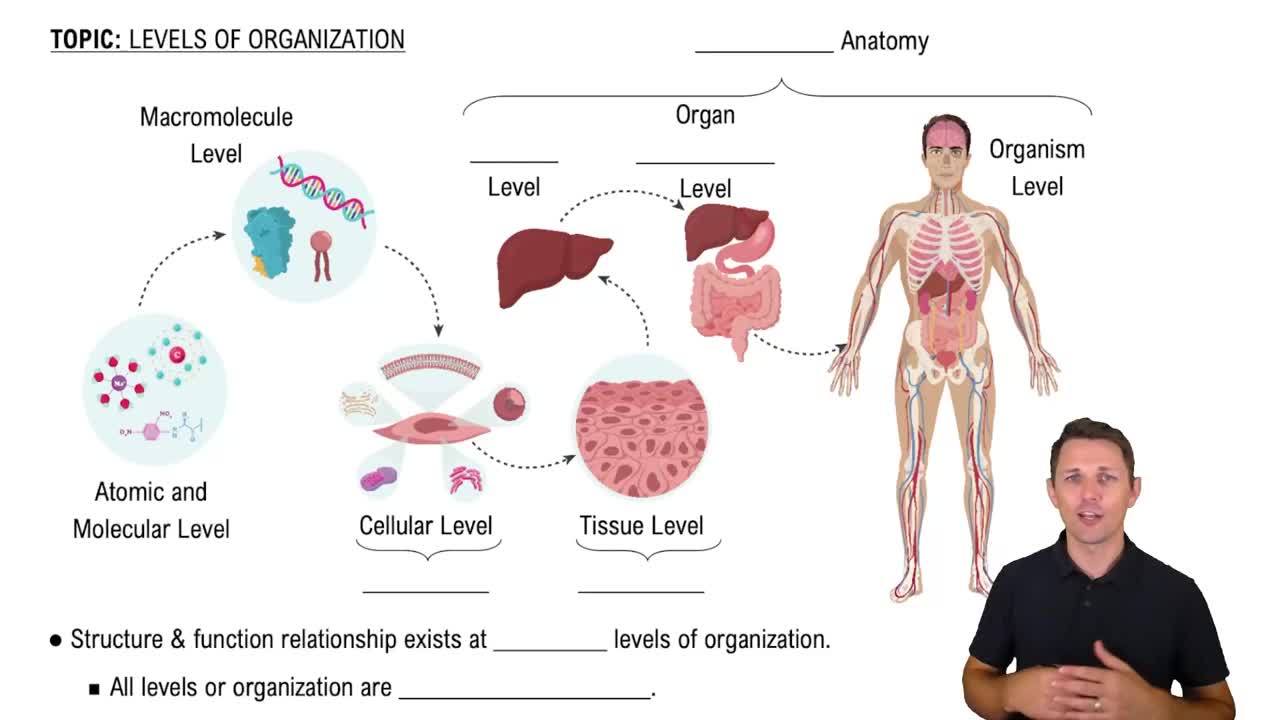
An atom is the smallest unit of matter that retains the original properties of an element.
Protons (p+), Neutrons (n0), and Electrons (e-).
The number of protons in the nucleus defines the atomic number and identity of an element.
Hydrogen, Oxygen, Carbon, and Nitrogen.
A chemical bond is an energy relationship between atoms that holds them together in molecules or compounds.
A molecule is two or more atoms bonded together; a compound is a molecule made of different elements.
An ionic bond forms when electrons are transferred between atoms, creating charged ions (cations and anions) that attract each other.
A covalent bond is the strongest bond formed when two or more nonmetals share electrons.
Nonpolar covalent bonds share electrons equally; polar covalent bonds share electrons unequally due to different electronegativities.
Hydrogen bonds are weak attractions between the partially positive end of one polar molecule and the partially negative end of another.
A chemical bond is formed, broken, or rearranged, converting reactants into products.
Potential energy is stored energy; kinetic energy is energy of motion.
Endergonic reactions require energy input; exergonic reactions release energy.
Catabolic (decomposition), Exchange, and Anabolic (synthesis) reactions.
A catalyst is a substance that increases the rate of a chemical reaction by lowering activation energy.
Enzymes are biological catalysts that speed up reactions by lowering activation energy.
1st shell: 2 electrons; 2nd shell: 8 electrons; 3rd shell: 18 electrons but usually satisfied with 8.
Atoms are most stable when their outer electron shell has 8 electrons.
A mixture is a physical combination of substances; a compound is a chemical combination with bonds.
It organizes elements by atomic number and shows which elements are major, minor, or trace in the human body.