Skip to main content
Anatomy & Physiology
My Course
Learn
Exam Prep
AI Tutor
Study Guides
Textbook Solutions
Flashcards
Explore
Try the app
My Course
Learn
Exam Prep
AI Tutor
Study Guides
Textbook Solutions
Flashcards
Explore
Try the app
Back
Anatomy & Physiology: Chemistry of Life Fundamentals
You can tap to flip the card.
What are atoms and elements?
You can tap to flip the card.
👆
What are atoms and elements?
Atoms
are the smallest units of matter retaining properties;
elements
are substances made of identical atoms defined by atomic number.
Track progress
Control buttons has been changed to "navigation" mode.
1/28
Recommended videos
Guided course
02:13
Atoms- Smallest Unit of Matter Example 1
30482
views
792
rank
Guided course
03:51
Atoms- Smallest Unit of Matter Example 3
19829
views
425
rank
Guided course
09:44
Electron Orbitals & Energy Shells
27589
views
589
rank
5
comments
Terms in this set (28)
Hide definitions
What are atoms and elements?
Atoms
are the smallest units of matter retaining properties;
elements
are substances made of identical atoms defined by atomic number.
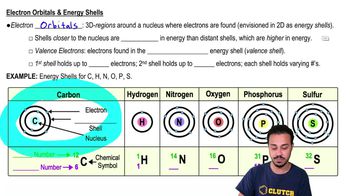
Where are protons, neutrons, and electrons located in an atom?
Protons
and
neutrons
are in the nucleus;
electrons
orbit in shells around the nucleus.
Which four elements make up 96% of the human body mass?
Oxygen (O), Carbon (C), Hydrogen (H), and Nitrogen (N)
.
What defines an isotope?
Atoms with the same number of protons but different numbers of neutrons.
What is a chemical bond?
An
attractive force
between atoms that holds them together.
Difference between molecule and compound?
A
molecule
is two or more atoms of the same element bonded; a
compound
is atoms of different elements bonded.
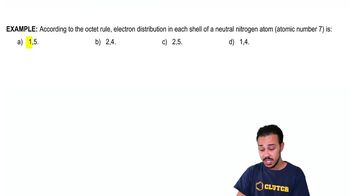
What is the octet rule?
Atoms are most stable with
8 electrons
in their valence shell.
How do ionic bonds form?
By
transfer of electrons
between a metal and a nonmetal, creating charged ions.
What are cations and anions?
Cations
are positively charged ions;
anions
are negatively charged ions.
What characterizes covalent bonds?
Formed by
sharing electrons
between nonmetal atoms; can be single, double, or triple bonds.
Difference between nonpolar and polar covalent bonds?
Nonpolar bonds share electrons
equally
; polar bonds share electrons
unequally
, creating dipoles.
What are hydrogen bonds and their importance?
Weak attractions between polar molecules; crucial for
water's properties
and
protein structure
.
What is potential and kinetic energy in chemical reactions?
Potential energy
is stored energy;
kinetic energy
is energy in motion.
What is activation energy?
Energy required for reactants to collide and react; enzymes lower this energy.
How do enzymes function?
They are biological catalysts that bind substrates at an
active site
and increase reaction rates without being consumed.
What is denaturation of proteins?
Loss of protein shape due to heat, pH, or chemicals, causing loss of function.
What are acids and bases in terms of proton transfer?
Acids are
proton donors
; bases are
proton acceptors
.
What does the pH scale measure?
The
hydrogen ion concentration
; pH 7 is neutral, below 7 acidic, above 7 basic.
What is the role of buffers in the body?
They
resist changes
in pH to maintain homeostasis, e.g., carbonic acid–bicarbonate system.
What are the main types of organic compounds in the body?
Carbohydrates, lipids, proteins, and nucleic acids.
What are carbohydrates composed of and their function?
Made of C, H, O in 1:2:1 ratio; provide
fuel, structure, and cell communication
.
What are lipids and their characteristics?
Nonpolar, hydrophobic molecules including fatty acids, triglycerides, phospholipids, and steroids.
What is the structure of phospholipids?
Glycerol backbone, two fatty acids (nonpolar tails), and a phosphate group (polar head); amphiphilic.
What is the steroid nucleus?
A four-ring hydrocarbon structure found in all steroids like cholesterol.
What are proteins made of and their structure levels?
Made of amino acids linked by peptide bonds; have primary, secondary, tertiary, and quaternary structures.
What are nucleotides and their role?
Monomers of nucleic acids; composed of nitrogenous base, sugar, and phosphate; store genetic info and energy (ATP).
What is ATP?
Adenosine triphosphate; main energy currency of the cell; energy released by hydrolysis.
Difference between DNA and RNA?
DNA is double-stranded with deoxyribose sugar and thymine; RNA is single-stranded with ribose sugar and uracil.
 BackBack
 02:13
02:13