Skip to main content
Anatomy & Physiology
My Course
Learn
Exam Prep
AI Tutor
Study Guides
Textbook Solutions
Flashcards
Explore
Try the app
My Course
Learn
Exam Prep
AI Tutor
Study Guides
Textbook Solutions
Flashcards
Explore
Try the app
Back
Anatomy & Physiology Comprehensive Review
You can tap to flip the card.
Define superior and inferior in anatomical terms
You can tap to flip the card.
👆
Define superior and inferior in anatomical terms
Superior
means above;
Inferior
means below.
Track progress
Control buttons has been changed to "navigation" mode.
1/28
Recommended videos
03:00
Introduction to Directional Terms
17437
views
976
rank
2
comments
Terms in this set (28)
Hide definitions
Define superior and inferior in anatomical terms
Superior
means above;
Inferior
means below.
What is the function of epithelial tissue?
Epithelial tissue provides
protection
,
absorption
, and
secretion
.
Name the layers of the epidermis and one key function of each
Stratum basale
: mitosis/stem cells;
Stratum spinosum
: Langerhans cells;
Stratum granulosum
: waterproofing;
Stratum lucidum
: thick skin only;
Stratum corneum
: dead keratinized cells.
What are the main functions of osteoblasts, osteoclasts, and osteocytes?
Osteoblasts
build bone;
osteoclasts
break down bone;
osteocytes
maintain bone.
Describe the difference between compact and spongy bone
Compact bone
is the dense outer layer;
spongy bone
consists of trabeculae inside the bone.
What joint movement decreases the angle between bones?
Flexion
decreases the angle between bones.
Outline the muscle contraction pathway starting from motor neuron stimulation
Motor neuron releases ACh → ACh binds sarcolemma receptors → action potential travels down T-tubules → sarcoplasmic reticulum releases Ca++ → Ca++ binds troponin → tropomyosin shifts → myosin binds actin → power stroke → ATP releases myosin → muscle relaxes.
What is the resting membrane potential of a neuron?
Approximately
-70 mV
.
Explain depolarization and repolarization in an action potential
Depolarization
is Na+ influx making the inside more positive;
repolarization
is K+ efflux restoring negativity.
Name the cranial nerve responsible for smell
Olfactory nerve (CN I)
is responsible for smell.
What is the function of the hypothalamus?
Controls
homeostasis
and
endocrine
functions.
Compare parasympathetic and sympathetic nervous system functions
Parasympathetic
: rest & digest, decreases heart rate, constricts pupils;
Sympathetic
: fight or flight, increases heart rate, dilates pupils.
What neurotransmitters are released by parasympathetic and sympathetic systems?
Parasympathetic
releases acetylcholine (ACh);
Sympathetic
releases norepinephrine (NE).
Describe the path of light through the eye
Cornea → aqueous humor → pupil → lens → vitreous humor → retina → optic nerve → optic chiasma → thalamus → occipital lobe.
What hormone raises blood calcium levels?
Parathyroid hormone (PTH)
raises blood calcium.
What hormone lowers blood calcium levels?
Calcitonin
lowers blood calcium.
Outline the RAAS pathway for blood pressure regulation
Low BP → kidneys release renin → angiotensinogen → angiotensin I → ACE converts to angiotensin II → vasoconstriction + aldosterone release → kidneys retain Na+ and water → blood pressure increases.
What is the functional unit of a muscle?
The
sarcomere
is the functional unit of muscle contraction.
What are the signs of inflammation?
Redness, heat, swelling, and pain.
What causes vasodilation during inflammation?
Histamine
causes vasodilation.
What is the difference between regeneration and fibrosis in tissue repair?
Regeneration
replaces normal tissue;
fibrosis
forms scar tissue.
What type of gland are sebaceous glands and sweat glands?
Sebaceous glands are
holocrine
; sweat glands are
merocrine
.
What is the mnemonic to remember the cranial nerves in order?
"Oh Oh Oh To Touch And Feel Very Good Velvet AH!"
What is the mnemonic to remember cranial nerve types (sensory, motor, both)?
"Some Say Marry Money But My Brother Says Big Brains Matter More"
What happens to bone density after menopause and why?
Bone resorption increases due to decreased estrogen, leading to lower bone density.
What is saltatory conduction?
Action potentials jumping between nodes of Ranvier on myelinated axons.
What is the role of the adrenal medulla?
Releases epinephrine and norepinephrine for fight or flight response.
What hormone does the posterior pituitary release and its function?
Releases ADH for water retention and oxytocin for labor.
 BackBack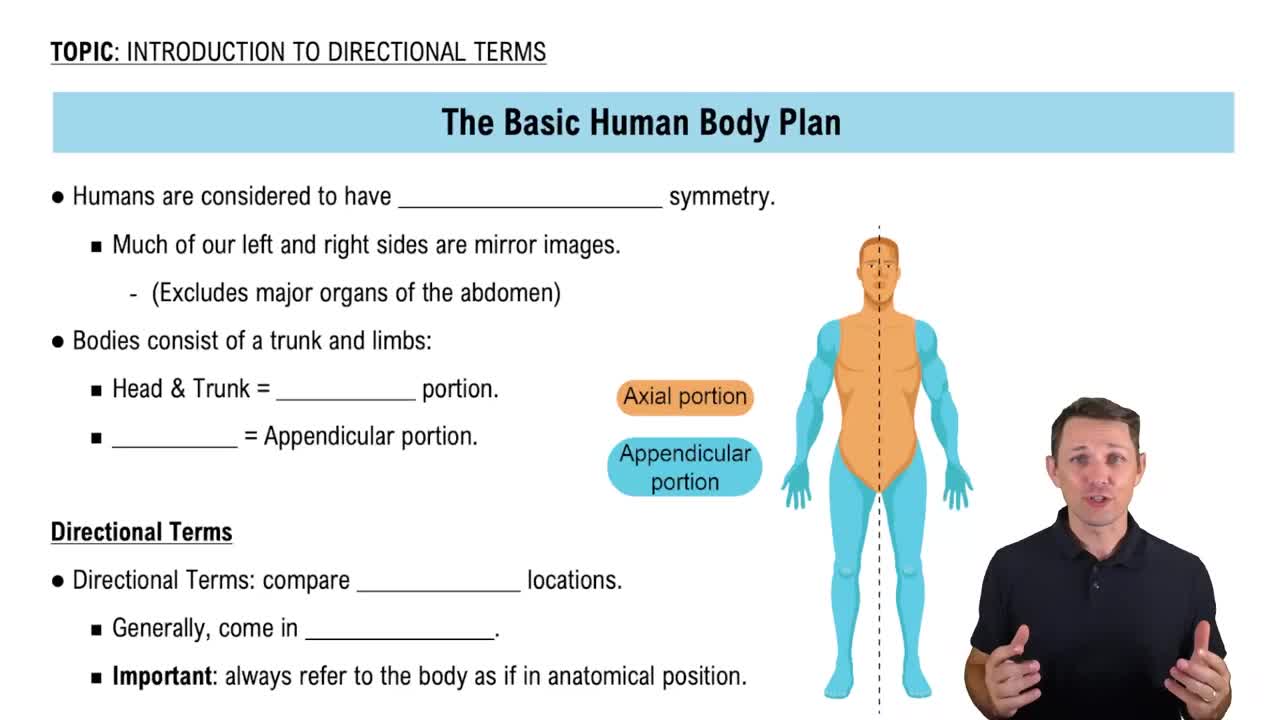
 03:00
03:00