Back

Anatomy & Physiology: Endocrine System Hormones and Glands

Control buttons has been changed to "navigation" mode.
1/26
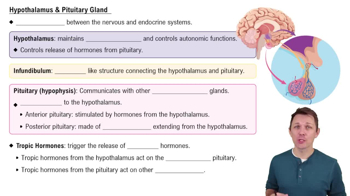
  • What is the anatomical connection between the hypothalamus and the pituitary gland?

    The hypothalamus is connected to the pituitary gland by the infundibulum, linking the nervous and endocrine systems.
  • Name the two lobes of the pituitary gland and their tissue types.

    The pituitary gland has an anterior lobe (adenohypophysis, endocrine tissue) and a posterior lobe (neurohypophysis, nervous tissue).
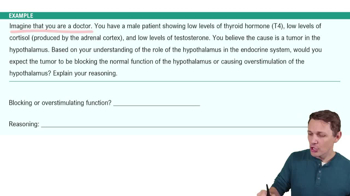
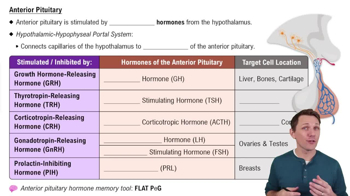
  • How does the hypothalamus regulate the anterior pituitary?

    Hypothalamus secretes releasing and inhibiting hormones into the hypophyseal portal system, which stimulate or inhibit anterior pituitary hormone release.
  • What hormones are produced by the anterior pituitary?

    TSH, ACTH, FSH, LH, prolactin (PRL), growth hormone (GH), and melanocyte stimulating hormone (MSH).
  • What is the diabetogenic effect of growth hormone (GH)?

    Hypersecretion of GH causes increased blood sugar levels, mimicking diabetes mellitus symptoms.
  • Describe the regulation of growth hormone secretion.

    Low blood sugar stimulates hypothalamic GHRH to increase GH; high blood sugar stimulates GHIH to decrease GH secretion.
  • What are tropic hormones? Give examples from the anterior pituitary.

    Tropic hormones stimulate other endocrine glands; examples include TSH, ACTH, FSH, and LH.
  • What hormones are stored and released by the posterior pituitary?

    Antidiuretic hormone (ADH) and oxytocin (OT), both produced by the hypothalamus and released by the posterior pituitary.
  • What is the function of ADH and how is it regulated?

    ADH promotes water reabsorption in kidneys and vasoconstriction; released in response to increased blood osmolarity detected by hypothalamus.
  • What causes diabetes insipidus related to ADH?

    Hyposecretion of ADH causes excessive urine output, dehydration, and thirst without glucose in urine.
  • What is the role of oxytocin during labor and lactation?

    Oxytocin stimulates uterine contractions during labor and milk ejection by contracting mammary duct smooth muscle.
  • Where is the thyroid gland located and what are its main hormones?

    Located anterior to the trachea and inferior to the larynx; main hormones are T3, T4, and calcitonin.
  • What is the function of thyroid hormones T3 and T4?

    They regulate metabolism, growth, development, increase heart rate, blood pressure, body temperature, and GI motility.
  • How is thyroid hormone secretion regulated?

    Low metabolism stimulates hypothalamic TRH, increasing anterior pituitary TSH, which stimulates thyroid T3 and T4 release.
  • What is the function of calcitonin and which cells produce it?

    Calcitonin lowers blood calcium by inhibiting osteoclasts and increasing kidney calcium excretion; produced by parafollicular (C) cells.
  • Where are the parathyroid glands located and what hormone do they secrete?

    Four small glands on the posterior thyroid surface; secrete parathyroid hormone (PTH).
  • What are the main effects of parathyroid hormone (PTH)?

    PTH increases blood calcium by stimulating osteoclasts, reducing kidney calcium loss, and promoting calcitriol formation.
  • Describe the zones of the adrenal cortex and their secretions.

    Zona glomerulosa secretes mineralocorticoids (aldosterone), zona fasciculata secretes glucocorticoids (cortisol), zona reticularis secretes androgens.
  • What are the effects of cortisol secreted by the adrenal cortex?

    Increases blood glucose, protein and lipid breakdown, ATP production, vasoconstriction, and has anti-inflammatory effects.
  • What hormones are secreted by the adrenal medulla and their function?

    Epinephrine and norepinephrine; they mediate the fight or flight response by increasing heart rate, blood pressure, and metabolism.
  • What are the endocrine functions of the pancreas?

    Pancreatic islets secrete glucagon (alpha cells), insulin (beta cells), and somatostatin (delta cells) to regulate blood glucose.
  • What causes Type I and Type II diabetes mellitus?

    Type I: beta cell destruction causing insulin deficiency. Type II: insulin resistance due to fewer receptors, often in obese adults.
  • What is the role of melatonin and which gland secretes it?

    Melatonin regulates circadian rhythms and gonadotropin secretion; secreted by the pineal gland.
  • What hormones do the ovaries produce and their functions?

    Estrogen, progesterone, relaxin, and inhibin; support follicle maturation, female secondary sex characteristics, and pregnancy preparation.
  • What hormones do the testes produce and their functions?

    Testosterone and inhibin; support sperm development and male secondary sex characteristics.
  • What is the primary function of the thymus gland?

    Maturation of T lymphocytes and secretion of thymosin to aid immune development.