 Back
Anatomy & Physiology Exam 1 Key Concepts
 05:04

Terms in this set (34)
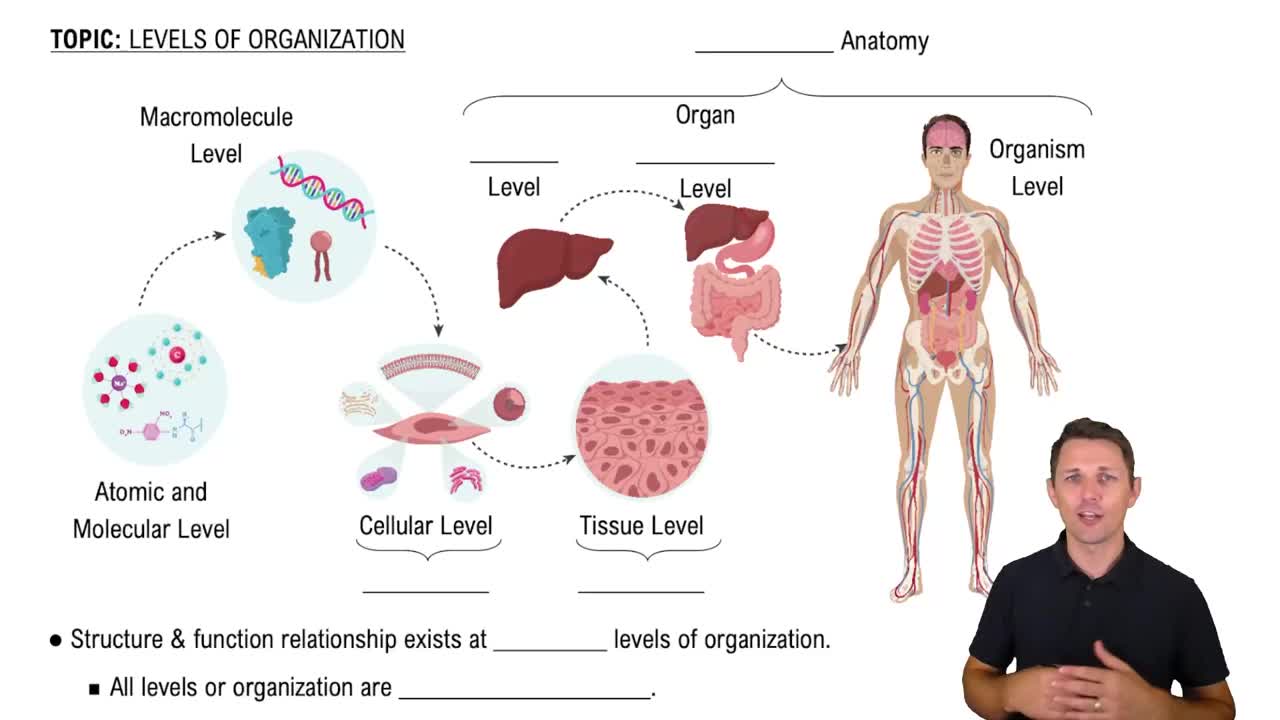
Cell is the most basic level of organization in the body.
A tissue is a group of similar cells working together to perform a specific function.
Cells → tissues → organs → organ systems → organism
The heart is an example of an organ.
Several organs working together to perform related functions form an organ system.
The complete living individual is called an organism.
Anterior means toward the front of the body.
Posterior means toward the back of the body.
Proximal means closer to the point of attachment.
Distal means farther from the point of attachment.
The sagittal plane divides the body into left and right portions.
The frontal plane divides the body into anterior and posterior portions.
The transverse plane divides the body into superior and inferior portions.
Body cavities house and protect internal organs.
Homeostasis is the body's ability to maintain relatively stable internal conditions.
Negative feedback reverses or reduces the original change to maintain stability.
Positive feedback amplifies or reinforces the original change.
Diffusion is the movement of particles from high concentration to low concentration.
Osmosis is the movement of water across a membrane toward an area with higher solute concentration.
Active transport requires energy to move substances against a concentration gradient; diffusion does not require energy.
Vesicular transport moves materials into or out of a cell using membrane-bound vesicles.
The nucleus contains the cell's genetic material and controls cell activities.
The mitochondrion is primarily responsible for ATP production.
Ribosomes are responsible for protein synthesis.
The Golgi apparatus modifies, sorts, and packages cellular products.
Lysosomes digest and break down cellular materials.
Carbohydrates, proteins, lipids, and nucleic acids.
Carbohydrates provide readily available energy.
Proteins are important for structure and cellular functions.
Lipids are important components of cell membranes and long-term energy storage.
Nucleic acids store and transmit genetic information.
An ionic bond involves the transfer of electrons and attraction between oppositely charged ions.
A covalent bond involves sharing electrons between atoms.
Hydrogen bonds are relatively weak attractions important for maintaining biological molecule structure.