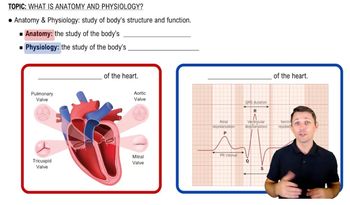
What principle states that anatomy is tied to its specific function?
The principle of complementarity states that anatomy is intimately tied to its specific function.
What is the correct logical organization from smallest to largest?
Atoms, molecules, cells, tissues is the correct logical organization.
Which body system is responsible for manipulating the environment?
The muscular system is responsible for manipulating the environment.
Define homeostasis.
Homeostasis is the ability to maintain relatively stable internal conditions even though the outside world changes continuously.
What is an example of a negative feedback mechanism?
The thyroid gland releasing thyroid hormone under TSH influence, where TSH decreases when thyroid hormone reaches set point, is an example of negative feedback.
Which of the following is NOT matter?
Energy is not matter; blood plasma, air, and bone are matter.
What is chemical energy?
Chemical energy is energy stored in bonds between atoms and is a form of potential energy.
What type of energy do your arms provide when rowing a boat?
Your arms provide mechanical energy when rowing a boat.
Example of conversion of potential energy into kinetic energy?
ATP hydrolysis to drive muscle contraction converts potential energy into kinetic energy.
When energy converts from one form to another, what is lost?
Some energy is lost as heat during energy conversion.
Which four elements make up 96% of living matter?
Carbon, hydrogen, nitrogen, and oxygen comprise 96% of living matter.
What does an atom’s nucleus contain?
An atom’s nucleus contains protons and neutrons.
What is the atomic number equal to?
The atomic number equals the number of protons in an atom.
Mass number of lithium with 3 protons and 4 neutrons?
The mass number is 7 (3 protons + 4 neutrons).
What forms when atoms of two different elements bind?
They form a compound.
Which mixtures are homogeneous?
Solutions are homogeneous mixtures.
What determines an atom’s bonding behavior?
The number of valence shell electrons determines bonding behavior.
What happens when atoms gain electrons?
Atoms become negatively charged when they gain electrons.
Isotopes have the same number of ______ but differ in ______.
Isotopes have the same number of protons but differ in the number of neutrons.
How do ionic bonds connect atoms?
Ionic bonds connect atoms by attractions between cations and anions.
What forms an ionic bond?
An ionic bond forms between a cation and an anion.
When do covalent bonds occur?
Covalent bonds occur when electrons are shared between atoms.
What type of bond shares electrons unequally?
A polar covalent bond shares electrons unequally.
What makes an atom electronegative?
An atom is electronegative if it lacks only 1–2 electrons in the valence shell.
Why is water a polar molecule?
Oxygen pulls electrons away from hydrogen and becomes more negative, making water polar.
How are hydrogen bonds similar to ionic bonds?
Both are due to opposite charge attractions.
In a chemical reaction, what combines to form what?
Reactants combine to form products.
During which reaction are bonds broken?
Bonds are broken during catabolic reactions.
What property of water explains its high heat capacity and solvent abilities?
Water’s ability to form hydrogen bonds explains these properties.
Which is NOT a function of water?
Water is NOT a source of electrolytes.
What happens at chemical equilibrium?
No further net change in amounts of reactants and products occurs.
Effect of increasing reactant concentration on reaction speed?
Increasing reactants increases the speed of the reaction.
Which factor does NOT affect reaction rate?
Density does not affect reaction rate.
What does a very acidic substance with pH 1 or 2 indicate?
It has a high concentration of H+ ions.
How much more acidic is HCl (pH 0) than lemon juice (pH 2)?
HCl is 100 times more acidic than lemon juice.
Which pH indicates a weak base?
A pH of 11.0 indicates a weak base.
How does the bicarbonate buffer system counteract acidosis?
The weak base HCO3- binds excess hydrogen ions, increasing pH.
How does the respiratory system decrease acidosis?
Carbonic acid is broken down into water and CO2; the CO2 is then exhaled.
What is a substance that dissociates into cations and hydroxyl ions?
It is a base.
What are the four major organic compounds in the body?
Proteins, carbohydrates, lipids, and nucleic acids.
Major function of carbohydrates in the body?
Carbohydrates serve as cellular fuel.
Which reaction breaks down biological molecules?
Hydrolysis breaks down biological molecules.
Three major subclasses of lipids?
Phospholipids, steroids, and triglycerides.
A steroid is an example of what type of compound?
A steroid is a lipid.
Major building block for proteins?
Amino acids are the building blocks of proteins.
Which is NOT a function of proteins?
Proteins do NOT act as genes.
What describes the tertiary structure of proteins?
Tertiary structure is the folding of α-helical or β-pleated regions upon one another.
What is the quaternary structure of proteins?
Quaternary structure involves aggregation of polypeptides forming a complex protein.
What is an enzyme’s substrate?
The substrate is the molecule upon which an enzyme acts.
Effect of increasing enzyme substrate concentration?
Increasing substrate concentration speeds up the reaction up to a point.
Major building blocks of nucleic acids?
Nucleotides are the building blocks of nucleic acids.
Four DNA nucleotides?
Adenine, thymine, cytosine, and guanine.
Which is NOT a metabolic function of ATP?
ATP does NOT provide energy for diffusion.
Primary energy-transferring molecule in the cell?
ATP is the primary energy-transferring molecule.
Three main components of all cells?
Plasma membrane, nucleus, and cytoplasm.
How do phospholipids orient in aqueous solutions?
Polar heads face the interior and exterior; lipid tails form the membrane center.
What stabilizes the membrane and decreases fluidity?
Cholesterol stabilizes the membrane and decreases fluidity.
Which membrane junction is prevalent in areas of mechanical stress?
Desmosomes are prevalent in mechanically stressed areas.
What happens to a red blood cell placed in distilled water?
It will gain water via osmosis.
What is secondary active transport?
Movement of substances driven by Na+ ions moving down their concentration gradient.
What are vesicles?
Vesicles are structures that store chemicals to be released outside the cell.
Which vesicular transport is common in lungs exposed to pathogens?
Phagocytosis is common in lungs exposed to pathogens.
What does the sodium-potassium pump do?
It pumps Na+ out of and K+ into the cell.
What is the fluid between the plasma membrane and nuclear envelope?
The fluid is called cytosol.
Which organelle detoxifies harmful substances?
Peroxisomes contain enzymes that detoxify harmful substances.
Which organelle is abundant in energy-demanding cells like muscle?
Mitochondria are abundant in energy-demanding cells.
Which organelle is abundant in biosynthetic secretory cells like neurons?
Rough endoplasmic reticulum is abundant in such cells.
During which cell cycle stage is DNA replicated?
DNA is replicated during the S phase.
Which cell cycle stage causes permanent muscle paralysis?
The G0 stage causes permanent muscle paralysis.
Main function of DNA?
DNA dictates protein production.
What is the process of protein synthesis called?
Protein synthesis is called translation.
How many amino acids does every three nucleotides code for?
Every three nucleotides code for one amino acid.
What molecule do ribosomes slide along to make proteins?
Ribosomes slide along messenger RNA (mRNA).
If tRNA has GAU anticodon, which mRNA codon does it attach to?
It attaches to the CUA mRNA codon.
If DNA template strand is ATTGAC, what is the mRNA sequence?
 Back
Back
 3:06
3:06