Skip to main content
Anatomy & Physiology
My Course
Learn
Exam Prep
AI Tutor
Study Guides
Textbook Solutions
Flashcards
Explore
Try the app
My Course
Learn
Exam Prep
AI Tutor
Study Guides
Textbook Solutions
Flashcards
Explore
Try the app
Back
Anatomy & Physiology Exam 1 Study Guide (Chapters 17-19)
You can tap to flip the card.
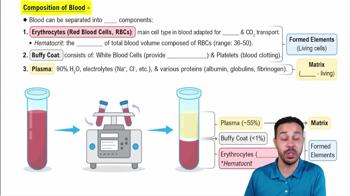
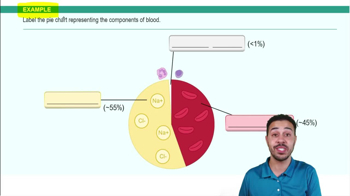
What are the formed elements of blood?
You can tap to flip the card.
👆
What are the formed elements of blood?
Erythrocytes
,
leukocytes
, and
platelets
.
Track progress
Control buttons has been changed to "navigation" mode.
1/29
Recommended videos
Guided course
2:36
Introduction to Blood Example 1
11112
views
331
rank
Guided course
7:49
Composition of Blood
11674
views
335
rank
Guided course
1:55
Introduction to Blood Example 2
9170
views
221
rank
Terms in this set (29)
Hide definitions
What are the formed elements of blood?
Erythrocytes
,
leukocytes
, and
platelets
.
Which formed elements have nuclei?
Leukocytes
have nuclei; erythrocytes lose their nucleus during maturation; platelets are cell fragments.
What is the lifespan of an erythrocyte and why?
120 days because erythrocytes lack nuclei and cannot undergo mitosis.
What is thrombocytopenia?
A decreased number of platelets in the blood.
Name the important plasma proteins and their functions.
Albumin
maintains osmotic pressure,
globulins
form antibodies, and
fibrinogen
forms fibrin during coagulation.
What triggers erythropoiesis?
Lack of oxygen or increased tissue oxygen demand.
Which organ produces erythropoietin and where are RBCs produced?
The
kidney
produces erythropoietin; RBCs are produced in the
red bone marrow
.
Which blood clotting disease is X-linked and more common in men?
Hemophilia
.
What leukocytes are granulocytes and which are agranulocytes?
Granulocytes:
neutrophils
,
basophils
,
eosinophils
. Agranulocytes:
lymphocytes
,
monocytes
.
What are the three steps of hemostasis?
1.
Vascular spasm
: vessel constricts. 2.
Platelet plug
: platelets stick to injury. 3.
Coagulation
: fibrin threads reinforce plug.
What is prothrombin converted to during coagulation?
Thrombin
.
What is fibrinogen converted to during coagulation?
Fibrin
.
Where are antigens and antibodies found in blood?
Antigens are on
RBC membranes
; antibodies are in the
plasma
.
Which blood type is the universal recipient and why?
AB+
because it has all antigens and no plasma antibodies.
Which blood type is the universal donor and why?
O-
because RBCs have no antigens.
What is erythroblastosis fetalis and when does it occur?
A condition where Rh- mother produces antibodies against Rh+ fetus during a second pregnancy, destroying fetal RBCs.
Where is the heart located anatomically?
In the
mediastinum
, on the diaphragm surface, apex points toward the left hip.
What is the coronary sulcus?
A groove between the atria and ventricles of the heart.
What happens if a coronary artery is blocked?
Ischemia (lack of oxygen) to the cardiac muscle served by that artery.
Name the branches of the left coronary artery.
Anterior interventricular branch
and
circumflex branch
.
Name the branches of the right coronary artery.
Posterior interventricular artery
and
left marginal artery
.
What valves are closed at the beginning of ventricular systole?
Atrioventricular (AV) valves
are closed.
What valves are closed at the beginning of ventricular diastole?
Semilunar (SL) valves
are closed.
What is the pacemaker of the heart?
The
sinoatrial (SA) node
.
What does an electrocardiogram (ECG) record?
The electrical activity of the heart.
What do the P wave, QRS complex, and T wave represent in an ECG?
P wave: atrial depolarization; QRS complex: ventricular depolarization; T wave: ventricular repolarization.
What are the three tunics of blood vessels?
Tunica intima
,
tunica media
, and
tunica adventitia
.
What is cardiac output and its formula?
Amount of blood ejected per minute; \(CO=SV \times HR\).
How do athletes maintain normal cardiac output with low heart rate?
They have a higher
stroke volume
.
 BackBack
 2:36