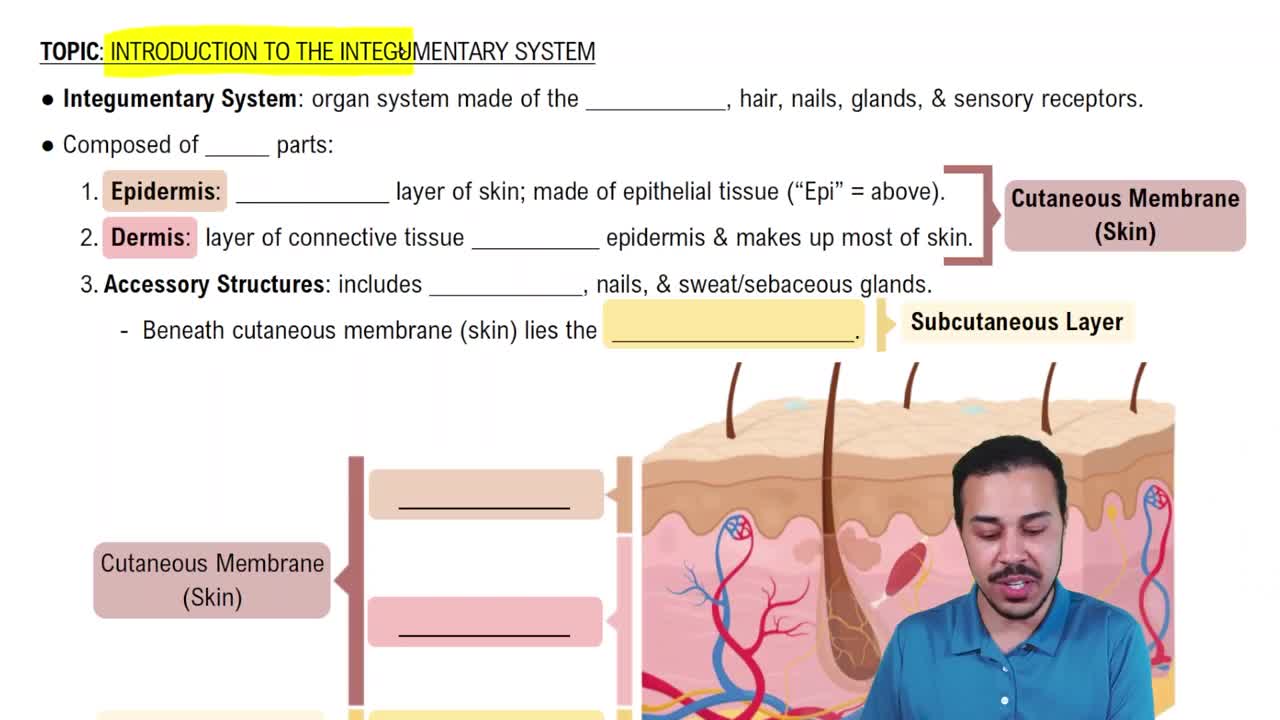
A cutaneous membrane is the skin, consisting of an outer epidermis and inner dermis, serving as a protective barrier.
What is a synovial membrane?
A synovial membrane lines joint cavities and produces synovial fluid for lubrication.
What is a mucous membrane?
A mucous membrane lines body cavities open to the exterior and secretes mucus for protection and lubrication.
What part of the hair is visible?
The hair shaft is the visible part of the hair above the skin surface.
What is the hair matrix?
The hair matrix is the growth zone at the base of the hair follicle where cells divide to form hair.
What are the layers of the epidermis?
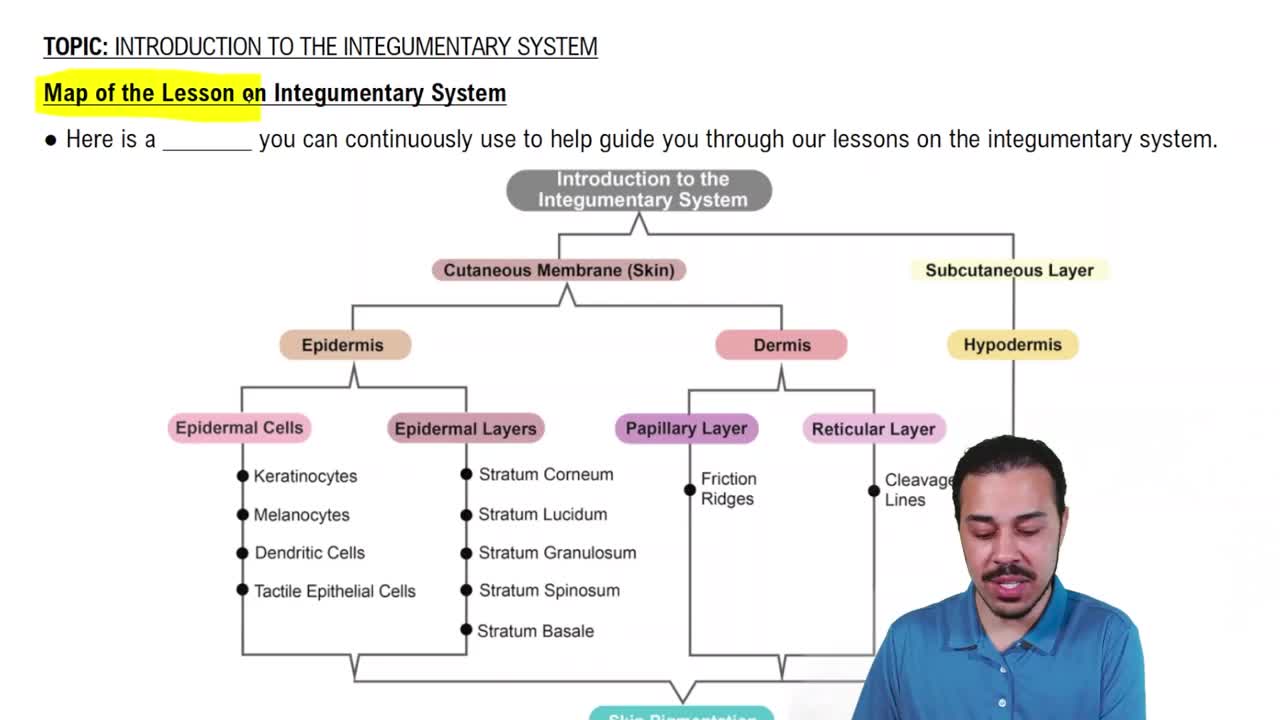
The epidermis has five layers: stratum basale, stratum spinosum, stratum granulosum, stratum lucidum (only in thick skin), and stratum corneum.
What gives skin its pigment color?
Skin color is mainly due to melanin, produced by melanocytes, with contributions from carotene and blood flow.
What determines hair color?
Hair color depends on the type and amount of melanin in the hair cortex.
What is an exocrine gland?
An exocrine gland secretes substances through ducts to an epithelial surface.
What is an endocrine gland?
An endocrine gland releases hormones directly into the bloodstream.
What are the types of burns and tissue involved?
First-degree burns affect the epidermis; second-degree burns affect epidermis and part of dermis; third-degree burns destroy epidermis, dermis, and possibly deeper tissues.
What are the parts of the fingernail?
Fingernails include the nail plate, nail bed, lunula, and cuticle.
What are the types of skin cancer?
Common types are basal cell carcinoma, squamous cell carcinoma, and melanoma, originating from different skin layers.
What are the ABCDE rules for melanoma?
Asymmetry, Border irregularity, Color variation, Diameter >6mm, Evolving shape or size.
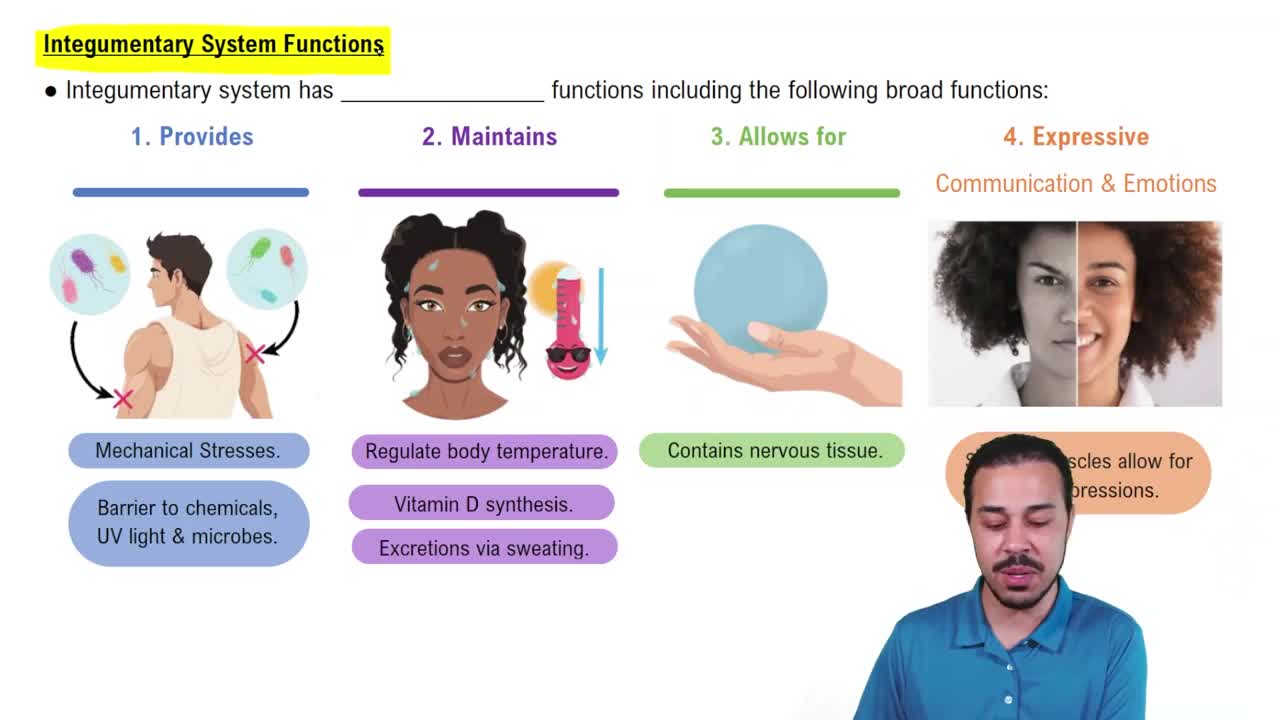
What are the functions of the integumentary system?
Protection, temperature regulation, sensation, vitamin D synthesis, and excretion.
What proteins are found in the skin?
Keratin is the main structural protein; collagen provides strength in the dermis.
What makes up the dermis and hypodermis?
The dermis contains connective tissue, blood vessels, and glands; the hypodermis is mainly adipose tissue for insulation and cushioning.
What are the characteristics of sebum?
Sebum is an oily secretion from sebaceous glands that lubricates and waterproofs skin and hair.
What is the rule of 9’s?
A method to estimate body surface area burned by dividing the body into sections of 9% or multiples thereof.
What causes graying of hair?
Loss of melanin production in hair follicles causes hair to turn gray or white.
What is vitiligo?
Vitiligo is a condition where melanocytes are destroyed, causing loss of skin pigment in patches.
What are the functions of the skeletal system?
Support, protection, movement, mineral storage, blood cell production, and fat storage.
What are the different types of bones?
Long, short, flat, irregular, and sesamoid bones.
What is canaliculi?
Canaliculi are tiny channels connecting osteocytes in bone for nutrient and waste exchange.
What is ossification?
Ossification is the process of bone formation.
What is hematopoiesis?
Hematopoiesis is the production of blood cells, occurring in red bone marrow.
What do osteoblasts, osteoclasts, and osteocytes do?
Osteoblasts build bone, osteoclasts break down bone, and osteocytes maintain bone tissue.
 Back
 06:54