 Back
Anatomy & Physiology Exam 2 Study Guide
 3:56

Terms in this set (29)
The skin has two main layers: the epidermis (superficial, epithelial, avascular) and the dermis (deep, connective tissue, vascularized).
Stratum basale → stratum spinosum → stratum granulosum → stratum lucidum (only in thick skin) → stratum corneum.
Keratinocytes produce keratin and are found in all epidermal layers, changing shape from cuboidal/columnar to squamous as they move outward.
Produce melanin pigment to protect keratinocyte nuclei from UV radiation; located in stratum basale.
Phagocytose foreign substances and activate immune responses; found in stratum spinosum.
Serve as sensory receptors for touch; located in stratum basale.
Granules in stratum granulosum keratinocytes that bind pre-keratin filaments together to form keratin.
Secrete water-resistant glycolipids in stratum granulosum, providing epidermal waterproofing.
Papillary dermis: superficial, loose areolar CT; Reticular dermis: deep, dense irregular CT.
Finger-like projections of dermis into epidermis containing capillaries and sensory receptors.
Raised epidermal ridges over dermal papillae that improve grip and tactile sensitivity (e.g., fingerprints).
Lines of collagen fiber orientation in reticular dermis; incisions parallel to these lines heal better.
Dermal folds near joints where skin is tightly anchored to underlying structures, allowing joint movement.
Melanin (produced by melanocytes), carotene (yellow-orange pigment), and hemoglobin (red pigment in blood).
Melanin sits above keratinocyte nuclei, absorbing UV radiation to prevent DNA damage.
From deep to superficial: medulla, cortex, cuticle.
Layer of rapidly dividing cells at hair bulb base responsible for hair growth.
Attached to hair follicle; contraction causes hair to stand (goosebumps) and stimulates sebum release.
Vellus: soft, fine hair on children and women; Terminal: coarse, pigmented hair on scalp, eyebrows, and after puberty in certain areas.
Eccrine glands: watery sweat for cooling; Apocrine glands: thicker sweat in axillary/genital areas; Sebaceous glands: secrete oily sebum.
Chemical (acidic secretions, melanin), physical (keratinocytes and lipids), and biological (immune cells).
Controls temperature via sweating (evaporative cooling) and blood vessel dilation/constriction.
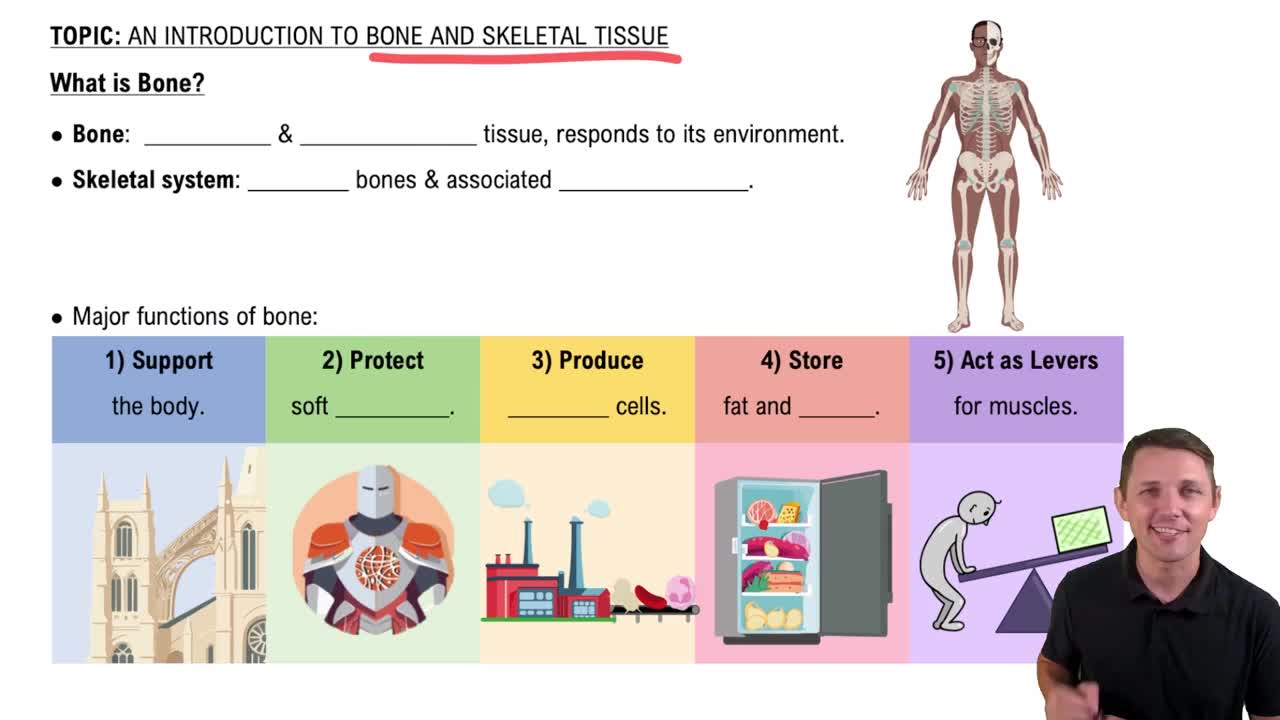
Support, protection, anchorage, mineral storage, blood cell formation, triglyceride storage, hormone production.
Hyaline: articular surfaces, ribs; Elastic: ear, epiglottis; Fibrocartilage: intervertebral discs, menisci.
Structural unit of compact bone; concentric lamellae surrounding a central canal with blood vessels and nerves.
Osteoblasts build bone; osteoclasts resorb bone; osteocytes communicate stress signals.
Bone remodels in response to mechanical stress, growing stronger where stress is greatest.
Articular cartilage, joint cavity, articular capsule, synovial fluid, reinforcing ligaments, nerves and blood vessels.
Plane (gliding), hinge (flexion/extension), pivot (rotation), condylar (biaxial), saddle (biaxial), ball-and-socket (multiaxial).