Number of cranial bones and their general function
There are 8 cranial bones that protect the brain and support the structures of the face.
Number of facial bones and their general function
There are 14 facial bones that form the shape of the face and provide cavities for the sense organs.
Bones forming the bony nasal septum
The bony nasal septum is formed by the vomer and the perpendicular plate of the ethmoid bone.
Bones forming the hard palate
The hard palate is formed by the palatine processes of the maxillae and the horizontal plates of the palatine bones.
Bones forming the zygomatic arch (cheekbone)
The zygomatic arch is formed by the zygomatic bone and the zygomatic process of the temporal bone.
Bones forming the bony orbit
The bony orbit is formed by parts of the frontal, sphenoid, zygomatic, maxilla, palatine, lacrimal, and ethmoid bones.
Bones containing paranasal sinuses and their function
Paranasal sinuses are found in the frontal, sphenoid, ethmoid, and maxillary bones. They lighten the skull and resonate the voice.
Number of bones in the vertebral column
The vertebral column has 24 vertebrae, plus the sacrum (5 fused bones) and coccyx (4 fused bones) for a total of 33 bones.
Divisions and curvatures of the spine
The spine has 5 divisions: cervical (7), thoracic (12), lumbar (5), sacral (5 fused), coccygeal (4 fused). Primary curvatures are thoracic and sacral; secondary curvatures are cervical and lumbar.
Intervertebral discs act as shock absorbers and allow flexibility. They consist of a nucleus pulposus (gelatinous center) and an annulus fibrosus (fibrous outer ring).
Articulation of ribs 2-9 with thoracic vertebrae
Ribs 2-9 articulate with the demifacets on two adjacent thoracic vertebrae and the .
Classification of ribs: true, false, floating
True ribs (1-7) attach directly to the sternum; false ribs (8-12) attach indirectly or not at all; floating ribs (11-12) do not attach to the sternum.
Bones forming the pectoral girdle and its function
The pectoral girdle consists of the clavicle and scapula. It supports the upper limbs and allows a wide range of motion.
Bones forming the pelvic girdle and its function
The pelvic girdle is formed by two coxal bones (ilium, ischium, pubis). It supports the weight of the body and protects pelvic organs.
Differences between male and female pelvis
Female pelvis is wider, shallower, and has a larger pelvic inlet and outlet for childbirth; male pelvis is narrower and taller.
Three types of cartilage and their locations
Hyaline cartilage: most common, found in joints and respiratory tract; elastic cartilage: flexible, in ear and epiglottis; fibrocartilage: strong, in intervertebral discs and pubic symphysis.
Appositional vs interstitial cartilage growth
Appositional growth adds new cartilage to the surface; interstitial growth expands cartilage from within by chondrocyte division.
Functions of the periosteum
The periosteum covers bone surfaces, contains osteoblasts for growth and repair, and provides attachment for tendons and ligaments.
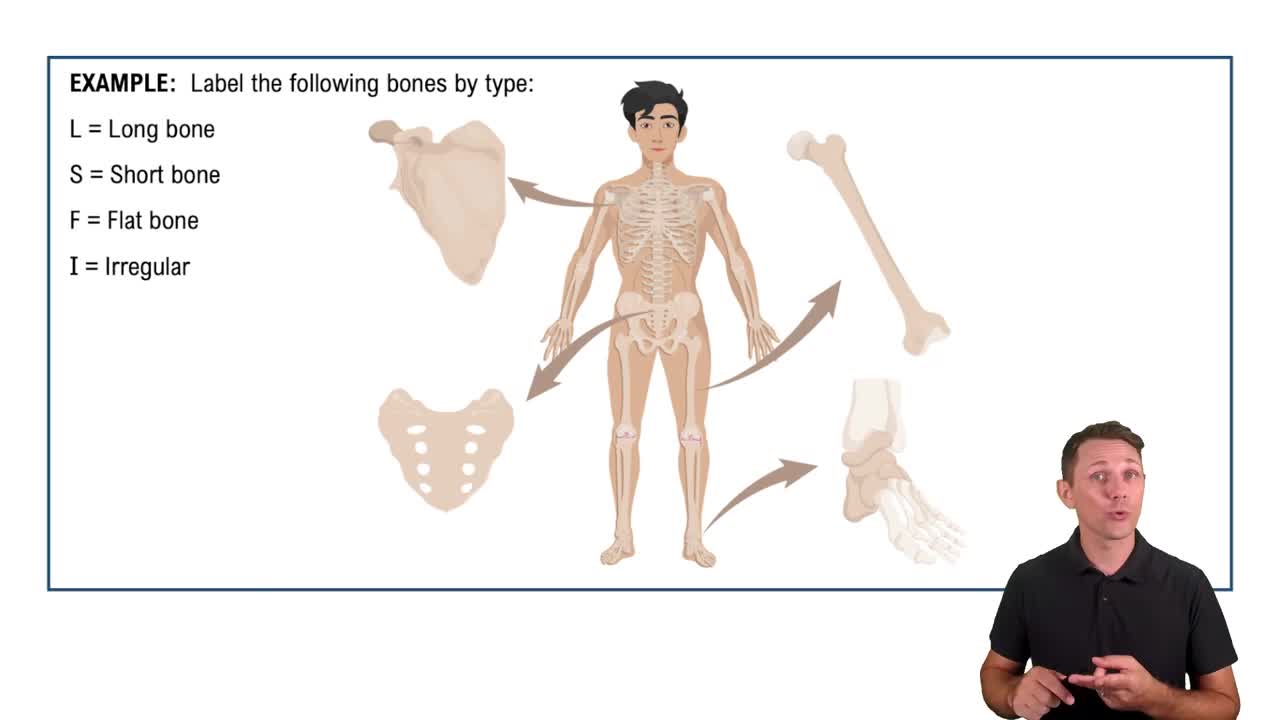
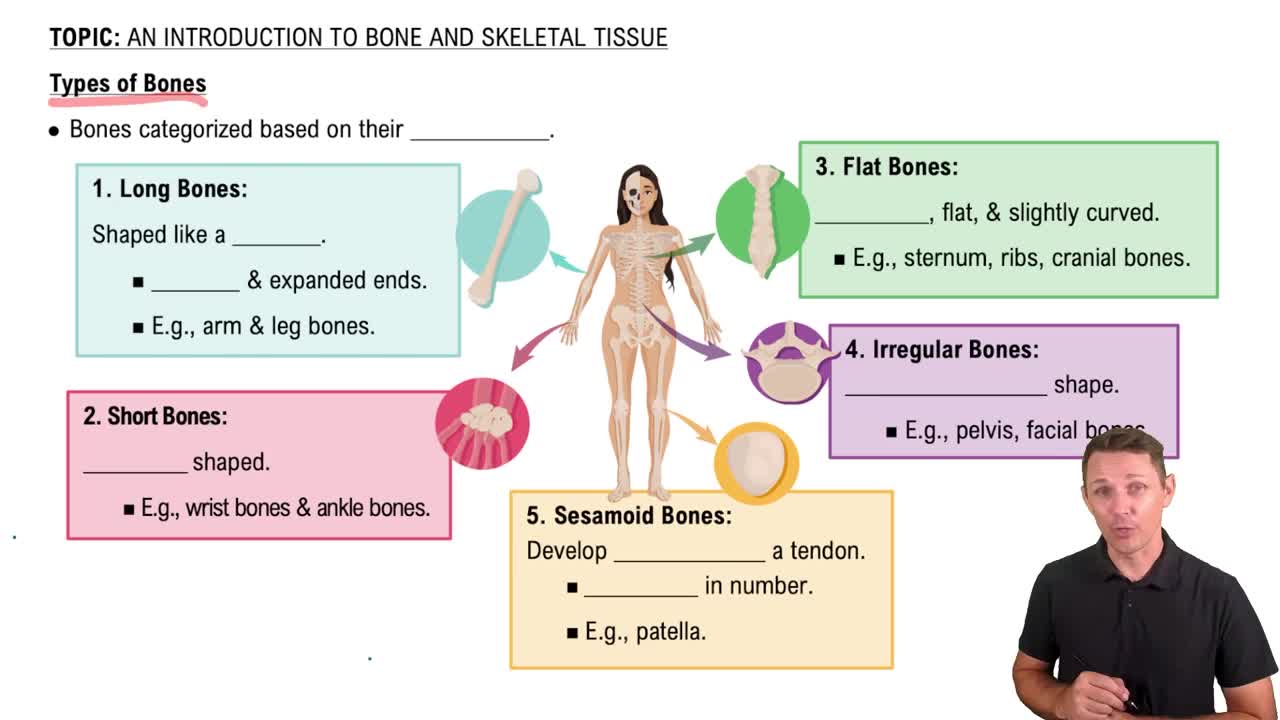
Classification of bones by shape
Bones are classified as long, short, flat, irregular, or sesamoid based on their shape and structure.
Differences between compact and spongy bone
Compact bone is dense and forms the outer layer; spongy bone is porous, found inside bones, and contains red marrow.
Structure of a long bone
Long bones have a diaphysis (shaft) of compact bone, epiphyses (ends) with spongy bone, periosteum outside, endosteum lining marrow cavity, and contain bone marrow.
Bone cells and their functions
Osteoblasts build bone, osteocytes maintain bone, osteoclasts resorb bone, all derived from different precursors.
Red vs yellow bone marrow
Red marrow produces blood cells and is found in spongy bone; yellow marrow stores fat and is found in medullary cavities of adults.
Organic and inorganic components of bone tissue
Organic matrix (collagen) provides flexibility; inorganic minerals (hydroxyapatite) provide hardness and strength.
Endochondral vs intramembranous ossification
Endochondral ossification forms most bones from cartilage models; intramembranous ossification forms flat bones directly from mesenchyme.
Zones of the epiphyseal plate during bone length growth
Zones include resting, proliferative, hypertrophic, calcification, and ossification, where cartilage grows and is replaced by bone.
Definition of joints (articulations)
Joints are points where two or more bones meet, allowing varying degrees of movement.
Structural and functional classifications of joints
 Back
 3:56