 Back
BackAnatomy & Physiology Exam 3 Study Guide Flashcards
 6:13
6:13
Terms in this set (29)
The pulmonary circuit carries blood to and from the lungs, while the systemic circuit transports blood to and from the rest of the body.
The heart has four chambers: right atrium, right ventricle, left atrium, and left ventricle.
The heart wall consists of the epicardium (outer layer), myocardium (muscular middle layer), and endocardium (inner lining).
Intercalated discs connect cardiac muscle cells, transmitting contraction force and action potentials between cells.
Blood enters the right atrium via the superior and inferior vena cava, passes through the tricuspid valve into the right ventricle, then through the pulmonary semilunar valve into the pulmonary trunk.
Oxygenated blood enters the left atrium via pulmonary veins, passes through the mitral (bicuspid) valve into the left ventricle, then through the aortic semilunar valve into the aorta.
The left ventricle has a thick muscular wall to pump blood systemically; the right ventricle has a thinner wall for pulmonary circulation.
Coronary circulation supplies oxygen and nutrients to cardiac muscle via coronary arteries and veins.
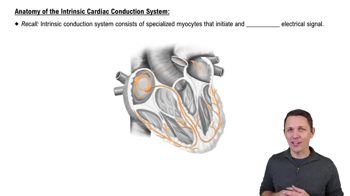
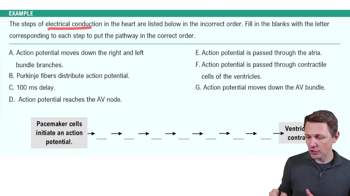
Impulse starts at the SA node, travels to the AV node, then to the AV bundle, bundle branches, and Purkinje fibers to ventricular myocardium.
P wave: atrial depolarization; QRS complex: ventricular depolarization; T wave: ventricular repolarization.
The cardiac cycle includes systole (contraction) and diastole (relaxation) of the heart chambers.
"Lub" is caused by closing of AV valves; "Dub" is caused by closing of semilunar valves.
Stroke volume (SV) is blood ejected per beat; cardiac output (CO) is blood pumped per minute, calculated as CO = SV × heart rate.
Increased ventricular wall stretch leads to stronger contractions and increased stroke volume.
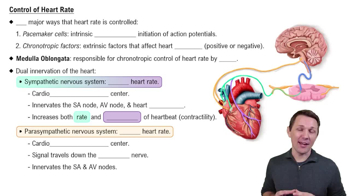
Parasympathetic stimulation (ACh) decreases heart rate and stroke volume; sympathetic stimulation (NE) increases both.
Arteries and veins have three layers: tunica intima, tunica media, and tunica externa.
Capillaries allow exchange of gases, nutrients, and wastes between blood and interstitial fluid.
Systolic pressure is peak arterial pressure during ventricular contraction; diastolic pressure is minimum pressure during relaxation; their difference is pulse pressure.
Baroreceptors in carotid sinuses, aortic arch, and right atrium detect stretch and help regulate blood pressure.
Innate immunity provides nonspecific defense; adaptive immunity involves specific responses by T cells and B cells.
Cytotoxic T cells kill infected cells; helper T cells stimulate immune responses; regulatory T cells moderate immunity; memory T cells provide long-term immunity.
B cells activated by helper T cells differentiate into plasma cells that produce antibodies and memory B cells for future responses.
IgG, IgM, IgA, IgE, and IgD each have distinct roles in immune defense and are found in different body fluids or cell surfaces.
Functions include gas exchange, air movement, protection of exchange surfaces, sound production, and olfactory stimulation.
Conducting portion moves air (nose to terminal bronchioles); respiratory portion (respiratory bronchioles and alveoli) allows gas exchange.
Airflow depends on pressure differences; inhalation uses diaphragm and external intercostals; exhalation is passive at rest.
Most oxygen binds to hemoglobin in red blood cells for transport to tissues.
CO2 is transported dissolved in plasma, bound to hemoglobin as carbaminohemoglobin, or as bicarbonate ions formed by carbonic acid dissociation.
From inside out: mucosa, submucosa, muscular layer, and adventitia or serosa.