 Back
BackAnatomy & Physiology: Eye, Visual Pathway, Chemical Senses, and Ear
 4:16
4:16
Terms in this set (32)
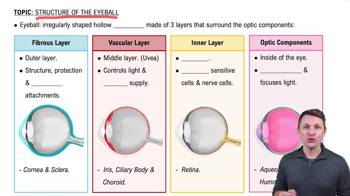
Consists of the sclera and cornea. The sclera shapes and protects the eye and anchors muscles. The cornea is transparent and refracts light.
Shapes the eye, protects it, and anchors the eye muscles. It is opaque and covers 5/6 of the eyeball.
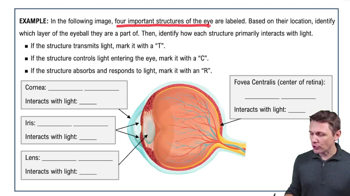
Transparent layer that refracts light entering the eye. It has no blood vessels.
Includes the choroid, ciliary body, and iris. Provides blood supply, holds the lens, and controls light entry.
Supplies oxygen and nutrients to the outer retina and absorbs stray light with brown pigment.
Contains smooth muscle to hold the lens and secretes aqueous humor via capillaries.
Sphincter pupillae constricts the pupil; dilator pupillae dilates the pupil. Controls light entry.
Contains cells like bipolar, ganglion, amacrine, and horizontal cells that process visual signals.
Blind spot where the optic nerve exits the eye; contains no photoreceptors.
Rods detect dim light and black/white vision; cones detect bright light and color.
Fills the anterior segment, helps shape the eye, and protects internal structures.
Excess aqueous humor increases intraocular pressure, potentially causing blindness.
Gel-like fluid in the posterior segment that maintains eye shape and supports the retina.
Transparent, avascular structure made of crystallin-filled fibers; focuses light precisely on the retina.
Clouding of the lens due to aging; surgery is the only treatment.
When moving from dark to bright, pupils constrict and cones activate to reduce glare.
When moving from bright to dark, pupils dilate and rods activate as cones stop working.
Light passes through cornea → aqueous humor → lens → vitreous humor → retina → photoreceptors.
Process of increasing lens curvature to focus light on the retina for near objects.
Both eyes simultaneously point toward the same object to maintain single binocular vision.
Use a concave lens to correct nearsightedness caused by an eyeball that is too long.
Use a convex lens to correct farsightedness caused by an eyeball that is too short.
Caused by unequal curvatures of cornea or lens; corrected with ground lenses, corneal implants, or laser surgery.
Retinal ganglion axons form optic nerve; fibers cross at optic chiasm; signals go to lateral geniculate nucleus and visual cortex.
Regulate wake/sleep signals, pupillary reflexes, and circadian rhythms via hypothalamic nuclei.
Bipolar neurons in the olfactory epithelium that detect odors and send signals to the brain.
Supporting cells protect receptors; basal cells regenerate olfactory receptor neurons.
Olfactory receptor cells → olfactory bulb → olfactory tract → olfactory cortex and limbic system.
Taste buds on fungiform, foliate, and circumvallate papillae detect chemicals dissolved in saliva.
Taste is about 80% dependent on smell; both require aqueous solutions to activate receptors.
External and middle ear handle hearing; internal ear handles hearing and balance (equilibrium).
Uses fluid-filled canals in the inner ear to detect head movement and maintain equilibrium.