 Back
Anatomy & Physiology: Fluids & Electrolytes
 02:59



Terms in this set (20)
Osmoregulation is the regulation of solute balance and water loss to maintain homeostasis of water content in the body.
Kidneys filter blood plasma and form urine, ureters transport urine to the bladder, the bladder stores urine, and the urethra is the opening through which urine leaves the body.
Ammonia: toxic, requires dilution; Urea: less toxic, energy costly; Uric acid: insoluble, minimal water loss, energy intensive.
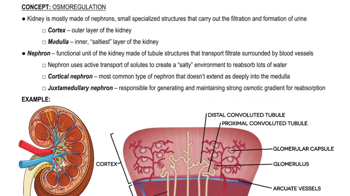
The nephron is the functional unit, consisting of tubules that transport filtrate and are surrounded by blood vessels. It includes the cortex and medulla regions.
Cortical nephrons are more common and stay mostly in the cortex; juxtamedullary nephrons extend deep into the medulla and create strong osmotic gradients for water reabsorption.
RAAS controls blood volume by increasing salt and water reabsorption, raising blood pressure through vasoconstriction and aldosterone release.
Aldosterone stimulates the distal tubule and collecting duct to reabsorb more salt, causing water to follow and increasing blood volume and pressure.
An electrolyte is a compound that dissociates into ions in water, such as NaCl dissociating into Na+ and Cl-.
Osmosis is the movement of water across a membrane from an area of low solute concentration to an area of high solute concentration.
Hyperosmotic: higher solute concentration; Isosmotic: equal solute concentration; Hypoosmotic: lower solute concentration compared to another solution.
Osmoconformers maintain internal osmolarity equal to their environment; Osmoregulators actively regulate internal osmolarity regardless of environment.
An adaptation allowing organisms like tardigrades to survive extreme dehydration by entering a dormant state without water.
An acid is any chemical that increases the concentration of H+ ions in a solution.
A base is any chemical that decreases the concentration of H+ ions in a solution.
Hydrochloric acid (HCl) is an acid; sodium hydroxide (NaOH) is a base.
Diffusion is the net movement of molecules from an area of high concentration to an area of low concentration.
Selective permeability means some solutes can cross a membrane due to transport proteins, while others cannot.
The nephron uses active transport of solutes to generate a high osmolarity in the medulla, facilitating water reabsorption.
Renin is released by the juxtaglomerular apparatus in response to low blood pressure or blood volume.
Angiotensin II raises blood pressure by causing vasoconstriction and stimulating aldosterone release.