What is the primary function of the heart in the body?
The heart's job is to pump blood continuously, ensuring oxygen and nutrients are delivered to tissues and waste products are removed.
What is the difference between the pulmonary circuit and the systemic circuit?
The pulmonary circuit carries deoxygenated blood from the heart to the lungs and back oxygenated, while the systemic circuit carries oxygenated blood from the heart to the body and returns deoxygenated blood.
What type of blood enters the right atrium and from where?
Deoxygenated blood enters the right atrium from the body via systemic veins.
What type of blood enters the left atrium and from where?
Oxygenated blood enters the left atrium from the lungs via pulmonary veins.
What are the four chambers of the heart and their primary functions?
Right atrium and left atrium collect blood; right ventricle and left ventricle pump blood out to lungs and body respectively.
Where does blood go after leaving the right ventricle?
Blood is pumped from the right ventricle to the lungs via the pulmonary artery for oxygenation.
Where does blood go after leaving the left ventricle?
Blood is pumped from the left ventricle to the body through the aorta.
What are the four main valves of the heart?
Tricuspid valve, pulmonary valve, mitral (bicuspid) valve, and aortic valve.
What is the purpose of the heart valves?
Valves prevent backflow of blood and ensure unidirectional flow through the heart chambers.
What are chordae tendinae and papillary muscles connected to, and why are they important?
They connect to the atrioventricular valves and prevent valve prolapse during ventricular contraction.
What does unidirectional blood flow mean in the heart?
Blood flows in one direction only, prevented from flowing backward by valves.
What is the cardiac cycle?
A sequence of heart chamber contractions and relaxations that pump blood, including systole (contraction) and diastole (relaxation).
Which chambers contract first during the cardiac cycle?
The atria contract first, followed by the ventricles.
What causes the 'lub' and 'dub' heart sounds?
'Lub' is caused by the closing of atrioventricular valves; 'dub' is caused by the closing of semilunar valves.
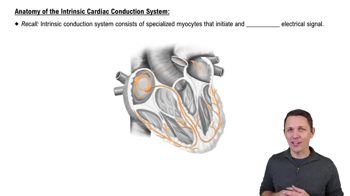
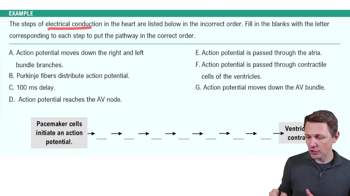
What are the main components of the heart's conduction system?
Sinoatrial (SA) node, atrioventricular (AV) node, bundle of His, bundle branches, and Purkinje fibers.
What is the role of the SA node?
The SA node generates electrical impulses that initiate the heartbeat and set the heart rate.
What are the three main layers of heart tissue?
Endocardium (inside), myocardium (middle muscular layer), and epicardium (outer layer).
What is the parietal layer and its function in the heart?
The parietal layer lines the pericardial cavity and, along with serous fluid, reduces friction during heartbeats.
Why is serous fluid important in the pericardial cavity?
It lubricates the heart, allowing smooth, frictionless movement during contractions.
 Back
Back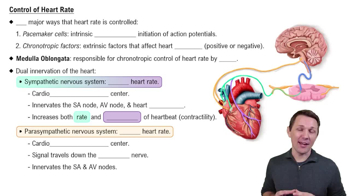
 6:13
6:13