 Back
Anatomy & Physiology: Homeostasis, Cell Structure, Membrane Transport, and Electrical Potentials
 01:59

Terms in this set (22)
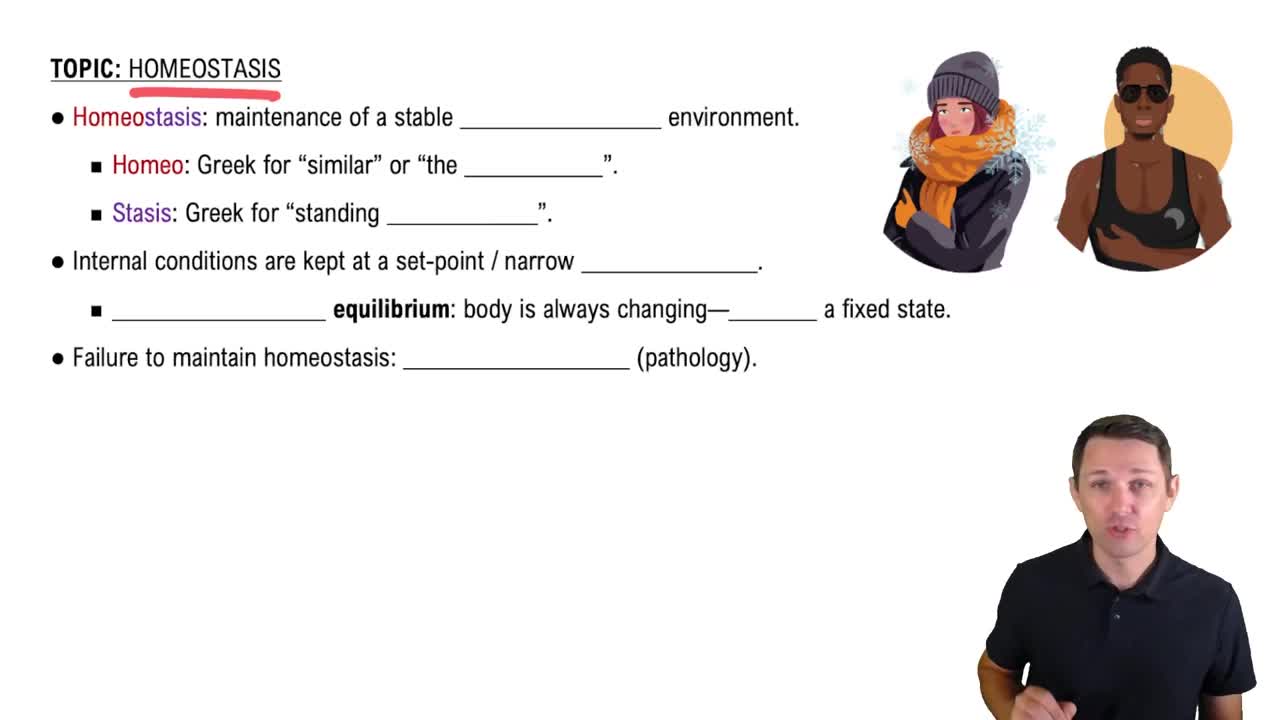
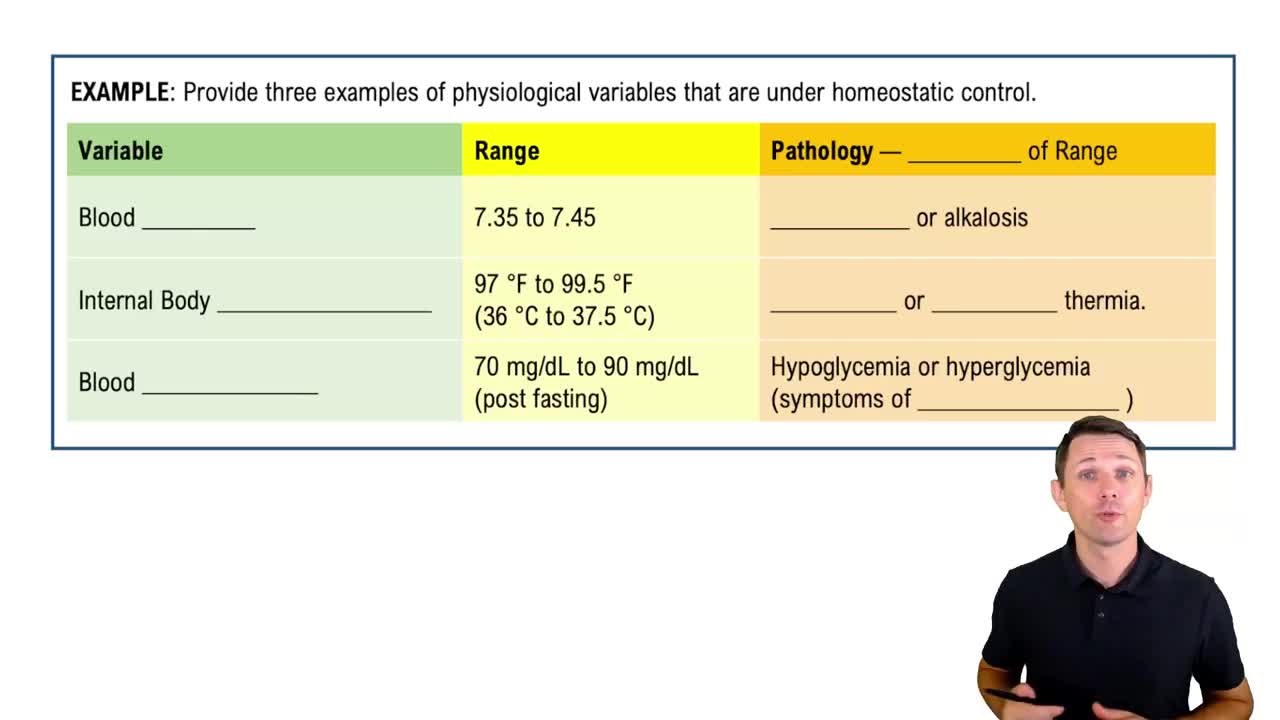
Homeostasis is the ability to detect change, activate mechanisms that oppose it, and maintain relatively stable internal conditions.
Negative feedback is a mechanism that reverses a change to maintain dynamic equilibrium around a set point, such as body temperature regulation.
1. Receptor senses change.
2. Integrating center processes information.
3. Effector carries out corrective action.
Positive feedback amplifies a change, leading to greater change in the same direction, such as oxytocin release during childbirth.
Atom → Molecule → Macromolecule → Organelle → Cell → Tissue → Organ → Organ system → Organism
The nucleus contains the cell's DNA and controls cellular activities.
Mitochondria are the powerhouse of the cell, converting nutrients into ATP (energy).
The plasma membrane is a phospholipid bilayer with hydrophilic heads facing outward and hydrophobic tails inward, making it selectively permeable.
It means the membrane allows some substances to pass while blocking others, controlling entry and exit of molecules.
1. Receptors bind chemicals to communicate.
2. Enzymes catalyze reactions.
3. Channels allow solutes/water passage.
4. Cell identity markers identify cells.
Movement of particles from high to low concentration down their concentration gradient without energy use.
Temperature, molecular weight, steepness of concentration gradient, membrane surface area, and membrane permeability.
Osmosis is the net flow of water across a selectively permeable membrane from low to high solute concentration.
Carrier-mediated transport of solutes down their concentration gradient without energy, using membrane proteins.
Active transport moves solutes against their concentration gradient and requires ATP, unlike facilitated diffusion.
The pump moves 3 Na+ ions out and 2 K+ ions into the cell using ATP, maintaining ion gradients essential for cell function.
RMP is the electrical potential difference across the plasma membrane at rest, typically around −70 mV in neurons.
Because of unequal ion distribution: more K+ inside, more Na+ outside, and negatively charged proteins inside.
Channels that open or close in response to stimuli: voltage-gated, ligand-gated, mechanically-gated, and leak channels.
Filtration uses physical pressure to force fluid through a membrane, while diffusion is movement down a concentration gradient.
Membrane receptors bind specific chemicals, triggering intracellular signaling cascades (second messengers) to alter cell activity.
It has hydrophilic heads and hydrophobic tails, allowing formation of a stable membrane that controls substance passage.