Back

Anatomy & Physiology: Human Body Structure and Chemistry

Control buttons has been changed to "navigation" mode.
1/25
  • What is the difference between anatomy and physiology?

    Anatomy studies the form and structure of the body, while physiology studies how the body functions. They are interconnected and cannot be studied separately.
  • Name the levels of structural organization from simplest to most complex.

    Chemical level, Cellular level, Tissue level, Organ level, Organ system level, Organismal level.
  • What are the four main tissue types in the human body?

    1) Epithelial tissue covers surfaces and lines cavities. 2) Connective tissue supports and binds structures. 3) Muscle tissue produces movement. 4) Nervous tissue conducts nerve impulses.
  • What are the three main layers of the skin in the integumentary system?

    The skin has three main layers: epidermis, dermis, and hypodermis (subcutaneous layer).
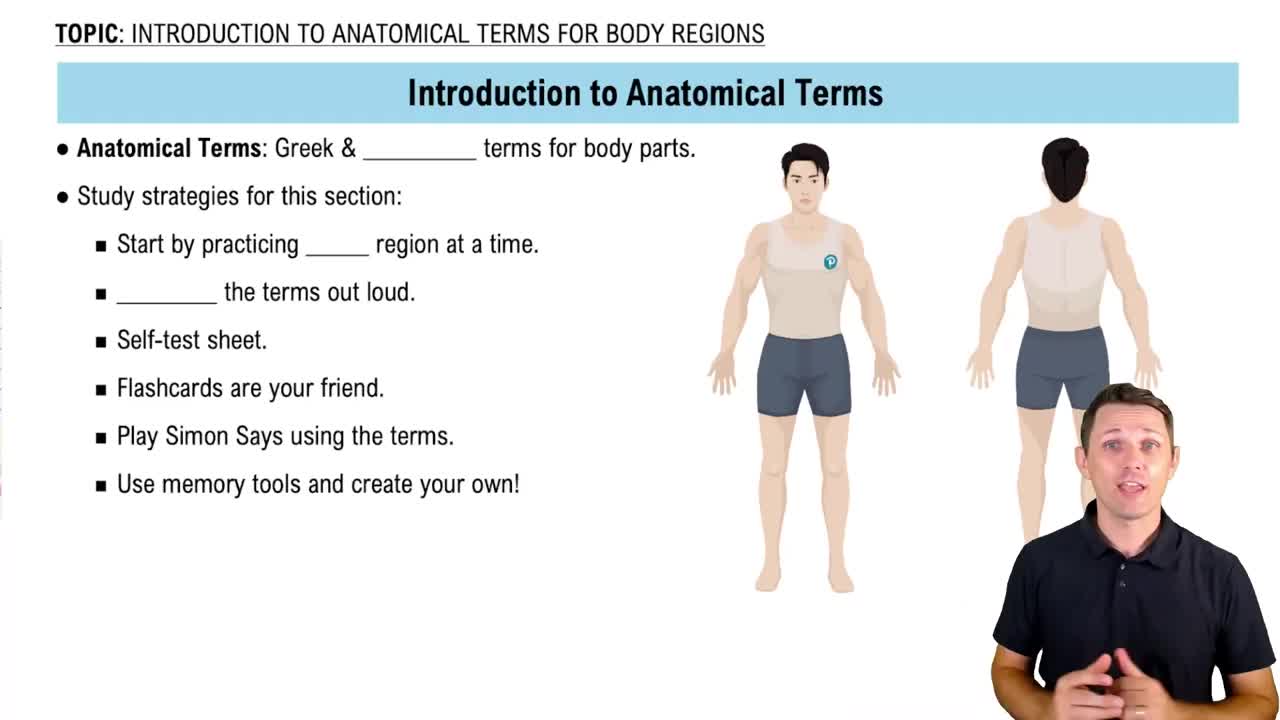
  • Describe the anatomical position.

    Upright stance, feet parallel and flat, upper limbs at sides, palms facing forward, head level, and eyes looking forward.
  • What are the three major body planes?

    Coronal (frontal) plane divides body into anterior and posterior; Transverse (cross-sectional) plane divides into superior and inferior; Midsagittal (median) plane divides into equal left and right halves.
  • Define homeostasis.

    The ability of an organism to maintain a stable internal environment or steady state despite changes in external or internal conditions.
  • What are the components of a homeostatic control system?

    Receptor detects changes, control center interprets input and initiates response, effector brings about change to restore homeostasis.
  • Explain negative feedback in homeostasis.

    A process where a change in a variable triggers a response that moves the variable in the opposite direction to return it to normal range.
  • What is the difference between negative and positive feedback?

    Negative feedback reverses a change to maintain stability; positive feedback amplifies a change until a climactic event occurs.
  • What are the major elements that compose the human body?

    Oxygen (65%), Carbon (18%), Hydrogen (10%), Nitrogen (3%), Calcium (1.5%), Phosphorus (1%).
  • What subatomic particles compose an atom?

    Protons (positive charge), Neutrons (no charge), and Electrons (negative charge).
  • What is the octet rule in chemical stability?

    Atoms tend to gain, lose, or share electrons to have a full outer shell of 8 electrons for stability.
  • Define ionic bond.

    An electrical attraction between positively charged cations and negatively charged anions forming salts.
  • What is a covalent bond?

    A chemical bond where atoms share one or more pairs of electrons.
  • What are isomers?

    Molecules with the same molecular formula but different arrangements of atoms in space.
  • Describe the polarity of water molecules.

    Water is a polar molecule with a partial negative charge near oxygen and partial positive charges near hydrogens, allowing hydrogen bonding.
  • What are the functions of water in the body?

    Transports substances, lubricates, cushions organs, and excretes wastes.
  • What is the pH scale and what does it measure?

    A scale from 0 to 14 measuring the concentration of hydrogen ions (H+) in a solution; lower pH is acidic, higher pH is basic.
  • What are the four major classes of organic biomolecules?

    Lipids, Carbohydrates, Nucleic acids, and Proteins.
  • What is dehydration synthesis?

    A chemical reaction where two monomers join by removing water, forming a covalent bond.
  • What is hydrolysis?

    A chemical reaction that breaks bonds between monomers by adding water.
  • What are the primary functions of proteins?

    Serve as enzymes, provide defense, aid transport, support structure, cause movement, regulate processes, and store molecules.
  • What determines the 3D conformation of a protein?

    Intramolecular interactions such as hydrophobic interactions, hydrogen bonds, ionic bonds, and disulfide bonds.
  • What is denaturation of a protein?

    A conformational change that disrupts protein function, often caused by heat or pH changes.