 Back
BackAnatomy & Physiology I - Key Concepts and Structures
 02:40
02:40
Terms in this set (31)
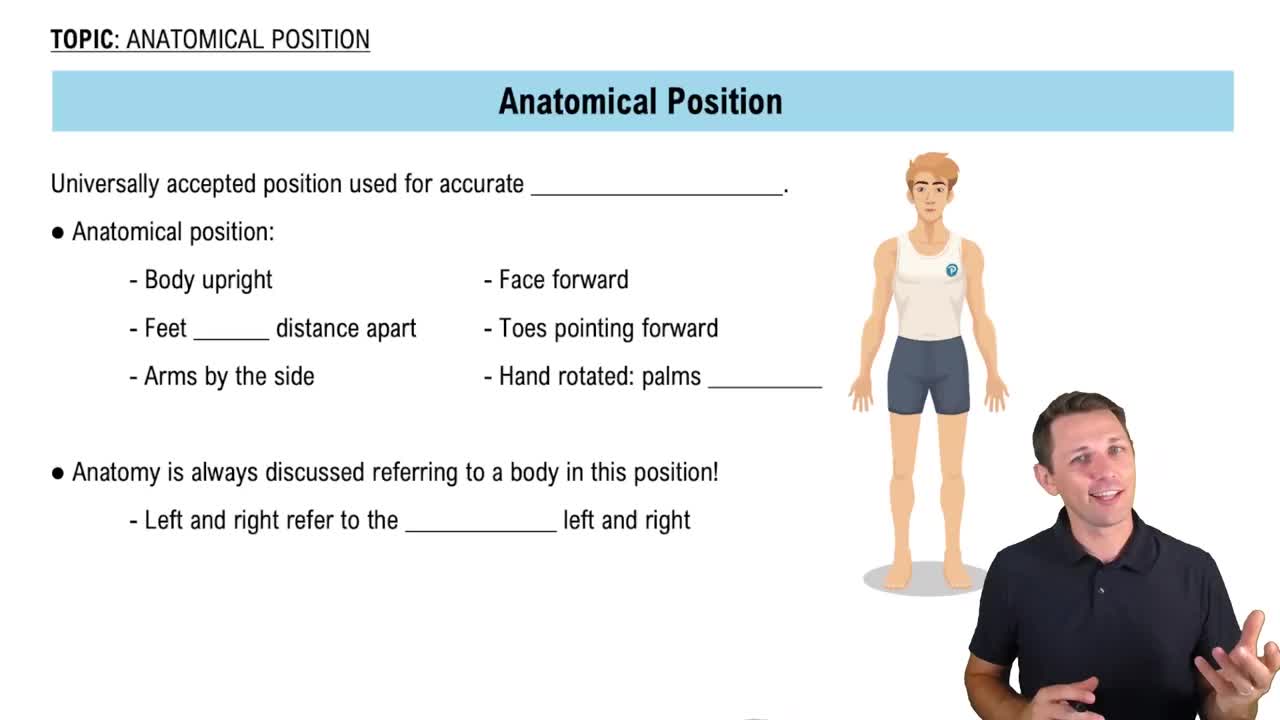
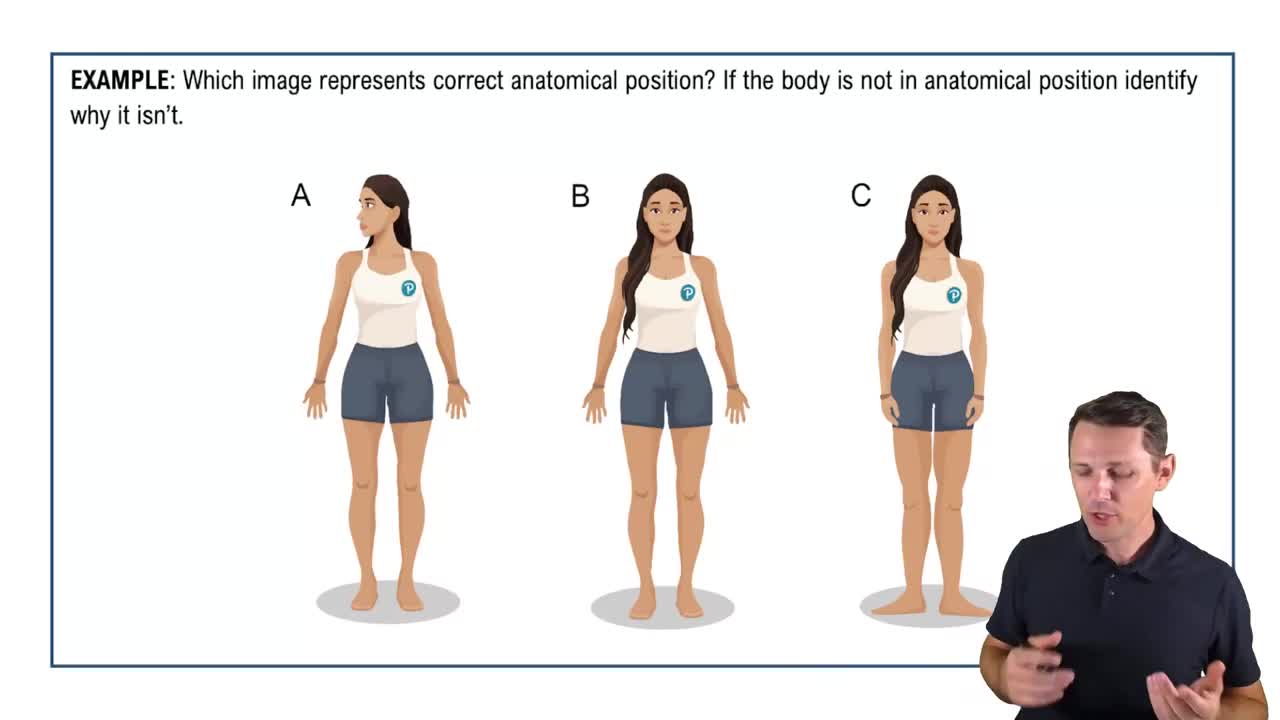
Body standing upright, facing forward, feet slightly apart, arms at sides, palms facing forward. Right and left refer to the patient's sides.
Medial: Toward the midline of the body.
Lateral: Away from the midline of the body.
Superior (cranial): Toward the head or upper part.
Inferior (caudal): Away from the head or toward the lower part.
Proximal: Closer to the origin of a body part.
Distal: Farther from the origin of a body part.
Frontal (coronal): Divides body into anterior/posterior.
Sagittal: Divides body into left/right.
Transverse: Divides body into superior/inferior.
Abdominopelvic quadrants: Right upper, left upper, right lower, left lower.
Used to localize organs and pain.
Examples: Cardiovascular (heart and vessels, transport), Respiratory (lungs, gas exchange), Muscular (movement), Nervous (control and communication).
Length: meter (m), Mass: gram (g), Volume: liter (L).
Conversions based on powers of ten.
Random movement of particles due to molecular collisions, increases with temperature.
Simple diffusion: Movement down concentration gradient.
Facilitated diffusion: Movement via membrane proteins.
Osmosis: Water movement across membrane toward higher solute concentration.
Hypotonic: Lower solute concentration.
Hypertonic: Higher solute concentration.
Isotonic: Equal solute concentration.
Carbohydrates - monosaccharides, Proteins - amino acids, Lipids - fatty acids, Nucleic acids - nucleotides.
Total magnification = ocular lens magnification (10X) × objective lens magnification.
Selective barrier surrounding the cell, controls entry and exit of substances.
Control center containing DNA, includes nucleolus and nuclear pores.
Squamous (flat), Cuboidal (cube-shaped), Columnar (tall), Spheroid, Discoid, Stellate, Fusiform, Polygonal, Fibrous.
By layers: Simple (one layer), Stratified (multiple layers), Pseudostratified (appears layered but one layer).
By shape: Squamous, Cuboidal, Columnar.
Loose (areolar, adipose, reticular) and Dense (regular, irregular, elastic).
Long (longer than wide), Short (cube-shaped), Flat (thin and flat), Irregular (complex shapes).
Basic unit of compact bone: central canal, concentric lamellae, osteocytes in lacunae, canaliculi.
Skeletal (voluntary, striated), Cardiac (involuntary, striated, branched), Smooth (involuntary, non-striated).
Examples: Biceps brachii (flexes forearm), Triceps brachii (extends forearm), Deltoid (abducts arm), Rectus femoris (extends leg).
Neurons (conduct impulses), Supporting cells (glial cells) protect and support neurons.
Cerebrum, Diencephalon (thalamus, hypothalamus), Brainstem (midbrain, pons, medulla), Cerebellum.
12 pairs with sensory and motor functions, e.g., I Olfactory (smell), II Optic (vision), X Vagus (visceral control).
Gray matter (neuronal bodies), white matter (axons), meninges (pia, arachnoid, dura mater), spinal nerves exit at vertebral levels.
Receptor, sensory neuron, integration center, motor neuron, effector.
Tests femoral nerve conduction by tapping patellar ligament causing leg extension.
Pupil constricts in response to bright light; abnormal responses may indicate neurological issues.
Measures skin sensitivity by determining minimum distance to perceive two points.
Measures sharpness of vision using Snellen chart; normal vision is 20/20.